New Selections

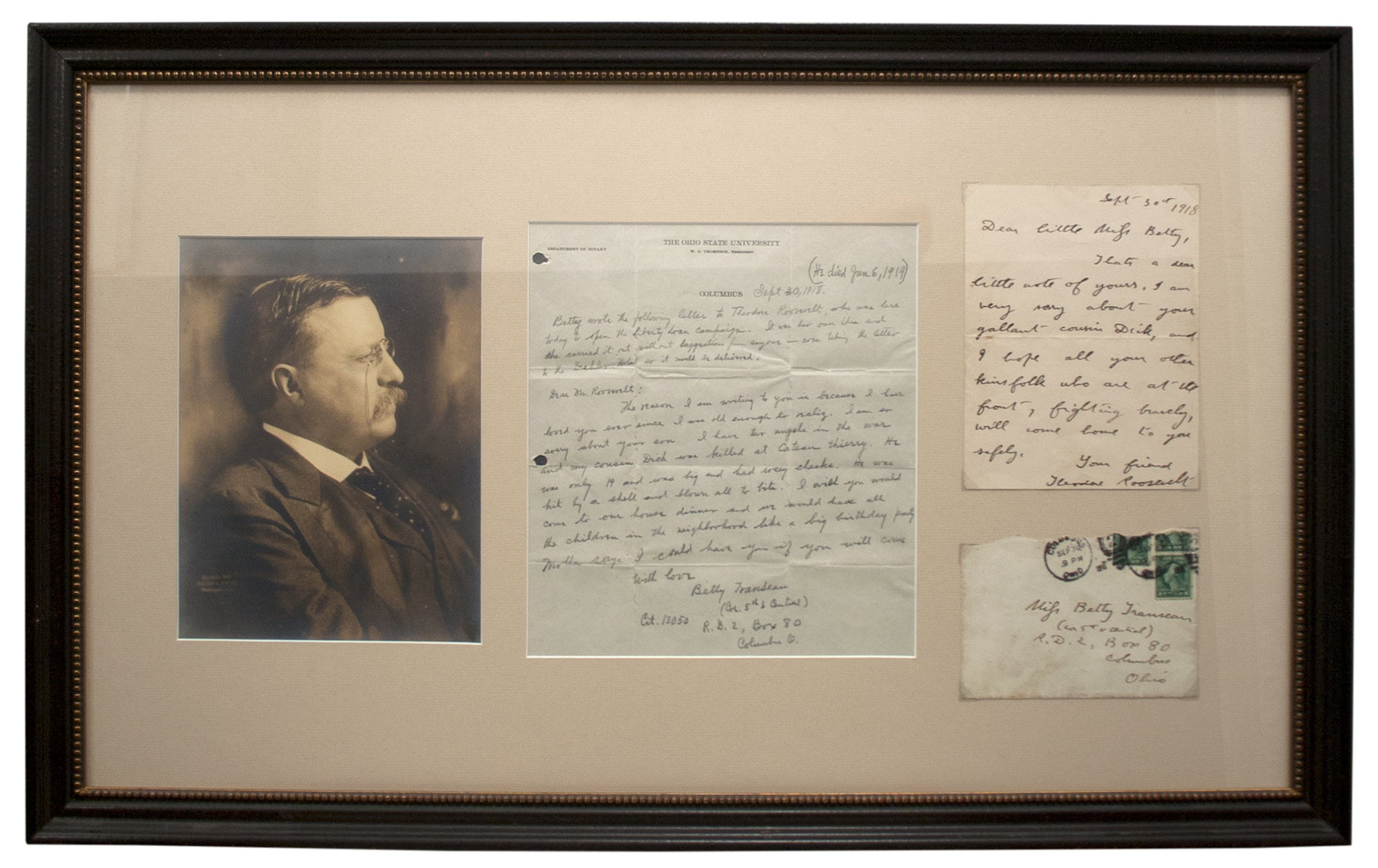
Only months after he lost his son Quentin, shot down by the German planes over France, Theodore Roosevelt consoles a woman on the death of her relative, killed by an artillery shell on the Western Front.
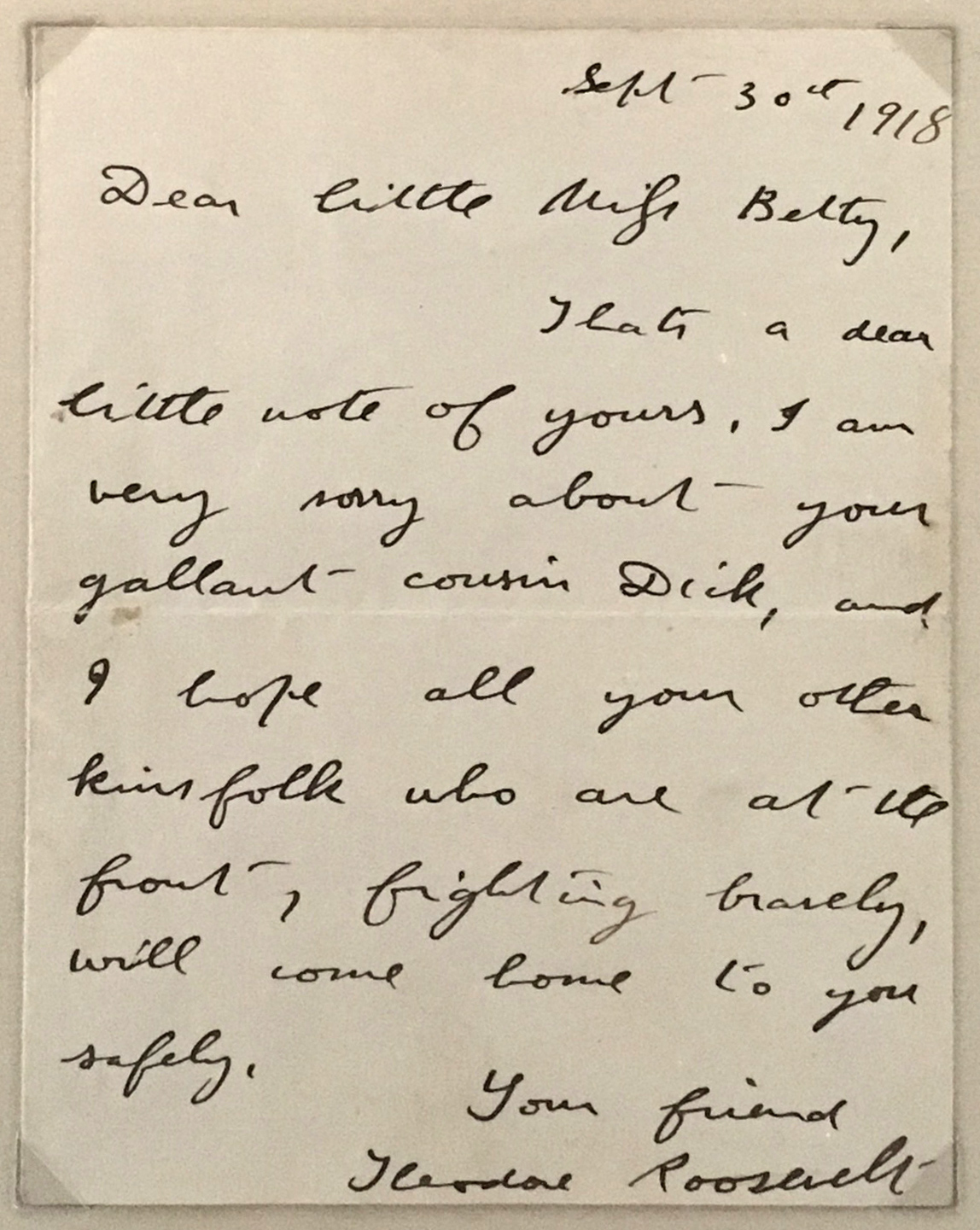
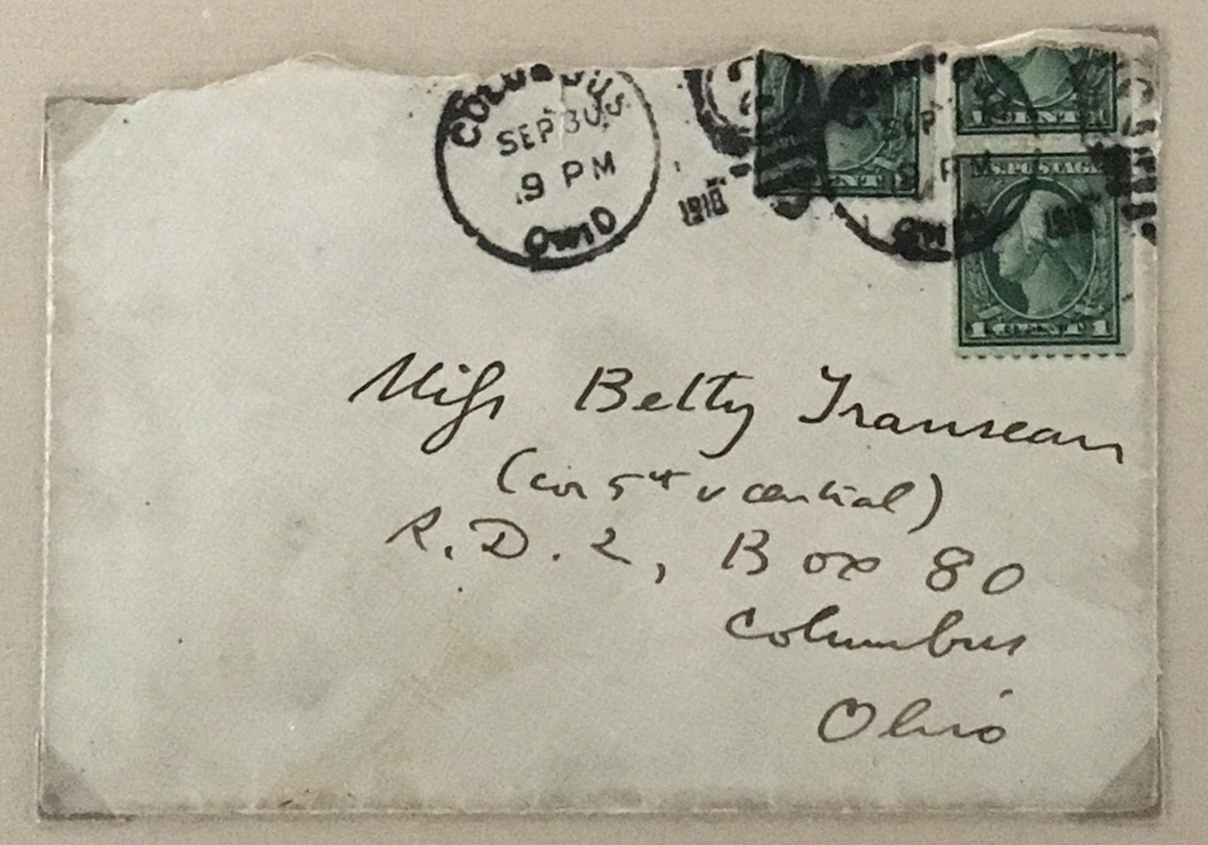
Theodore Roosevelt ALS on death of his sonTheodore ROOSEVELT (1858-1919) Fine content Autograph Letter Signed, “Theodore Roosevelt” 1 page, 165 x 128 mm (5 x 6 1/2 in.) [Columbus, Ohio], 30 September 1918, addressed in his hand on the accompanying transmittal envelope to “Miss Betty Trudeau” in Columbus. Matted and framed with a transcript of the original letter from Truseau to Roosevelt and a 1907 Harris and Ewing photograph, a bust portrait of Roosevelt. 215 x 165 mm. (6 1/2 x 8 1/2 in) (sight).

A touching letter to a young woman, who had offered her condolences to the former President for the recent death of his son Quentin, an Army Air Service pilot who had been shot down over France. According to an anonymous relative, who’s account of the exchange is framed together with Roosevelt’s letter, accomplished on Ohio State University Department of Botany letterhead, that Betty had written the letter to Roosevelt, “who was here today to open the Liberty Loan campaign. It was her own idea and she carried it out without suggestion from anyone – even taking the letter to the Deshler Hotel so it would be delivered.

Theodore Roosevelt ALS on death of his sonBelow, the writer proceeds to transcribe the contents of Betty’s letter: “The reason i am writing to you is because i have loved you ever since I was old enough to realize. I am so sorry about your son. I have two ungles [sic] in the war and my cousin Dick was killed at C[h]ateau Thierry. He was only 19 and was big and had rosey [sic] cheecks. He was hit by a shell and blown all to bits. I wish you would come to our house dinner and we would have all the children in the neighborhood like a big birthday party. Mother says I could have you if you will come.

Her heartfelt letter elicited the following response from Roosevelt the same day: “Dear little Miss Betty, That’s a dear note of yours, I am very sorry about your gallant cousin Dick, and I hope all you other kinsfolk who are at the front, fighting bravely, will come tome to you safely. Your friend Theodore Roosevelt“.

The news of Quentin’s death deeply wounded the former President, who after war erupted in Europe in 1914 had staunchly advocated U.S. involvement in the conflict. With Archie Roosevelt already wounded, it was more than either he, or Edith, could bear. Feeling responsible for urging his sons to go into harm’s way, he wrote, “It is rather awful to know ath he paid with his life, and that my other sons may pay with their lives, to try to put in practice what I preached.”1 While in Columbus, Roosevelt was greeted by Justice E. W. McCormick, whose son, Lt. Vaughn R. McCormick had been Quentin Roosevelt’s commander in the 22nd Aero Squadron. Tragically, Lt. McCormick had also killed serving in France on September 12, 1918—only two weeks before.2
Theodore Roosevelt ALS on death of his son
His loss did nothing to deter his resolve to prosecute the war vigorously. Roosevelt had been in the midst of a multi city speaking tour promoting the Liberty Loan, including Baltimore, Columbus, Kansas City, and Wichita before returning to New York. As he had in Baltimore the evening beforehand, Roosevelt urged “universal obligatory service” for both men and women, as a means of preparedness as well as the deportation of conscientious objectors employing the reasoning that only those who were wiling to die for the country were fit to live here. Roosevelt also cited the lack of American preparedness before she entered the war, arguing that “‘the war would have been over ninety days after this country entered it…'”3

Expected folds, some minor but normal loss to top margin of transmittal envelope, else very good condition.

(EXA 6002) $5,750
_________
1 Kathleen Dalton, Theodore Roosevelt: a Strenuous Life (2007), 504.
2 Plain Dealer, Cleveland, 2 Oct. 1918, 13.
3 New York Times, 1 October 1918, 8.
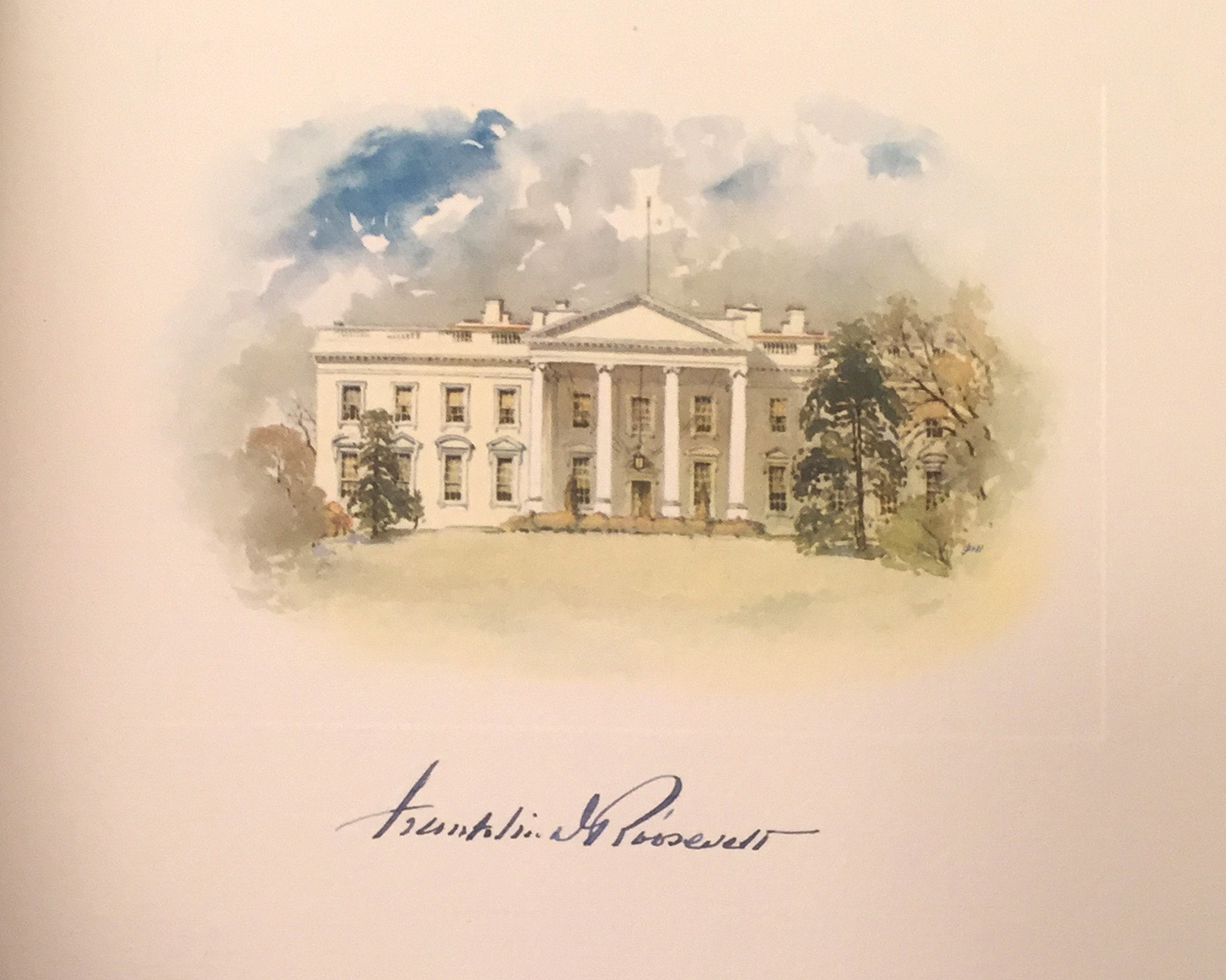
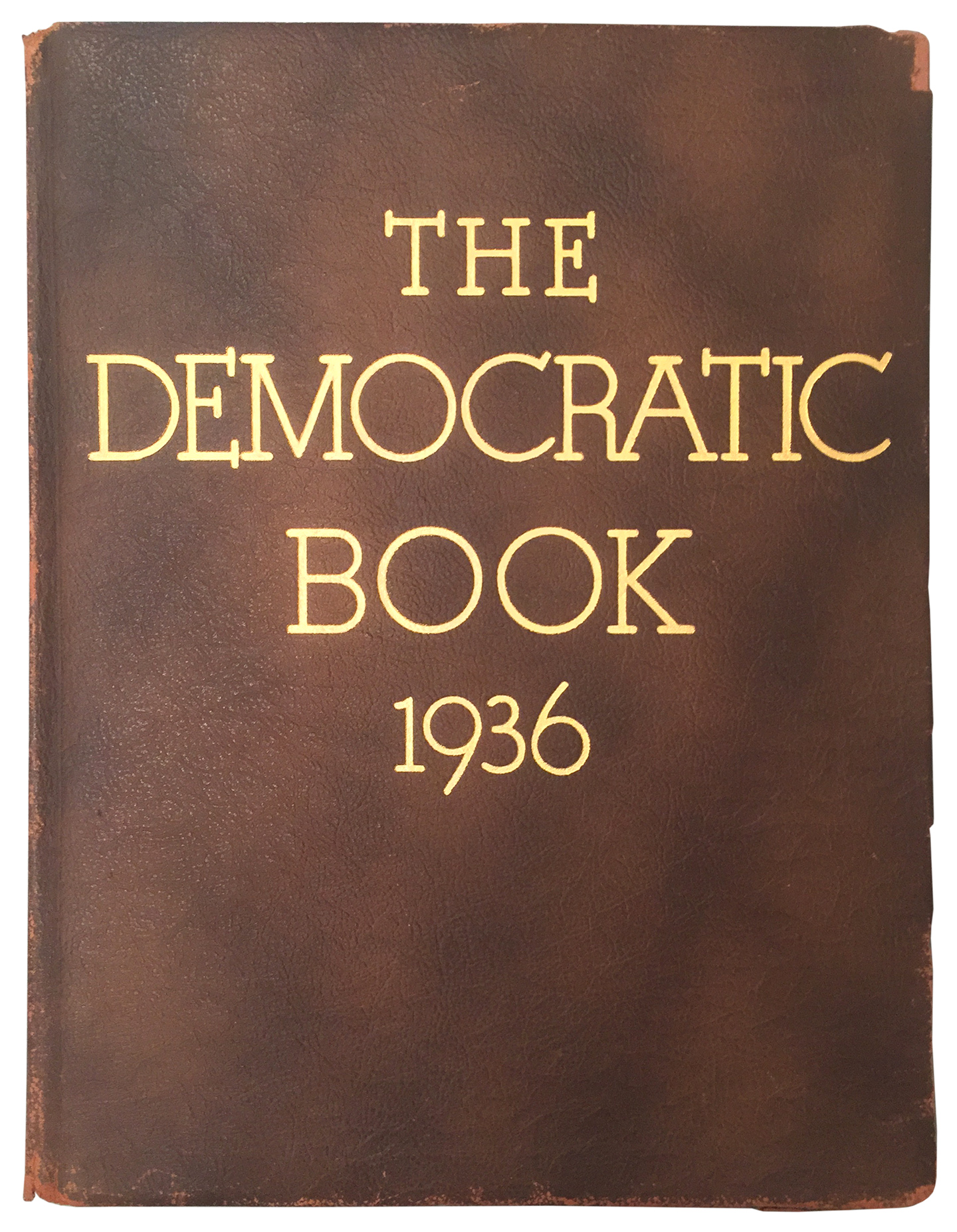
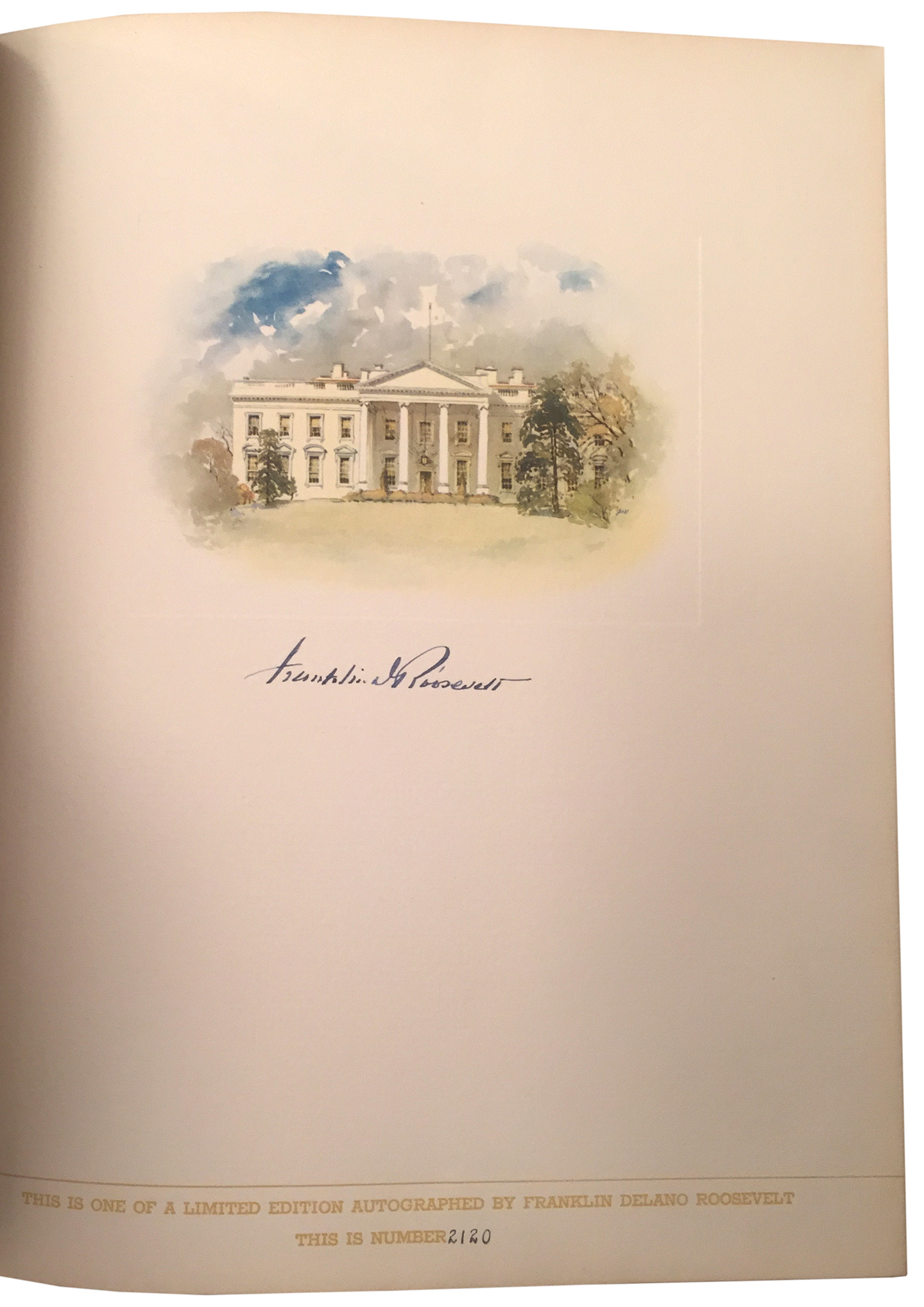
Franklin Roosevelt signs a beautiful color print of the White House in the controversial 1936 Democratic Book

Franklin Roosevelt signed 1936 Democratic BookFranklin D. ROOSEVELT (1882-1945) His signature, “Franklin D. Roosevelt” as President, accomplished beneath a charming color engraving of the White House 365 x 285 mm. (14 1/2 X 11 1/2 in.), bound in a limited edition volume THE DEMOCRATIC BOOK 1936. ([Philadelphia, 1936]) 384 pp., quarto, bound in soft brown leather with gilt lettering and the original pictorial wraps bound in. Limited Edition #2,120 of 2,500 copies.

A voluminous book of information and advertising (many liquor ads) that was used as a fundraiser for the Democratic Party containing FDR’s acceptance speech, the Democratic Platform of 1936, and biographies of all the Cabinet members as well as articles on Congress, the Supreme Court, the Cabinet departments, and reproductions of the Declaration of Independence and the Constitution.


Franklin Roosevelt signed 1936 Democratic Book Franklin Roosevelt signed 1936 Democratic Book

 
The Democratic National Committee published the volume with fund-raising for the 1936 campaign in mind, charging $2,500 for full-page advertisements. Republicans, observing that many of the sponsors, which included General Electric, General Motors and U.S. Still, had pending business before the government, immediately accused the D.N.C. of violating the Corrupt Practices Act.

Boards and spine rubbed at edges and especially at corners, interior pages and signed White House print is pristine and other pages quite clean.

(EXA 6006) $2,650

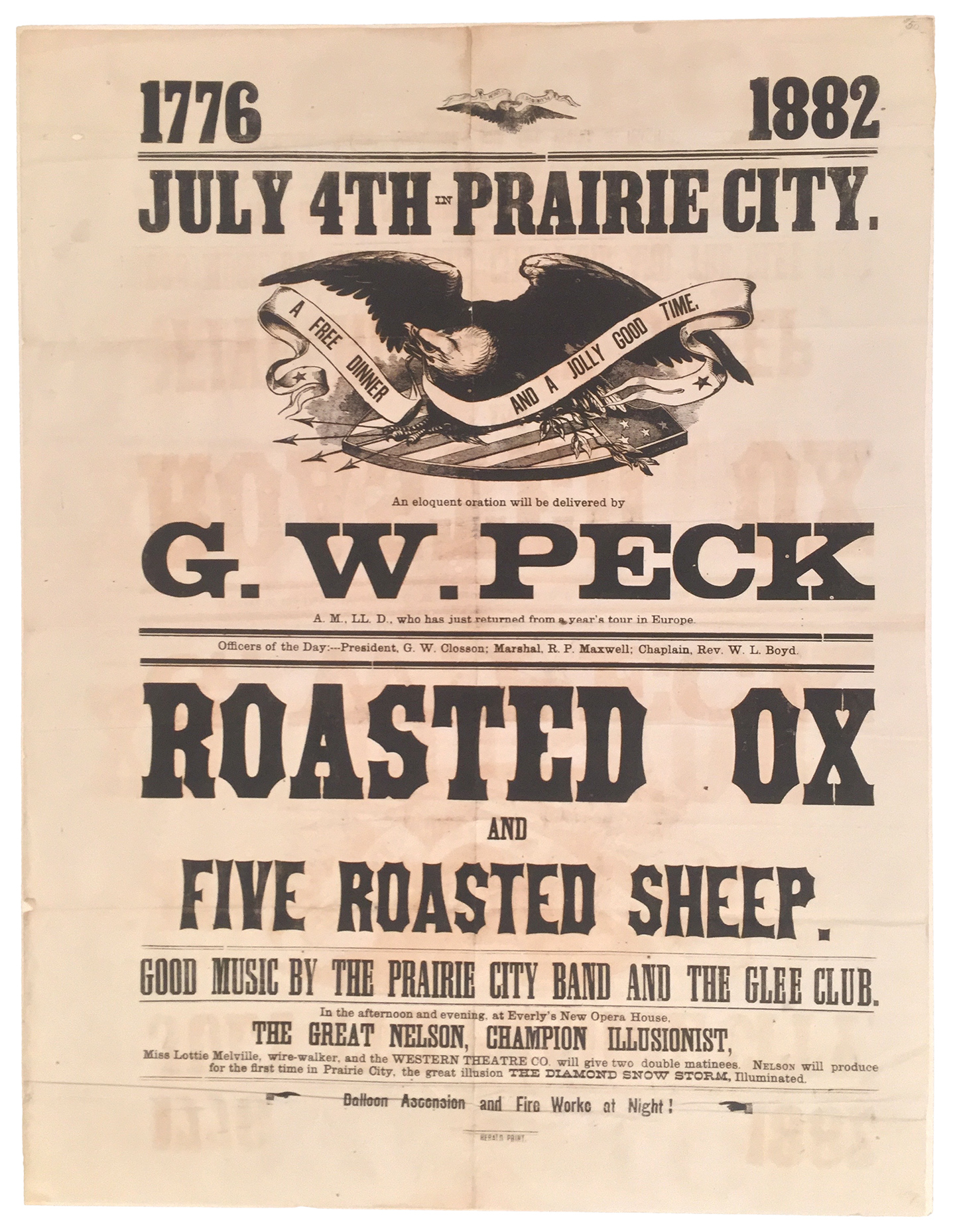
Fourth of July Broadside, Prairie City, Illinois, 1882 offering “A FREE DINNER AND A JOLLY GOOD TIME” featuring “ROASTED OX”

Fourth of July broadside(4th of July) Broadside, 1776 – 1882 JULY 4TH IN PRAIRIE CITY…, 656 x 505 mm. (25 7/8 x 19 7/8 in.), ([n.p. Illinois ]: Herald Print, [1882]).

A wonderful broadside, prominently featuring a bald eagle atop an American shied at top, detailing an elaborate program for an Independence Day celebration in Prairie City, Illinois* featuring a oration by local attorney, G.W. Peck, “who has just returned from a year’s tour in Europe.” Mr. Peck’s “eloquent oration,” was to be accompanied by a variety of distractions, most prominently, a dinner of “ROASTED OX AND FIVE ROASTED SHEEP,” as well as “GOOD MUSIC” by the “PRAIRIE CITY BAND AND THE GLEE CLUB.” For those less musically inclined, there was an afternoon and evening performance of “THE GREAT NELSON, CHAMPION ILLUSIONIST,” who promised to astonish the crowd with “the great illusion THE DIAMOND SNOW STORM, Illuminated,” as well as “Miss Lottie Melville, wire-walker.

The evening was concluded by a “Balloon Ascension,” and (of course), “Fire Works at Night!

Folds with a minor separation at top margin, a few minor marginal tears, light soiling, a few pinholes at top, mild ink transfer, else very good.

(EXA 6063) $850
_________
* History of McDonough County, Illinois: Together with Sketches of the Towns… (1885), 218.

A scarce broadside announcing a store closure in honor of Garfield’s funeral, September 1881

Garfield Memorial broadside

(James A. GARFIELD) Broadside, IN MEMORIAM, 231 x 317 mm. (9 1/8 x 12 1/2 in.), bearing an engraved bust portrait of the recently-deceased President Garfield at left: “In respect to the memory of the deceased President of the United States, this Store Will be Closed the day of the funeral. MONDAY, the 26th inst.” Garfield had died of wounds inflicted by Charles Guiteau on September 19, 1881.


Mounted to another sheet, small losses at corners do not affect text or imagery, light spots of toning, else very good.

(EXA 6074) $850

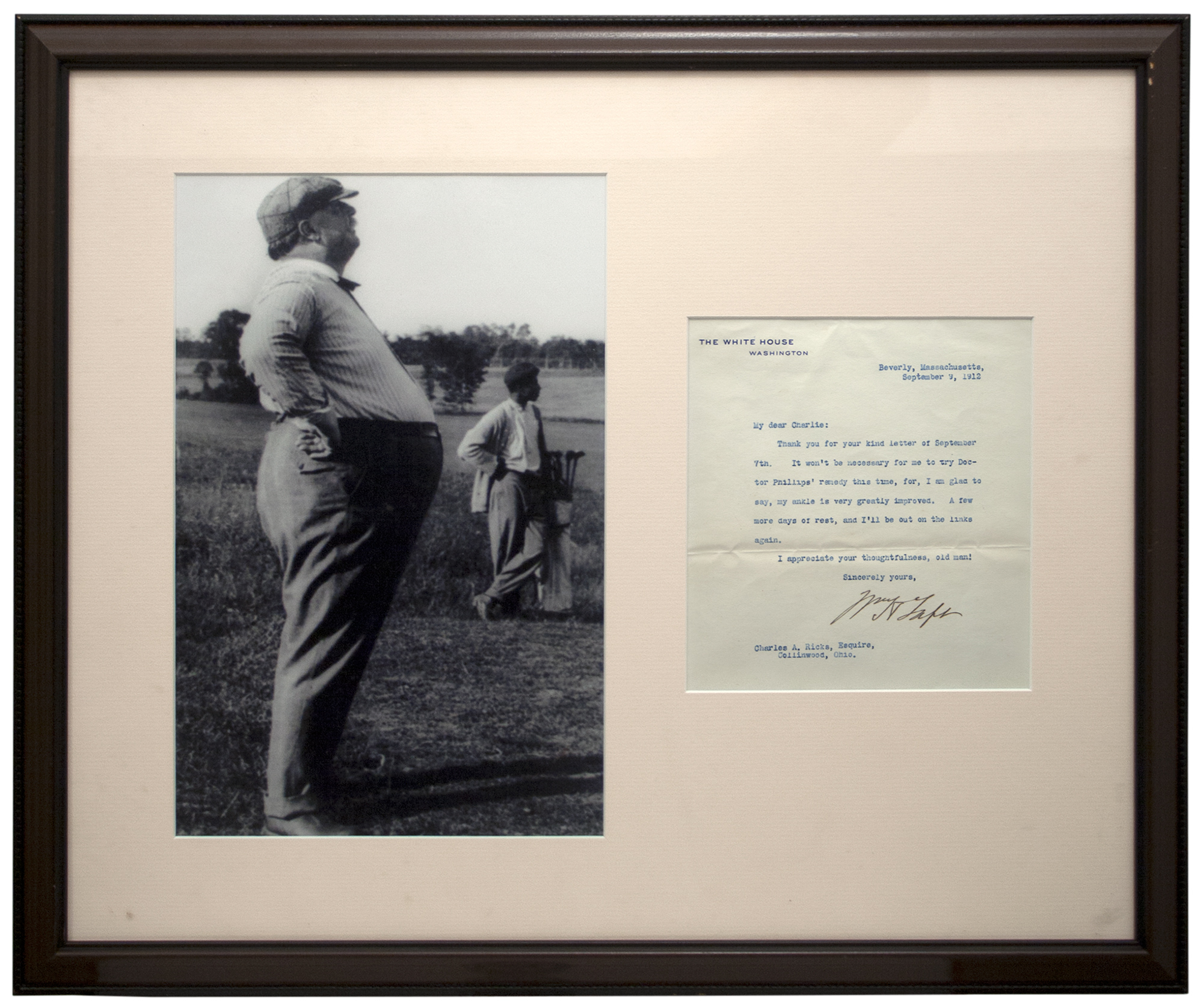
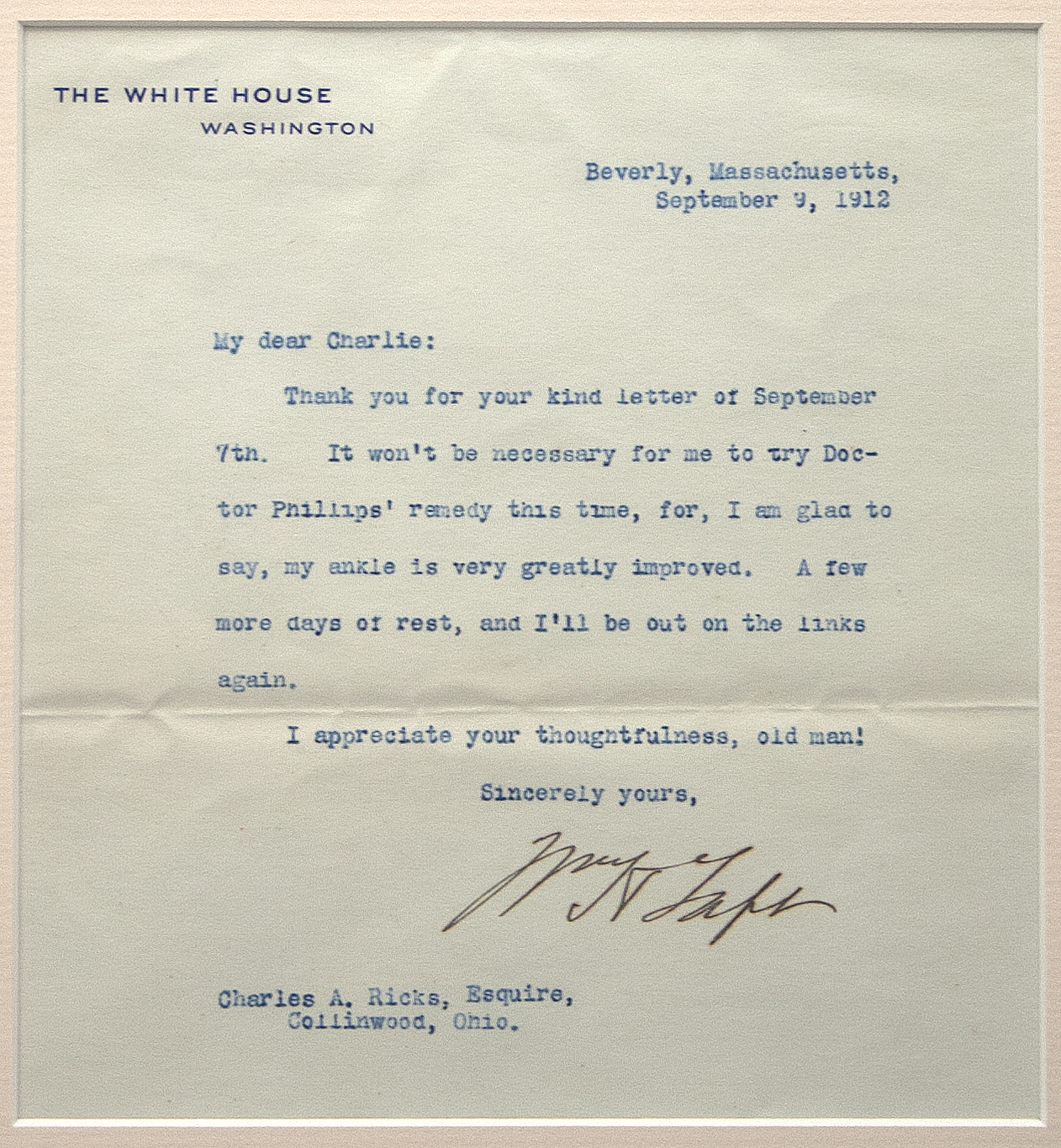
After suffering a sprained ankle after a day of golf in the midst of the Election of 1912 against Wilson and Roosevelt’s Bull Moose, Taft assures his correspondent, “A few more days of rest, and I’ll be out on the links again.”

William H. Taft ALS as PresidentTyped Letter Signed, “Wm H Taft” as President, 1 page, 6″ x 6.5″ (sight) on White House letterhead, Beverly, Massachusetts, September 7, 1912, to Charles A. Ricks in Collinwood, Ohio. Matted and framed with a photograph.

Taft writes, in full: “Thank you for your kind letter of September 7th. It won’t be necessary for me to try Doctor Phillips’ remedy this time, for, I am glad to say, my ankle is very greatly improved. A few more days of rest, and I’ll be out on the links again. I appreciate your thoughtfulness, old man!

What exactly constituted the doctor’s “remedy” is anyone’s guess. Taft was the target of a good deal of ridicule in the press due to his penchant to hit the links during the bitter campaign against Theodore Roosevelt’s breakaway Progressive Party, which split the Republican vote and cost him the Presidency. Ironically, he sprained his ankle while playing golf over the weekend before he returned to Washington on September 4, 1912.1

William H. Taft ALS as President
The recipient, Charles A. Ricks (1869-1914) was a manger for Standard Oil in Cleveland when he organized the G. C. Kuhlman Car Company, serving as the electric railroad car manufacturer’s secretary and treasurer until his death in 1914.2

Fine condition.

(EXA 6003) $1,200
_________
1 “Taft Suffers from Sprained Ankle,” The New Orleans Item, 4 Sept. 1912, 5.
2 Samuel Peter Orth, A History of Cleveland, Ohio: Biographical (1910), 819; Electric Railway Journal, 29 Aug. 1914, 44:409.

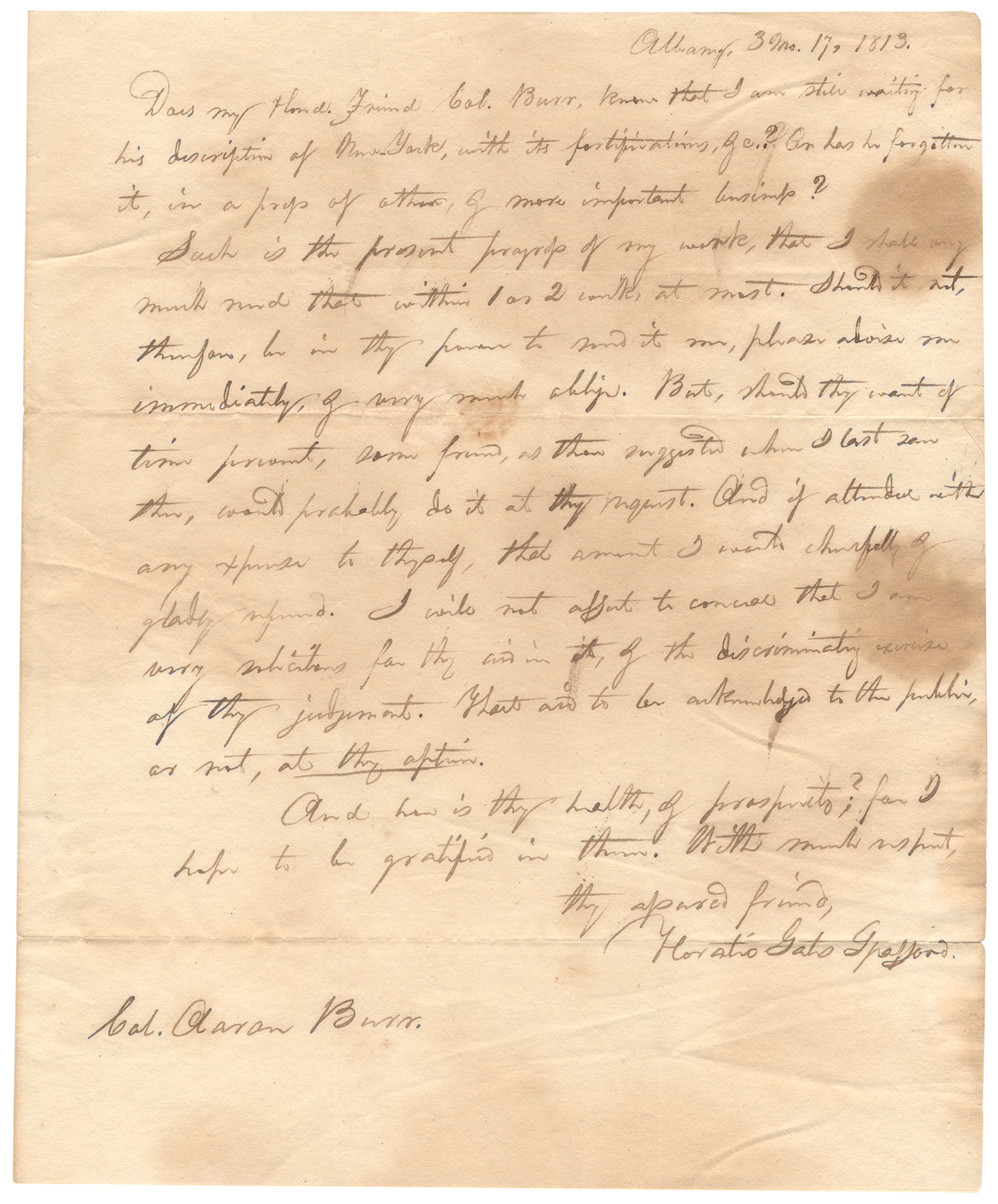
Horatio Gates Spafford writes to Aaron Burr, recently returned from a self-imposed exile in Europe, for information on New York City’s fortifications to use in the latest edition of his New York Gazateer

Horatio Gates Spafford ALS 1813 to Aaron BurrAaron BURR (1756-1836); Horatio Gates SPAFFORD, Sr. (1778-1832) American author, publisher, inventor, attorney and entrepreneur who authored and painstakingly compiled the first comprehensive atlas of New York state, A Gazetteer of the State of New-York; Carefully Written from Original and Authentic Materials, Arranged on a New Plan . . . With an Accurate Map of the State (H.C. Southwick: Albany, N.Y., 1813); The American Magazine, A Monthly Miscellany, Devoted to Literature, Science, History, Biography, and the Arts; Including also State Papers and Public Documents, with Intelligence, Domestic, Foreign, and Literary, Public News, and Passing Events; Being an Attempt to form a Useful Repository for every Description of American Readers (E. & E. Hosford: Albany, 1815), and the text book General Geography, and Rudiments of Useful Knowledge (Hudson, N.Y., 1809). He acquired a patent for fireplace improvements in 1805, and is largely credited as the inventor of the Bessemer process for steelmaking. He corresponded frequently with Thomas Jefferson, James Madison and John Adams, championing the establishment of education in the arts and sciences as a means for national advancement. During the American Revolution, his father, Captain John Spafford, commanded a company of Green Mountain Boys under Ethan Allen, participating in the Battles of Ticonderoga and Crown Point, and served under General Horatio Gates at Bennington. His son, Horatio Gates Spafford, Jr. (1828-1888) was a prominent Chicago attorney best known for penning the Christian hymn “It is Well With My Soul” following the tragic deaths by shipwreck of his wife and four children.

Horatio Gates Stafford ALS to Aaron Burr
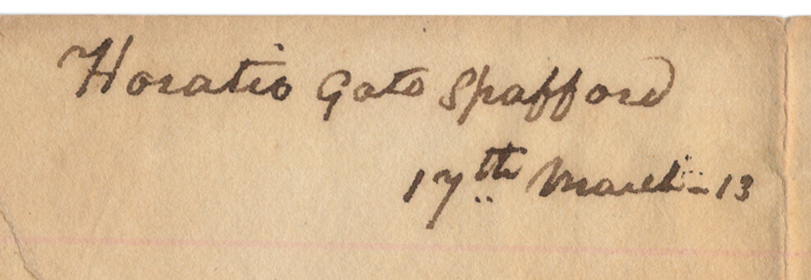
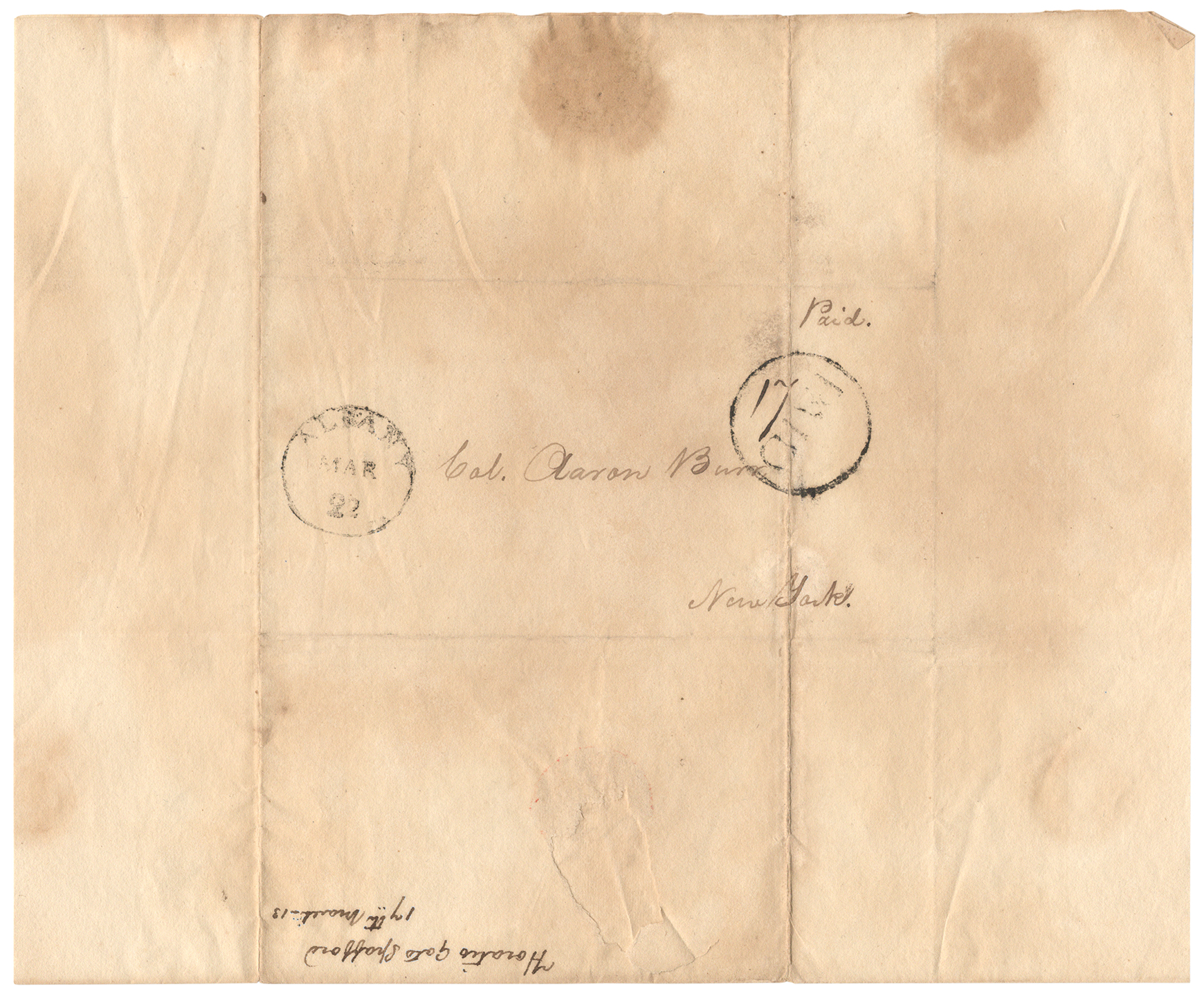
Autograph Letter Signed “Horatio Gates Stafford“, 1 page, 248 x 205 mm. (9 3/4 x 8 in.), Albany [New York], 17 March 1813, to Aaron Burr, and docketed by Burr on the address panel, “Horatio Gates Stafford 17th March -13″.

Horatio Gates Spafford ALS 1813 to Aaron BurrSeaford writes in full (with original spellings retained throughout): “Does my Hon[orable] d[ear]. Friend Col. Burr, know that I am still waiting for his description of New York, with its fortifications, &c.? Or has he forgotten it, in a press of other, & more important business? Such is the present progress of my work, that I shall very much need that within 1 or 2 weeks at most. Should it not, therefore, be in thy power to send it me, please advise me immediately, & very much oblige. But, should thy want of time prevent, some friend, as thou suggested when I last saw thee, would probably do it at they request. And if attendance with any expense to thyself, that amount I was to cheerfully & gladly refund. I will not assent to conceal that I am very solicitous for thy aid in it, & the discriminating exercise of they judgement. That aid to be acknowledged to the public, or not, at they option. And how is thy health, & prosperity; for I hope to be gratified in them.

Usual folds, soiling, light creasing, overall very good to fine condition.

(EXA 6057)  $600

A Know-Nothing and a Jacksonian Democrat spar over the Nullification Crisis.

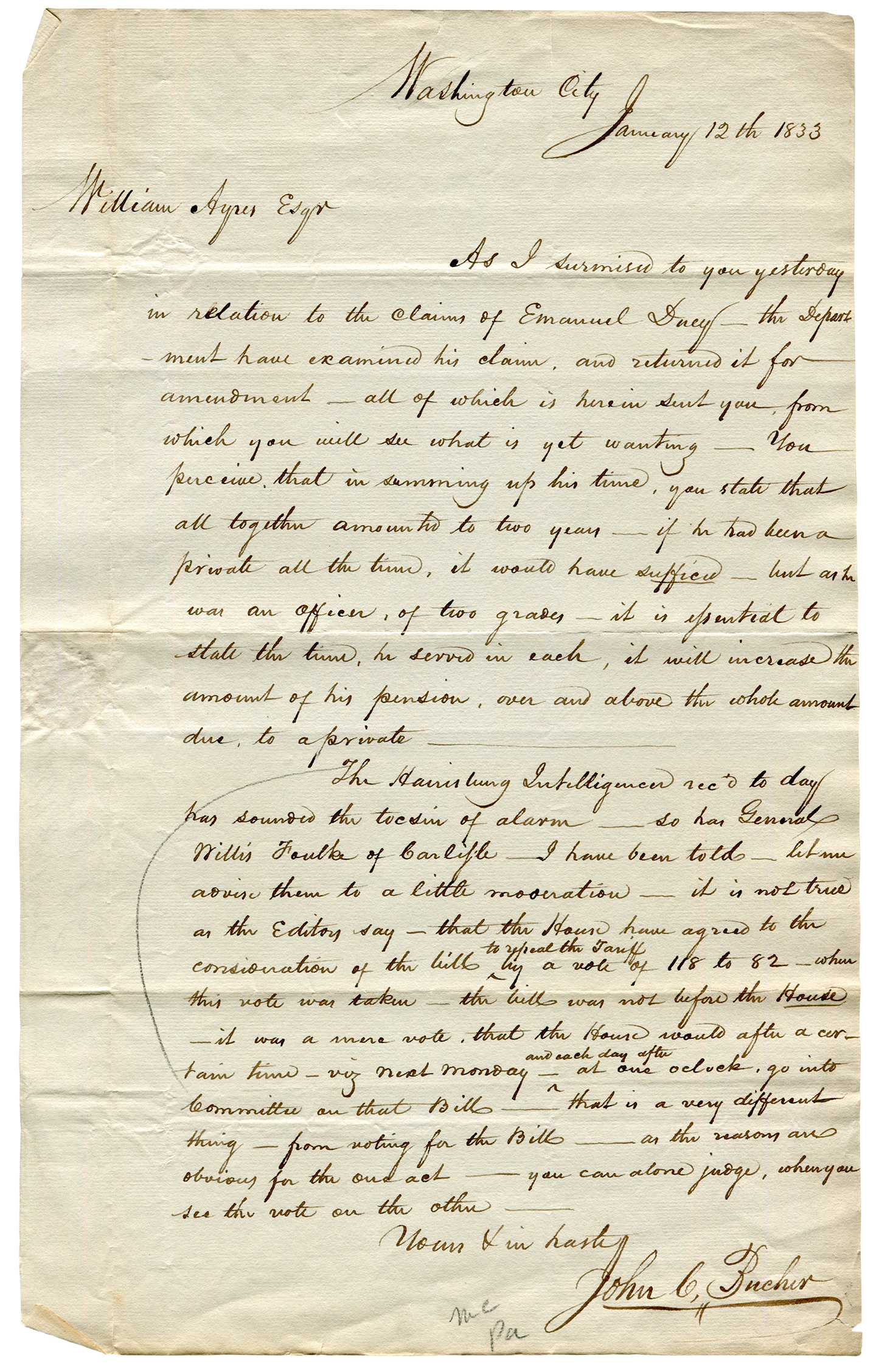
Nullification Crisis 4 ALSs 1830-1833(Nullification Crisis) John Conrad BUCHER (1792-1851) Pennsylvania politician and lawyer who served as a  Jacksonian Democrat in the 22nd Congress, (1831-1833) during the Nullification Crisis. Following his Congressional tenure, he was elected a trustee of Harrisburg Academy, Franklin College (Lancaster) and Marshall College (Mercersburg). In 1839, Bucher was appointed associate judge of Dauphin County, Pennsylvania, by Governor David R. Porter, a position he held until his death in 1851.

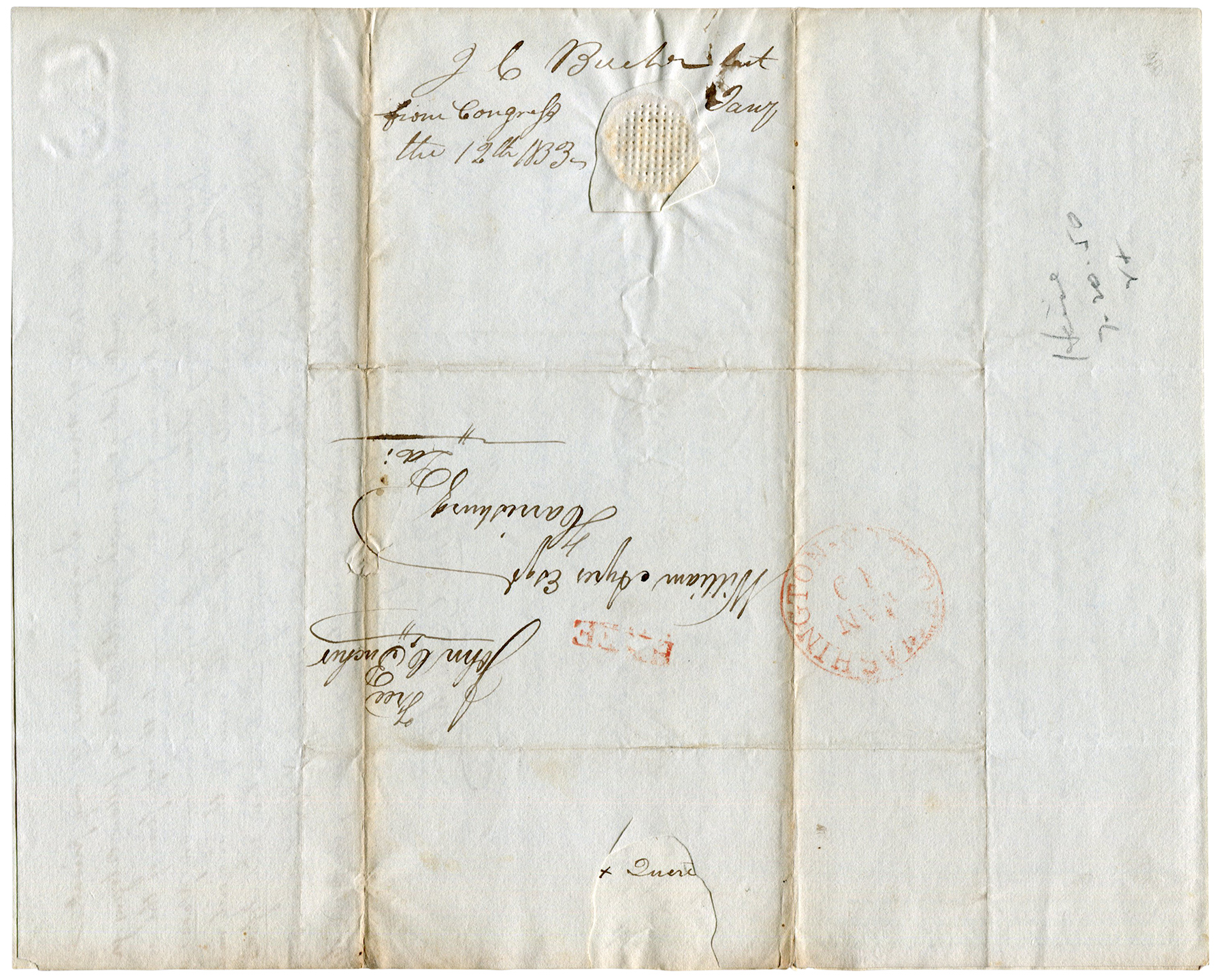
A collection of four Autograph Letters Signed “John C. Bucher” and “Jno. C. Bucher“, 8pp., various sizes, Philadelphia and Washington, 18 Sept. 1830 to 19 January 1833 to his brother-in-law William Ayres (1788-1856) of Harrisburg,* providing great detail on the political polarization afflicting Congress during the Nullification Crisis of 1832. Bucher exercises wit and scorn in equal measure when chastising Ayres for his Anti-Mason position, and delivers some derisive jabs regarding his brother-in-law’s public conduct. Bucher issues corrections to accusations made by the press, and assists Ayres, perhaps half-heartedly, with furthering a Revolutionary War soldier’s petition for compensation from the government. He also addresses a personal conflict between himself and Ayres regarding the administration of the estate of Bucher’s father (and Ayres’ father-in-law), John Jacob Bucher (1764-1827).

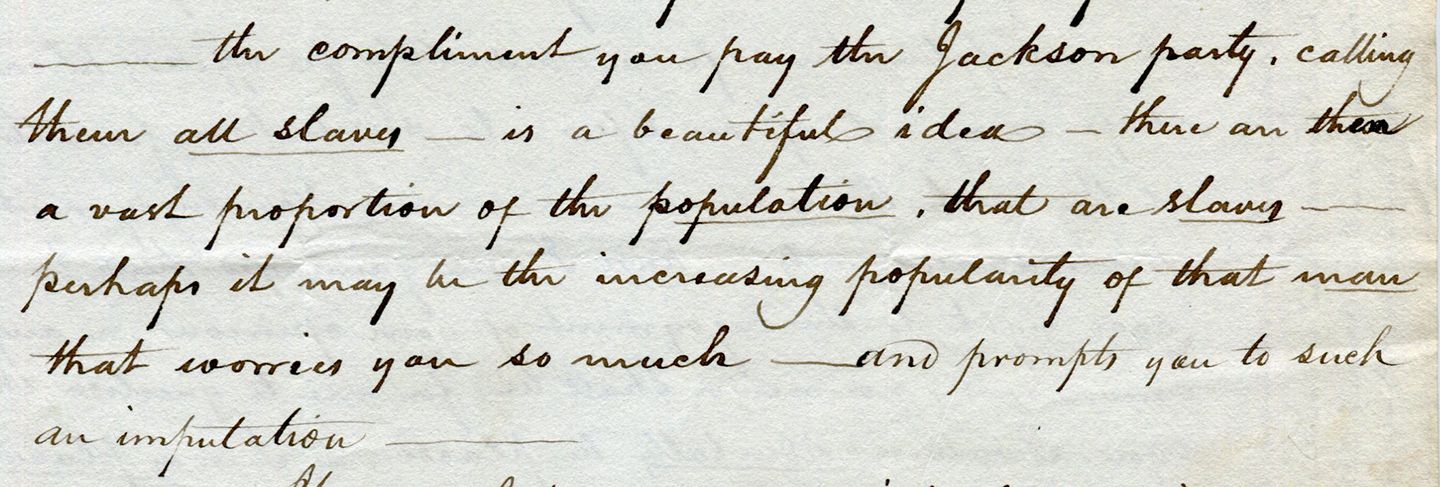
The correspondence reads, in part: “[Philadelphia, 18 September 1830] This afternoon I received a letter from Harrisburg… it is alleged you are making great complaints, about the sale of a Lot, belonging to our late Fathers Estate,— and that you can produce a person that will give $1000— for the same property… as so much has been said about this matter it is to be presumed the purchaser is ready,— will you be so good as to assure the Gentleman, that so far as my control of the matter goes, he shall have the property. I will expect you to attend to this to see this to see this engagement consummated… You were not consulted about this, it is true— but no disrespect was intended by me— I pray you if your purchaser does not intend to close in, that you say nothing about it, that the parties with whom I had the interview know nothing of this… if you are not authorized by facts; to animadvert as severely as you have on my course of action, that your conduct is uncourteous, and exhibits more recklessness than I thought your nature would urge you to… my situation with our Fathers Estate has necessarily caused me to have more than a proportionate share of duty to perform, but I have never wished to assume more than my equal part… [Washington City, 18 December 1832] …the arena of Strife, furnishes matter continually for intense consideration— John C. Calhoun is elected to the Senate— vice R. Hayne who is elected Governor of South Carolina, Nullification Crisis 4 ALSs 1830-1833we have arrived at serious crisis in the affairs of our Country, to preserve peace among ourselves, and the preservation of those principles, which a large majority of us, say are fundamental— the right of protection— did time permit, I should like to run my thoughts here, by asking, or saying, whether our notions of protection, were not more interwoven, with our political creeds than in our absolute knowledge of the practical benefits resulting therefrom— before the Tariff Bill of last session was passed, our Legislature and our people, gave an almost unanimous expression in favor of holding on to ultra notions of protection— the majority in Congress adopted a modified scheme— reducing the scale of protection considerably— no evil consequences resulted, few dissenting voices were heard— all were satisfied— now if to save our Country— and to get rid of six million dollars per annum taxes which you anti Masons look on as a great bug bear— can preserve the Union— and with it the blessing of peace, and happiness to the American people, ought it not to be done? [Washington City, 12 January 1833] The Harrisburg Intelligence rec’d today has sounded the tocsin alarm— so has General Willis Foulke of Carlisle… the Editors say… the House have agreed to the consideration of the bill to repeal the Tariff by a vote of 188 to 82— when this vote was taken— the bill was not before the House, it was a mere vote, that the House would after a certain time viz next Monday and each day after at one o’clock, go into Committee on that Bill— that is a very different thing from voting on the Bill— as the reasons are obvious for the one act— you can alone judge when you see the vote on the other… [Washington City, 19 January 1833] …You mistake me much in supposing, my charge against you, was referring to any publication in the P. Intelligence, in relation to my public acts— not so— they were spread before the public before they reached Harrisburg. Mr. Strong and yourself are at liberty to put such construction on them, as you please. My allusions were to editorial remarks… which had such a squinting to opinions I had communicated to you, that I had concluded you had furnished them— and especially as you called my attention to said papers— as to the compliment of Mr. Strong, to Mr. George H. Bucher, it was merely to send a phillipick at me— the compliment you pay the Jackson party, calling them all slaves— is a beautiful idea— there are then a vast proportion of the population, that are slaves— perhaps it may be the increasing popularity of that man that worries you so much— and prompts you to such an imputation… Those ‘Honorable matters’ you refer to, that you were so kind to suppress— which my neighbors knew— it is a strange kind of suppression, to conceal that that every body knew— you know me long enough to know that I have never endeavoured to suppress any act of mine— hence I too frankly speak my actions— in the revolution of circumstance, certain acts will admit of interpretations or glossary at one time, differently, from another— no man can foresee that the public may use him at any future time for a candidate for office, he cannot therefore shape every act of his life— to shield him from the Paul Pry’s of the times… You have as good right to the enjoyment of your opinion as any man— it never was, nor never shall be for me to question them— but if you should accidentally be placed, as I was placed— and I should act towards you, as you have towards me— you will be enabled alone to judge of the propriety of the course.

Nullification Crisis 4 ALSs 1830-1833Bucher concludes his correspondence with an acknowledgment that his Congressional career has come to an end by no choice of his own, “On the 4th of March I again return to my private pursuits, with feelings of much gratitude to my fellow Citizens, for the honor they have conferred on me— to the expression of the people, in having chosen another to represent them in my place. I have not, not will not complain, the voice of the majority must prevail; I find many here like myself— it has been so heretofore and it may be so hereafter…

Soiling, light toning and edge wear, usual folds, overall fine condition.

(EXA 3594) $1,250
_________
* Ayres was admitted to the bar in Harrisburg in 1826. Active in Whig party politics, he was elected to the Pennsylvania Legislature, serving from 1833 to 1835, and as coadjutor of Thaddeus Stevens, fought for the establishment of a free school system in Pennsylvania. In 1841, he was elected Director of the United States bank at Philadelphia. Between 1850 and his death in 1856, he sat as President of the Harrison Gas Company, the Huntington and Broad Top Railroad, and the Harrisburg and Hamburg Railroad Company. He married Mary Elizabeth Bucher (1795-1847), sister of John Conrad Bucher, in 1817.

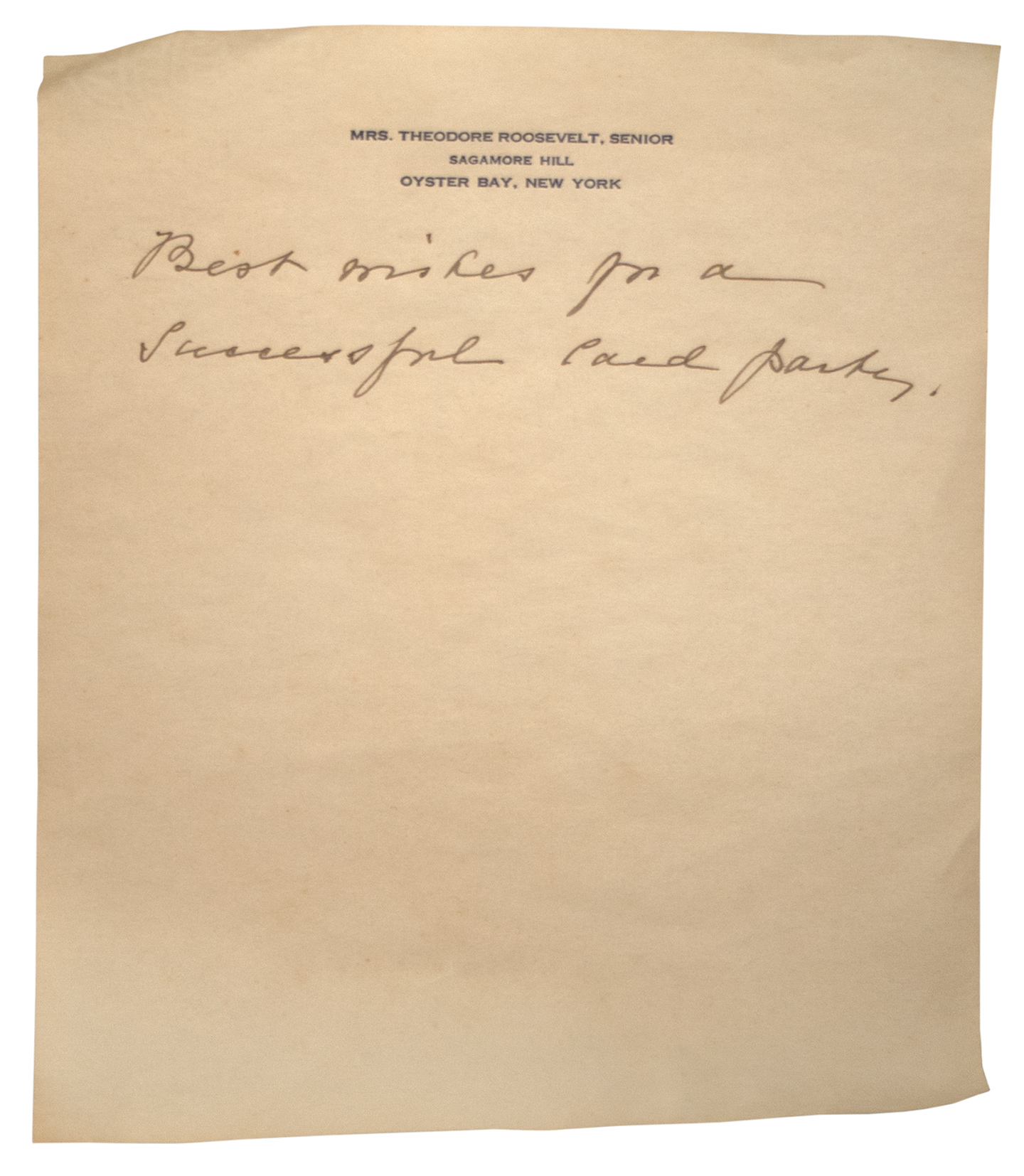
Edith Kermit Roosevelt hand makes a gift for the Needle Guild of America in the depths of the Great Depression

Edith Kermit Roosevelt AN

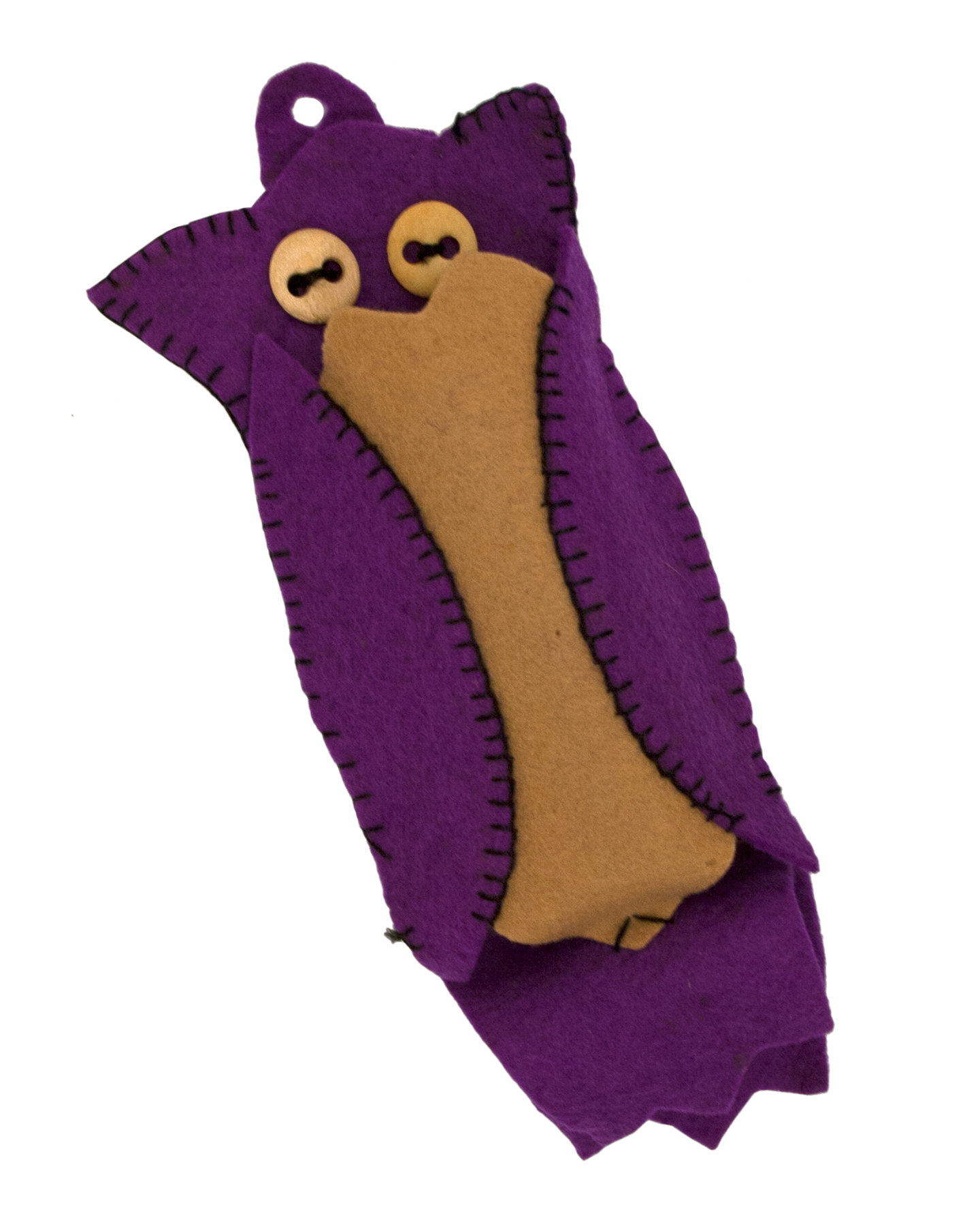
Edith Kermit ROOSEVELT (1861-1948) Autograph Note [in Edith Kermit Roosevelt’s hand?] on her “MRS. THEODORE ROOSEVELT, SENIOR SAGAMORE HILL OYSTER BAY, NEW YORK” stationery, 175 x 150 mm. (6 7/8 x 5 7/8 in.), offering her “Best wishes for a successful coed party“. Offered together with the enclosure, a purple and tan felt thread holder fashioned as an owl, stitched with black thread, 165 x 80 mm. (6 1/2 x 3 in.). One of the more unusual pieces that we have had the pleasure of offering in some time.

Edith Kermit Roosevelt AN Edith Kermit Roosevelt AN

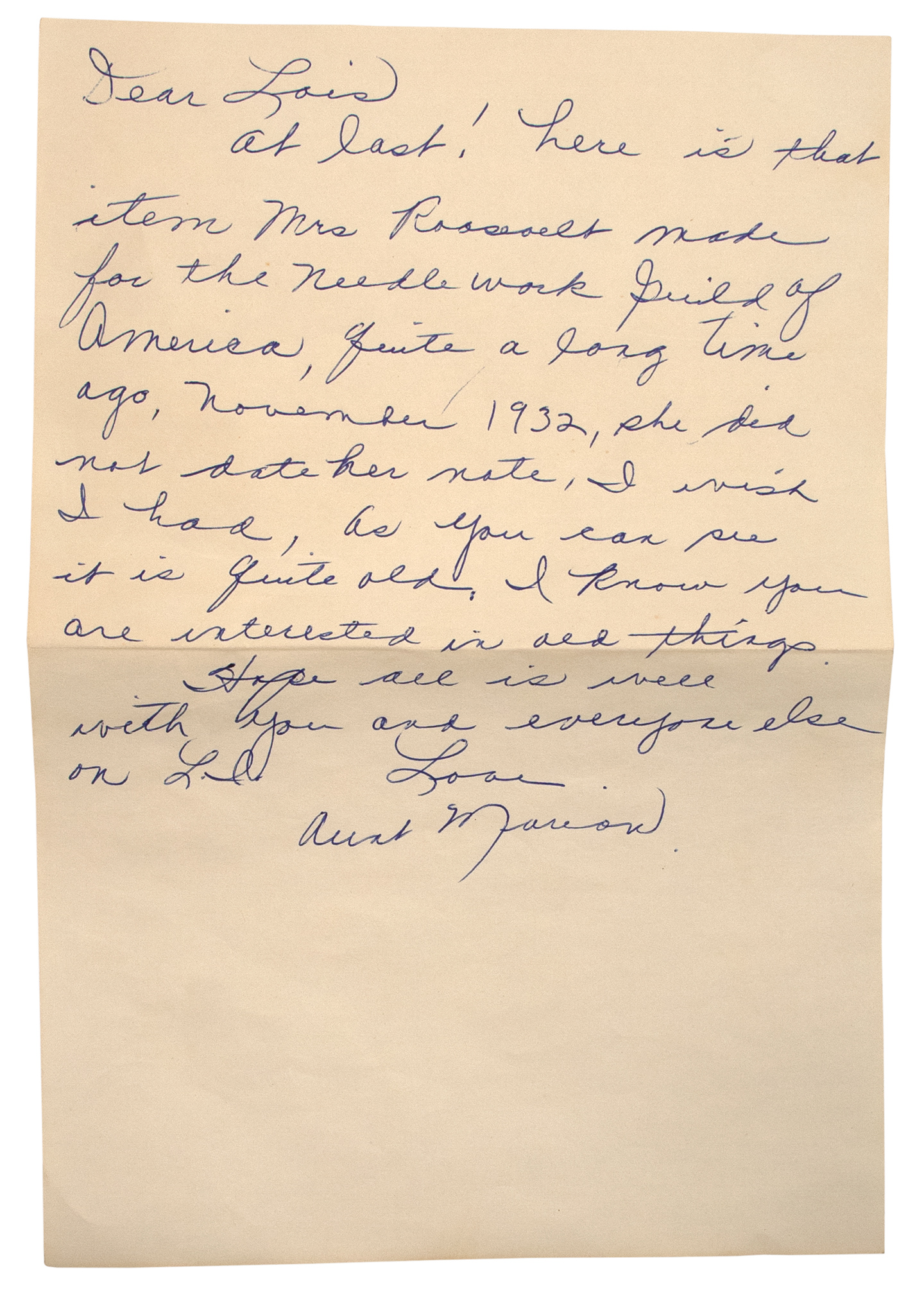
Her note and gift are accompanied by a note of provenance from “Aunt Marion” to “Lois“, writing “…here is that item Mrs Roosevelt made for the Needle work Guild of America, quite a long time ago, November 1932, she did not date her note, I wish I had, as you can see it is a quite hold…” 227 x 152 mm. (9 x 6 in.).

Edith Kermit Roosevelt AN

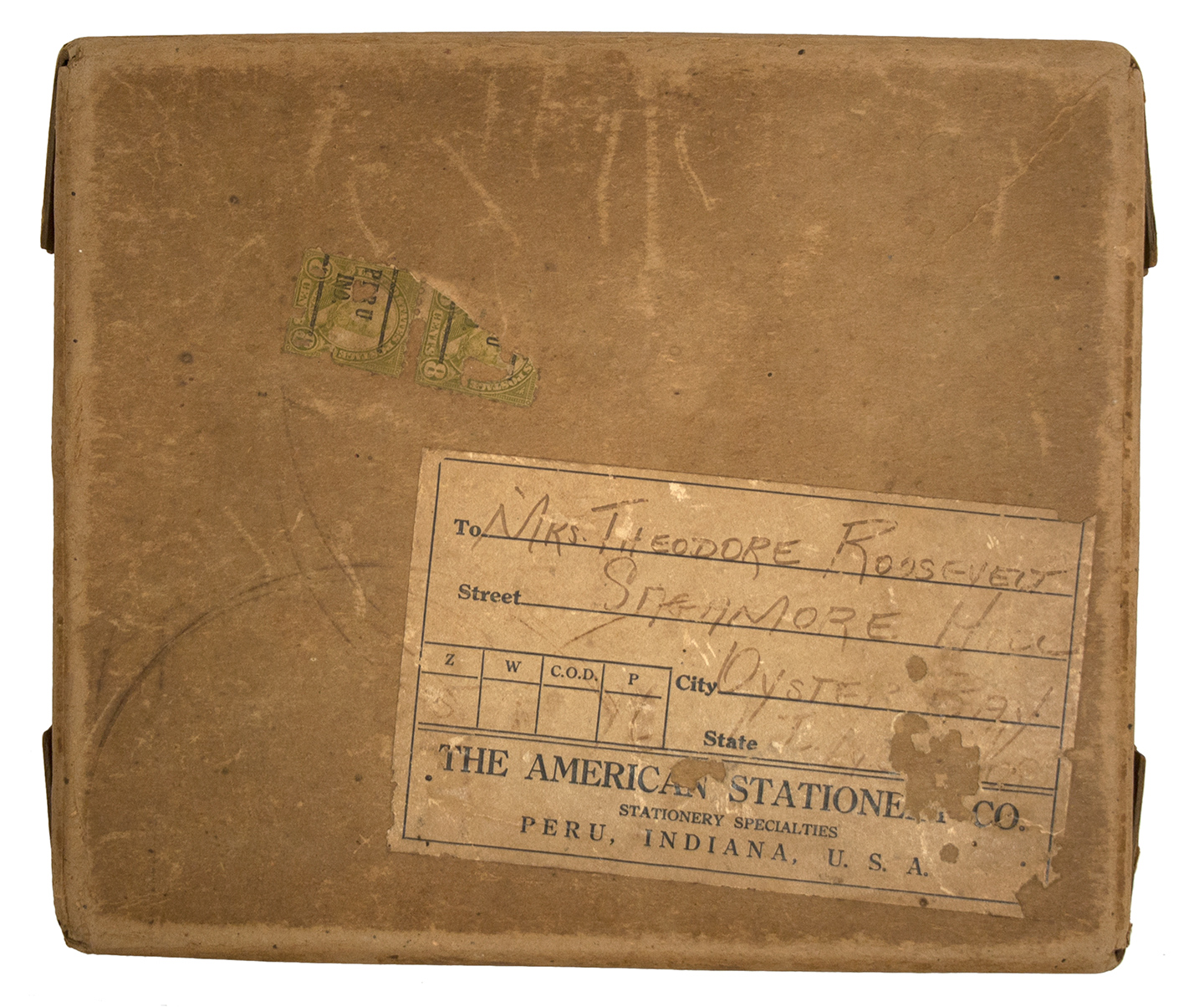
Housed in a 8 x 7 x 1 1/2 in. Cardboard box addressed to “MRS. THEODORE ROOSEVELT, SAGAMORE HILL, OYSTER BAY“. On a printed label from The American Stationery Co., of Peru, Indiana.

Fine condition overall.

(EXA 6007) $750

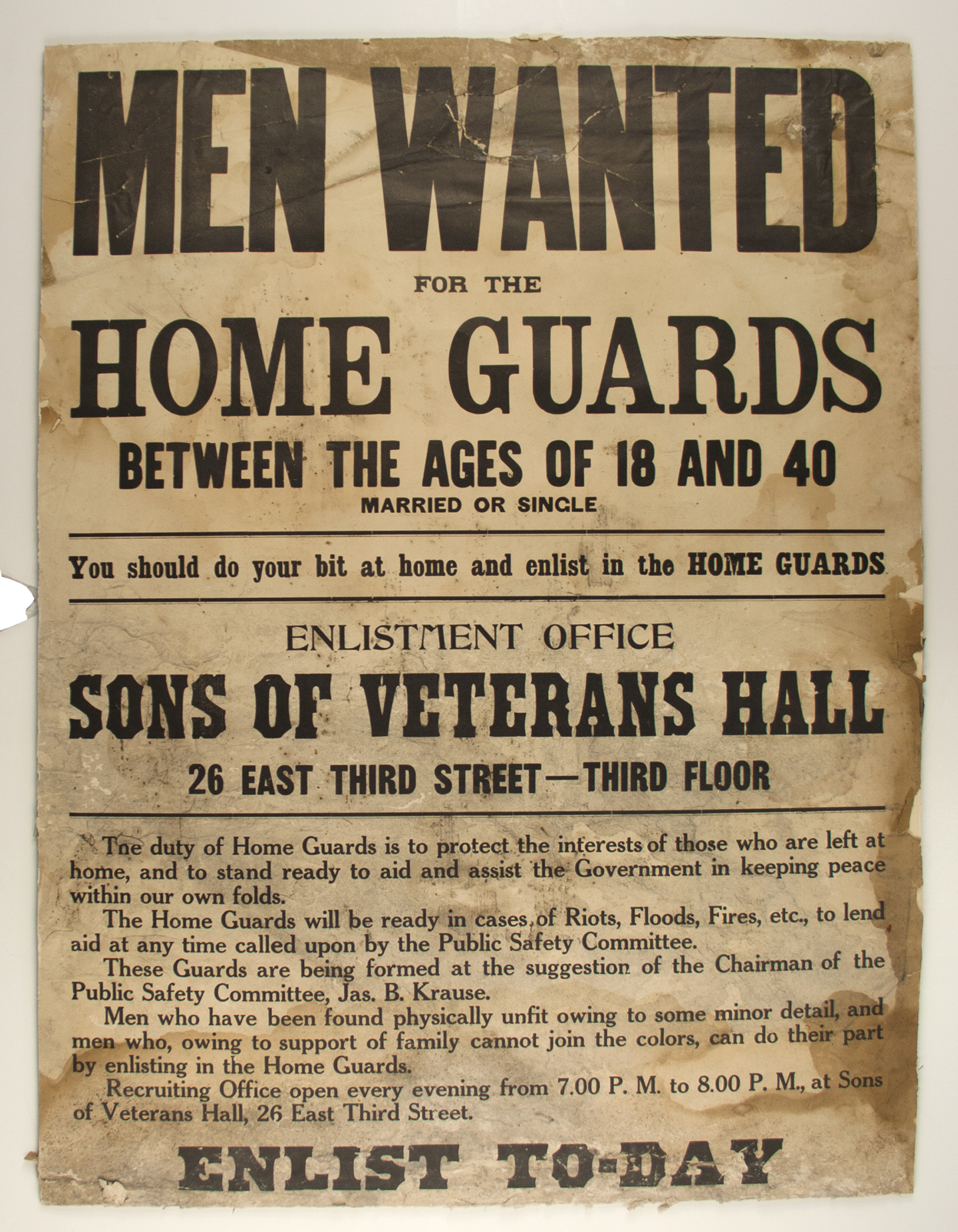
A rare broadside urging enlistment in the Home Guards as the United States entered the First World War

Rare WWI Broadside(First World War) Rare Broadside, MEN WANTED FOR THE MOME GAURDS BDETGWEEN THE AGES OF 18 AND 40 MARRIED OR SINGLE… ([Williamsport, Penn?: 1917], [SIZE].

An exhortation, made soon after the United States entered the First World War in April 1917, urging those who have not gone overseas to “… do your bit at home and enlist in the HOME GUARDS… The duty of Home Guards is to protect the interests of those who are left at home, and to stand ready to aid and assist the Government in keeping peace within our own folds. The Home Guards will be ready in cases of riots, Floods, Fires, etc., to lend aid at any time called upon by the Public Safety Committee. these Guards are being formed at the suggestion of the Chairman of the Public Safety Committee, Jas. B. Krause. Men who have been found physically unfit owing to some minor detail, and men who, owing to support of family cannot join the colors, can do their part by enlisting in the Home Guards…

James Barber Krause (1854-1923) was a prominent Williamsport, Pennsylvania attorney, who the State. In March 1917, the Governor of Pennsylvania appointed him as a member of the Committee of Public Safety for the Defense of Pennsylvania.*

Mounted to a board, marginal chipping dampstains and soiling as shown, else fair to good condition overall. Sold as is.

(EXA 5365) $550
_________
* “Two Hundred Residents Selected by Executive for Public Safety Committee” Wilkes-Barre Times, 22 Mar. 1917, page 8.

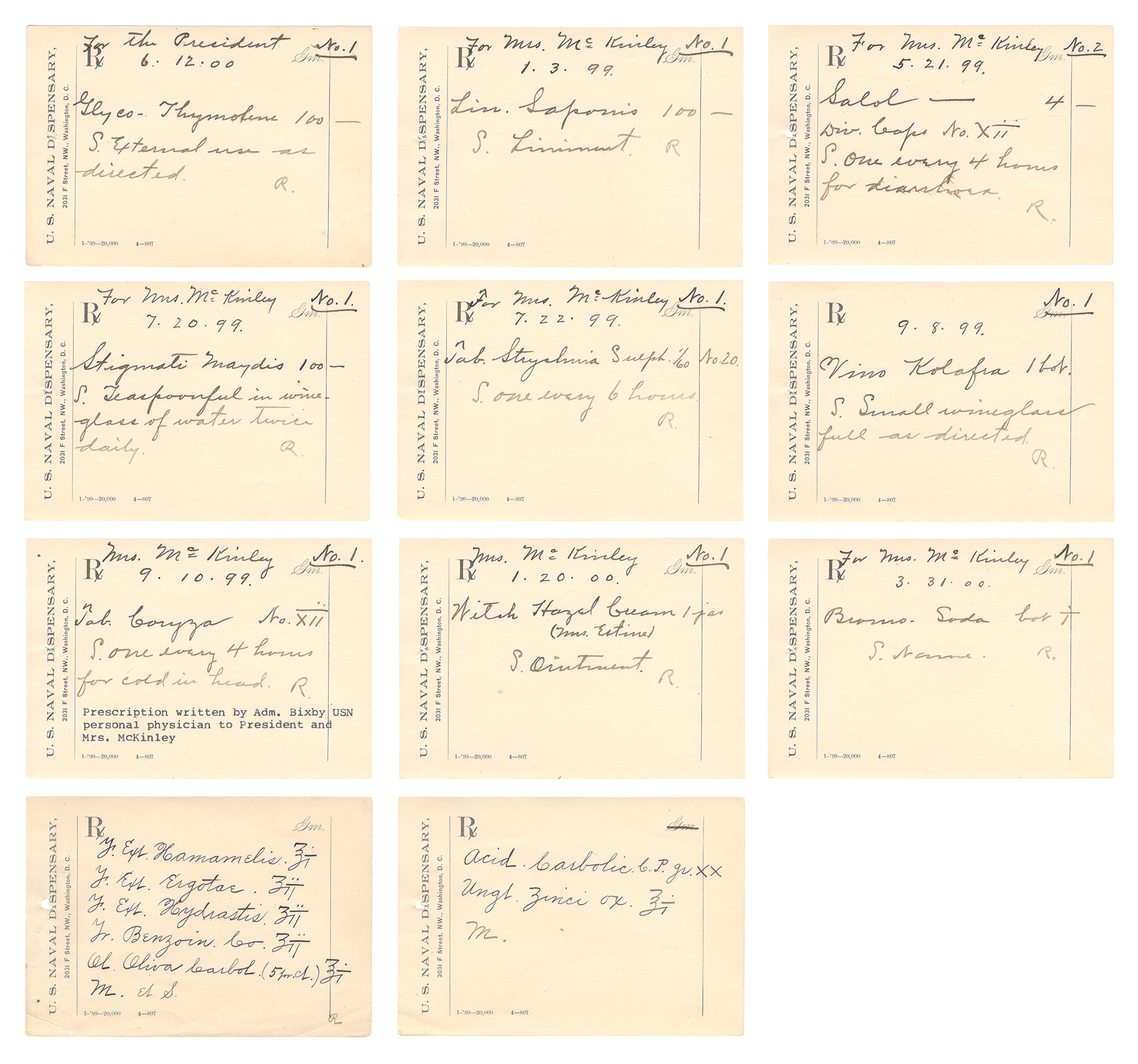
Collection of medical prescriptions for William & Ida McKinley signed by the President’s personal physician, Admiral Rixey

President & Mrs. McKinley medical prescriptions President & Mrs. McKinley medical prescriptions

(William and Ida McKINLEY) Admiral Presley Marion RIXEY (1852-1928) Surgeon General of the U.S. Navy fro 1902-1910, personal physician to Presidents William McKinley (1897-1901) and Theodore Roosevelt (1901-1909). He attended to McKinley after he was shot by American anarchist Leon Czolgosz in Buffalo, New York in 1901.

President & Mrs. McKinley medical prescriptions
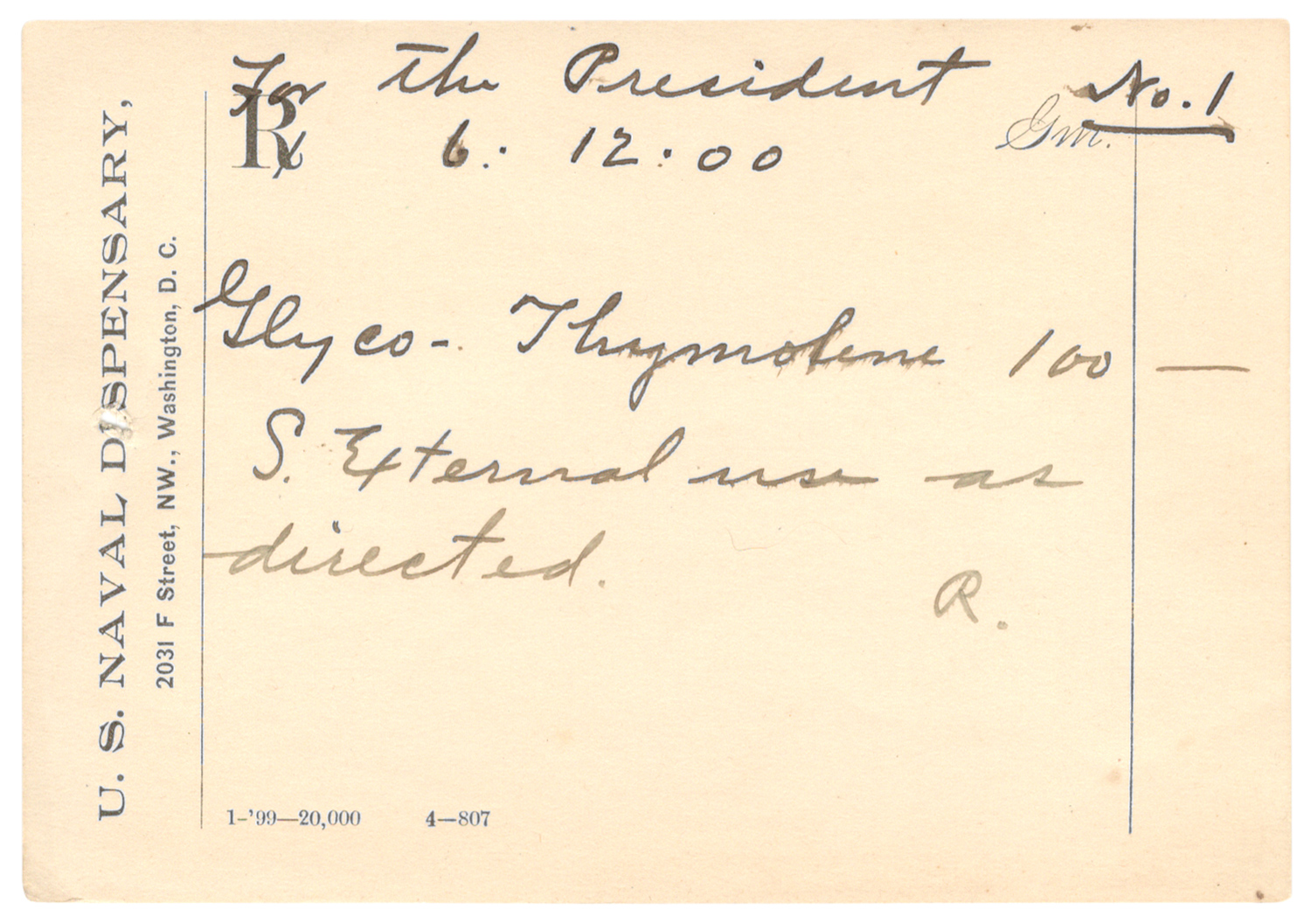
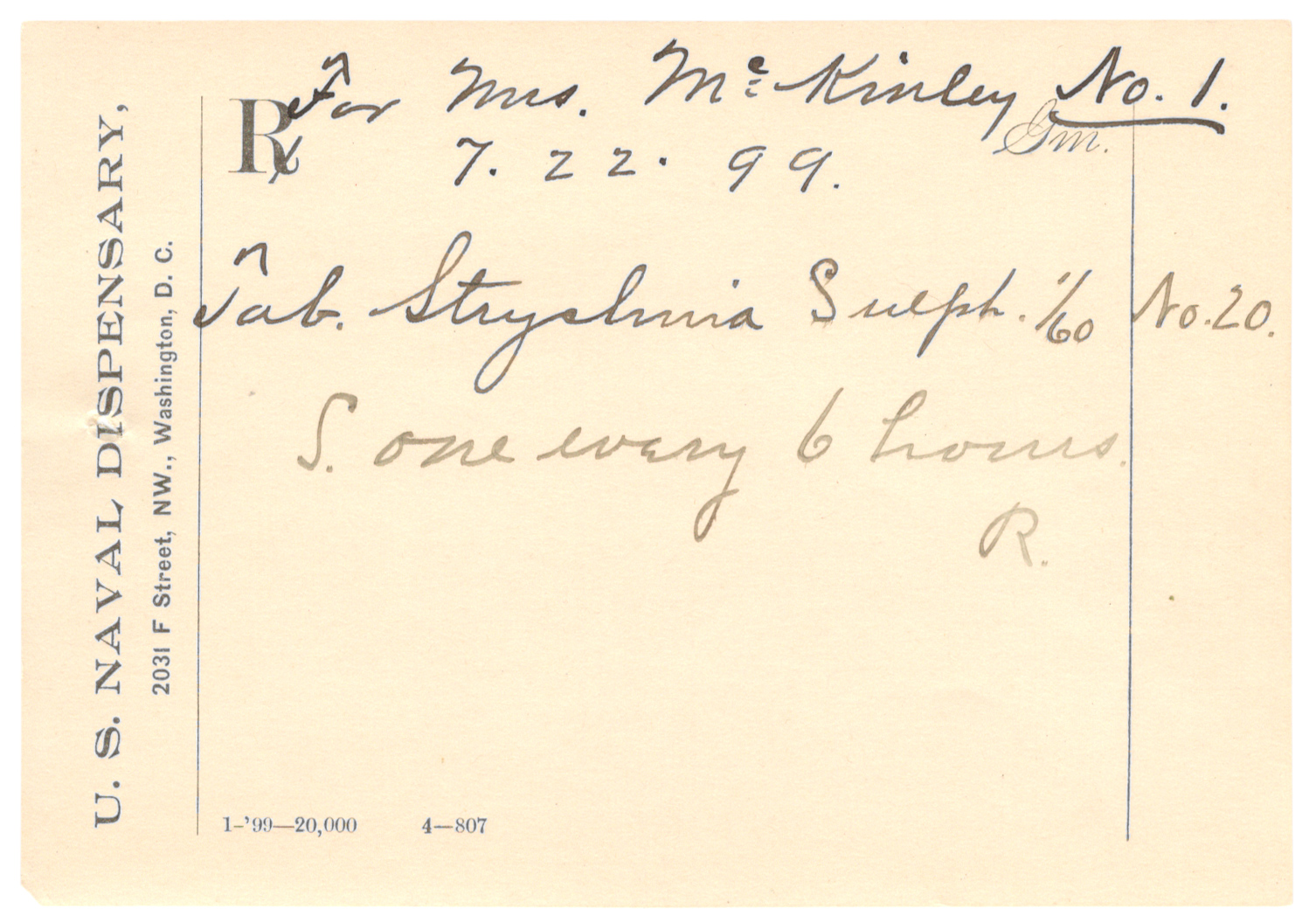
Eleven Autograph Documents Signed “R.“, 1 page each, 85 x 124 mm. (3 3/8 x 4 7/8 in.), 3 January 1899 to 12 June 1900, prescriptions for President McKinley (1) and Mrs. McKinley (10), on U.S. Naval Dispensary prescription paper. The prescription for President McKinley for Glyco-Thymoline (mouthwash) was issued on 12 June 1900, a week before he diverted troops from the Philippines to spearhead the China Relief Expedition, a multi-national military rescue mission sent to liberate U.S. Citizens and European nationals trapped in China during the Boxer Rebellion.

Light soiling and edge wear, some creasing, overall fine condition.

(EXA 6001) $950