Autographs

The Roosevelts opine on portraits of Theodore Roosevelt

Edith Roosevelt ALSs (1)Edith Roosevelt ALSs (2)
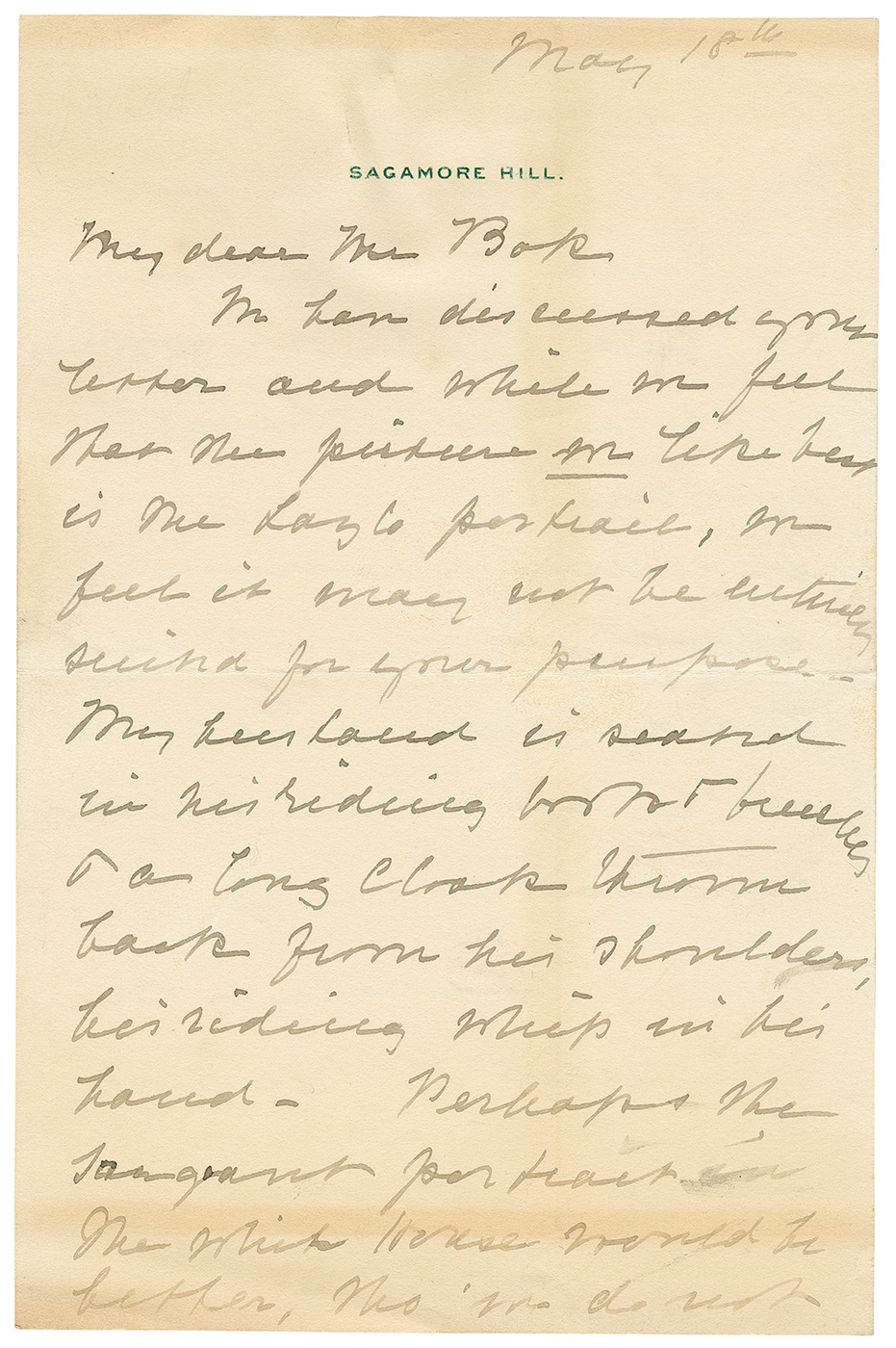
“…the picture we like best is the Lazlo portrait… the Sargent portrait in The White House… we do not care much for it… The photograph which we all like is a head by Pirie Macdonald…”

Edith Kermit Carow ROOSEVELT (1861-1948) A pair of fine content letters written to Edward W. Bok1, editor of the Ladies’ Home Journal concerning two portraits of Theodore Roosevelt. Theodore Roosevelt and Bok were close friends. For a number of years the former President anonymously authored the column, “Men” in the Ladies’ Home Journal at Bok’s request.

The first is an Autograph Letter Signed “Edith K. Roosevelt, Mrs. Theodore Roosevelt”, 2 pp., 175 x 115 mm. (7 x 4 1/2 in.), Oyster Bay, New York, 18 May [1916-1918], on Sagamore Hill letterhead, in which she writes, in full: “We have discussed your letter and while we feel that the picture we like best is the Lazlo portrait2, we feel it may not be entirely suited for your purpose. My husband is seated in his riding boots not breeches a long cloak thrown back from his shoulders, his riding whip in his hand- Perhaps the Sargent portrait in The White House would be better, tho we do not care much for it. The photograph which we all like is a head by Pirie Macdonald,3 but perhaps you wish a full length picture. Of course I have photographs of all kinds, and shall only too glad to help in any way—”

Edith Roosevelt ALSs (3)
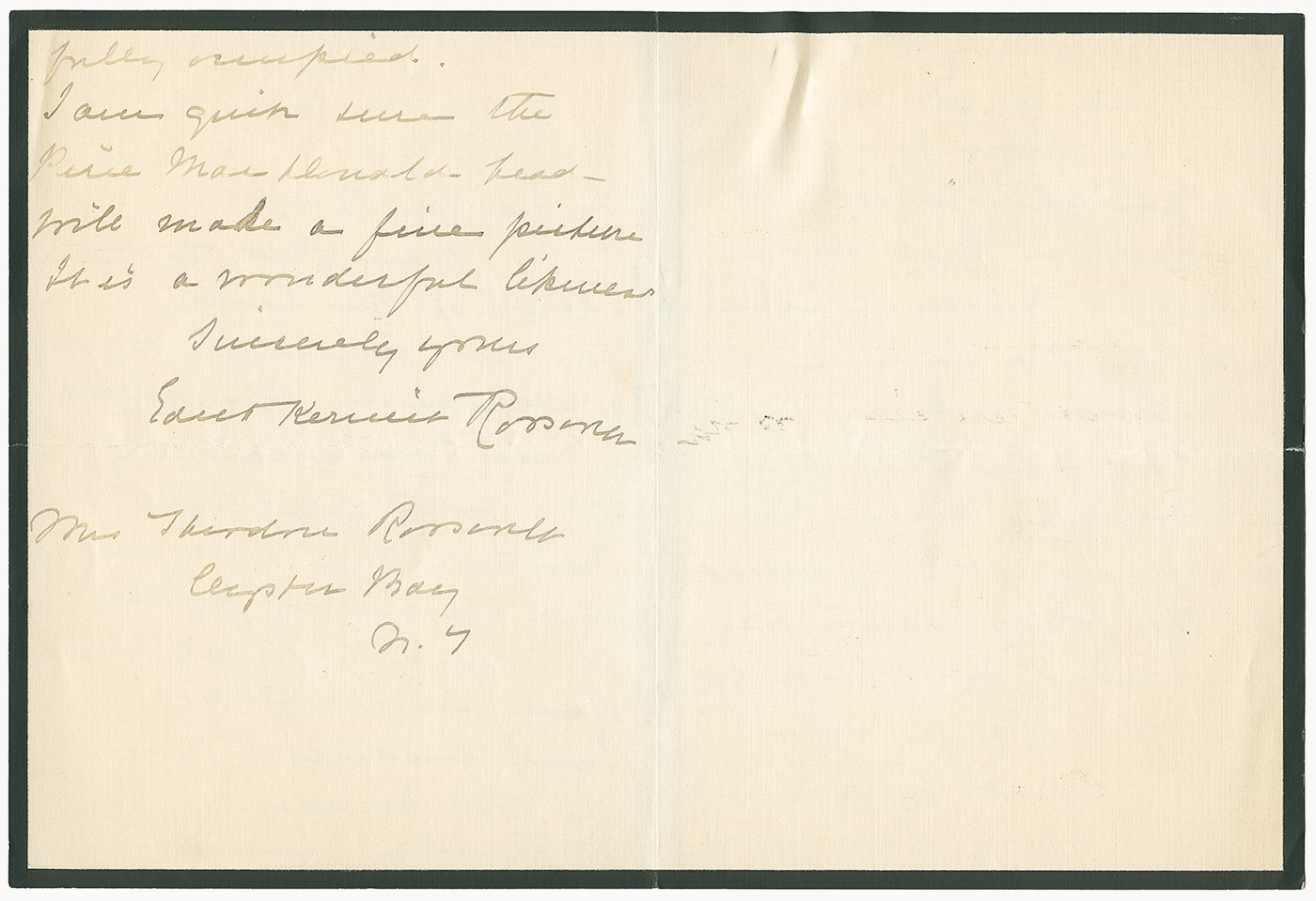
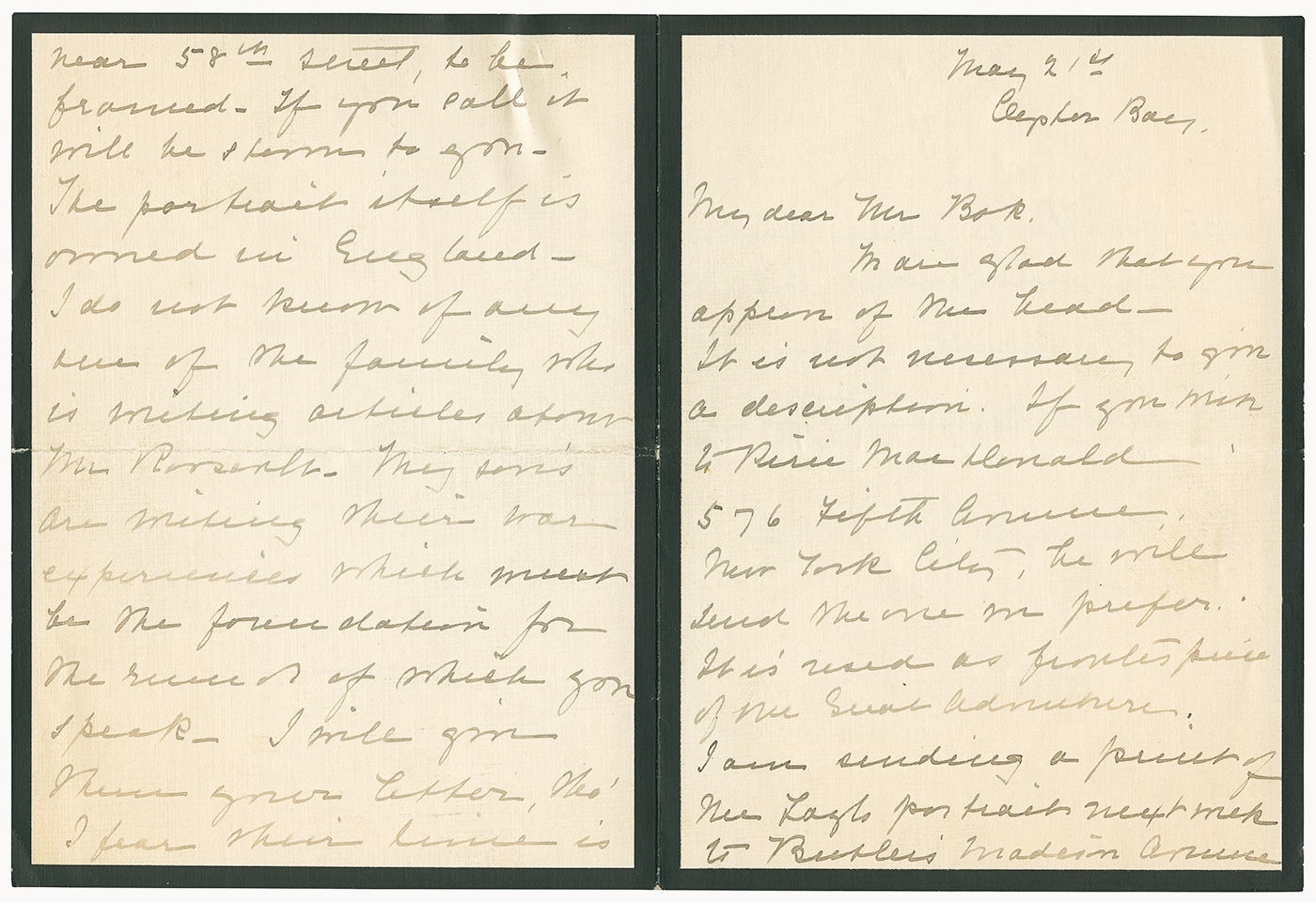
Soon after Theodore Roosevelt’s death in 1919, Bok received another Autograph Letter Signed, “Edith Kermit Roosevelt [and] Mrs Theodore Roosevelt” 3pp., 165 x 120 mm. (6 1/2 x 4 3/4 in.) on black-bordered mourning stationery, Oyster Bay, 21 May [1919]:

“We are glad that you approve of the head— It is not necessary to give a description. If you write to Pirie MacDonald 576 Fifth Avenue New York City, he will send the one we prefer. It is used as [the] frontis piece of The Great Adventure.4 I am sending a print of the Laszlo portrait next week to Butler’s Madison Avenue near 58th street, to be framed- If you call it will be shown to you – The portrait itself is owned[?] in England – I do not know if any one of the family who is writing articles about Mr. Roosevelt- My sons are writing their war experiences which must be the foundation for the rumor of which you speak — I will give them your letter, Tho’ I fear their time is fully occupied. I am quite sure the Pirie MacDonald head will make a fine picture. It is a wonderful likeness.”

A pair of fine content letters which reveal the Roosevelt family’s opinion of some of the significant portraits rendered of the 26th President.

The 18 May letter bears some light uneven toning, usual middle fold, paper clip impression, else very good. The 21 May letter bears extremely minor marginal tear, minor mark from paperclip at top margin of second page, one horizontal crease, else fine. Together, two pieces.

(EXA 4618) $800
_____________
1 (1863-1930) Dutch-born American editor and Pulitzer Prize-winning author. For three decades Bok edited Ladies Home Journal where he coined the term, “Living Room”—updating the Victorian parlor for the twentieth century.

2 Philip Alexius de László, “President Theodore Roosevelt,” oil on canvas, 1908. Portrait part of the collection of the Museum of Natural History, New York.

3 (1867-1942) Noted New York photographer.

4 (New York: Charles Scribner’s Sons, 1919).

A Mediterranean passport signed by John Tyler as President… a year after he left office?

Ship's Manifest signed by Tyler and Calhoun
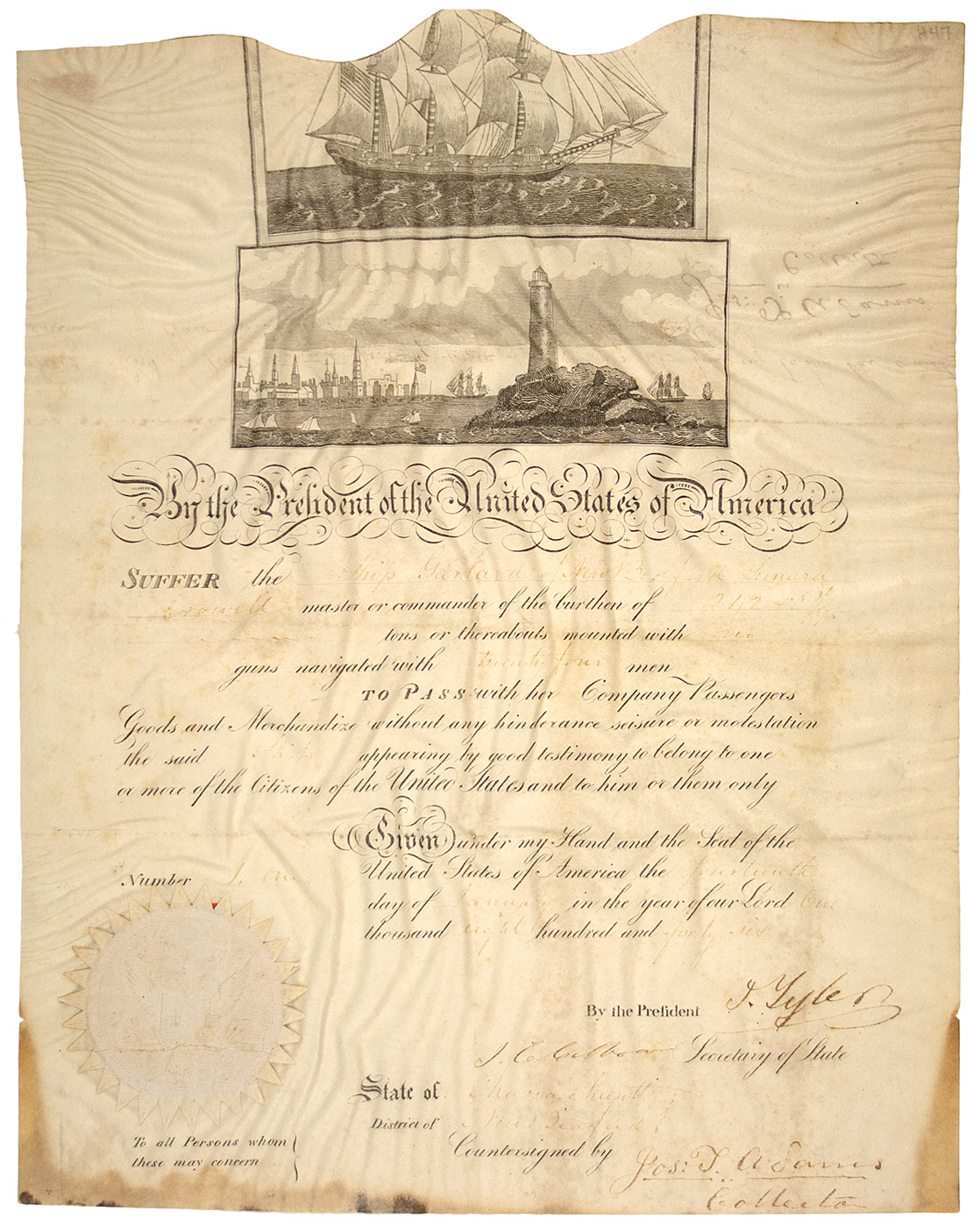
John TYLER (1790-1862) Partly engraved Document Signed “J. Tyler” as President, 1p. 370 x 290 mm. (14 5/8 x 11 1/2 in.), Washington, 14 January 1846 [but actually c. 1844-1845*], and countersigned by John C. CALHOUN (1782-1850) as Secretary of State (“J Calhoun”). A scallop top Mediterranean passport executed at New Bedford, Mass. by “Joseph T. Adams Collector” for the ship Garland, an unarmed 242 ton vessel owned and commanded by Leonard Crowell with a crew of 24. Endorsed on the verso by Collector Adams, 9 June 1849. A strong engraving with an intact seal of the United States affixed at lower left.

An oddly dated passport that illuminates how these documents were produced and processed. Mediterranean passports, like other routine documents requiring the President’s signature, were signed while the documents were still blank to allow the signing of a sufficient quantity in a short time. The blanks were forwarded to the various federal port collectors throughout the country who, in turn, executed them for specific ships.

In this case, it appears that Collector Adams at New Bedford was unable to obtain a passport bearing the signature of James Polk and figured that no one would be the wiser.

The date of execution raises a question for the legal minded: did the document’s language “Given under my Hand and the Seal of the United States of America…” render the passport invalid upon issuance, as neither Tyler nor Calhoun were in office at the time?

Engrossment light, minor toning at bottom margins, light marginal wear with some cockling, else very good condition.

(EXA 5248) $850

_________
* Calhoun served as Secretary of State from 1 April 1844 to 10 Mar. 1845.

Revolutionary War hero William Barton writes to Vermont Senator Bradley 1815 from debtors prison seeking an attorney

Revolutionary War hero William Barton writes from debtor's prison, 1815
(American Revolution) William BARTON (1748-1831) Officer in the Continental Army during the American Revolution who attained the rank of Colonel (and later adjutant general of the Rhode Island militia), fought in the Battle of Bunker Hill, and captured Major General Richard Prescott in a July 1777 raid on British Headquarters in Rhode Island, for which he was rewarded by the Continental Congress. Barton was an original member of the Rhode Island Society of the Cincinnati, joining at the inception of the Society’s first constituent branch in 1783. Upon Rhode Island’s ratification of the U.S. Constitution in 1790, Barton was selected to travel to New York to inform George Washington. In 1789, Barton and 59 other Revolutionary War soldiers received a land grand for an area in northern central Vermont, chartered as the town of Barton. While his namesakes of the town, and Fort Barton in Tiverton, Rhode Island were a testament to his prominence, he was successfully sued for selling the same plot of land to two different investors. Upon Barton’s refusal to pay his debt, he was sentenced to serve 14 years in debtor’s prison in Danville, Vermont, beginning in 1812 when Barton was 64 years old. He was finally released 13 years later when the Marquis de Lafayette agreed to pay off the remainder of Barton’s debt.

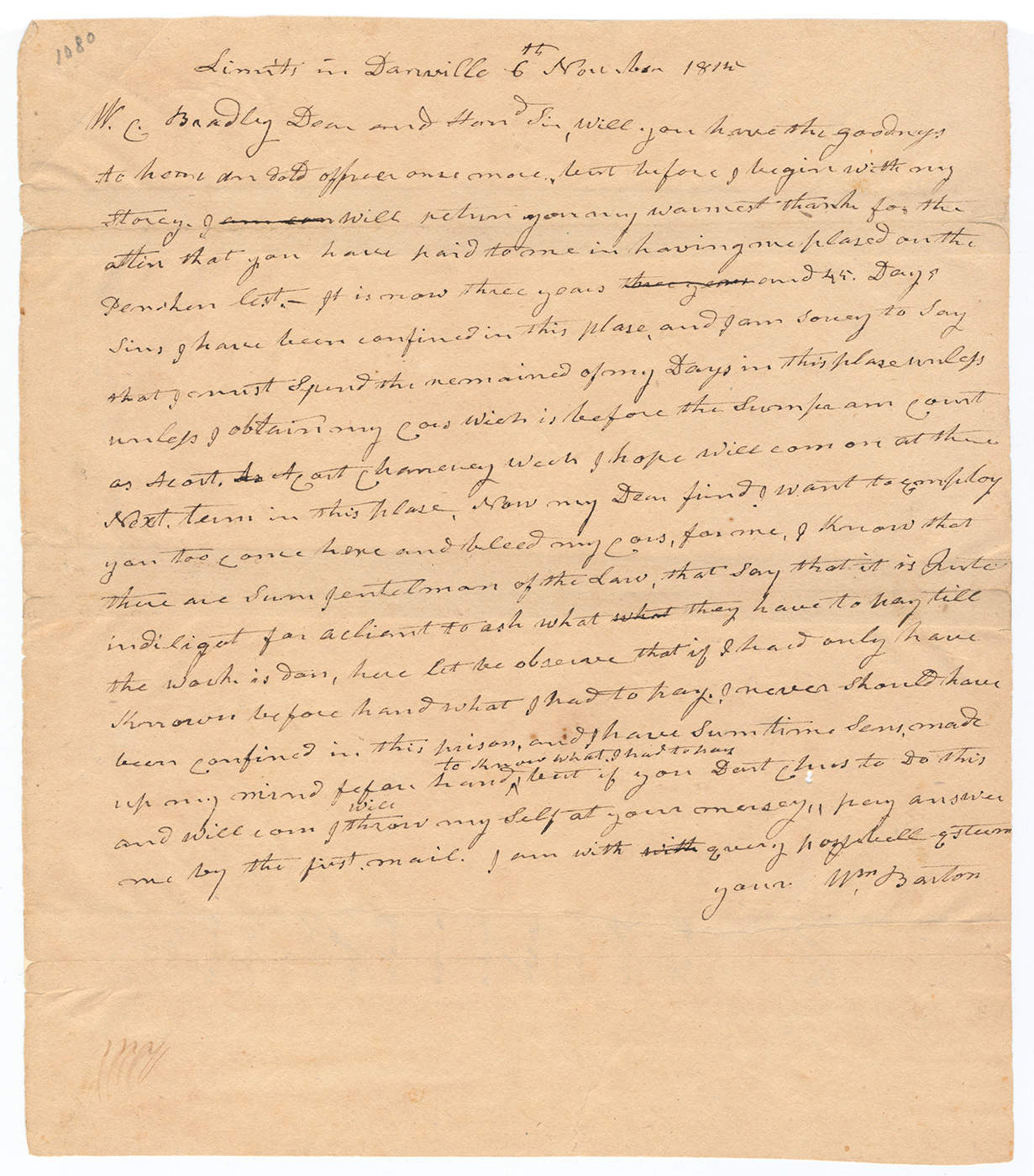
Autograph Letter Signed “Wm. Barton” from debtors prison, 1 page, 224 x 195 mm. (8 7/8 x 7 5/8 in.), Danville [Vermont], 6 November 1815, to U.S. Senator from Vermont William Czar Bradley (1782-1867). Barton, a veteran of the American Revolutionary War, was incarcerated for debt in 1812 following a bad land deal in Vermont. Three years later, he humbly (and largely phonetically) seeks an attorney to represent him:

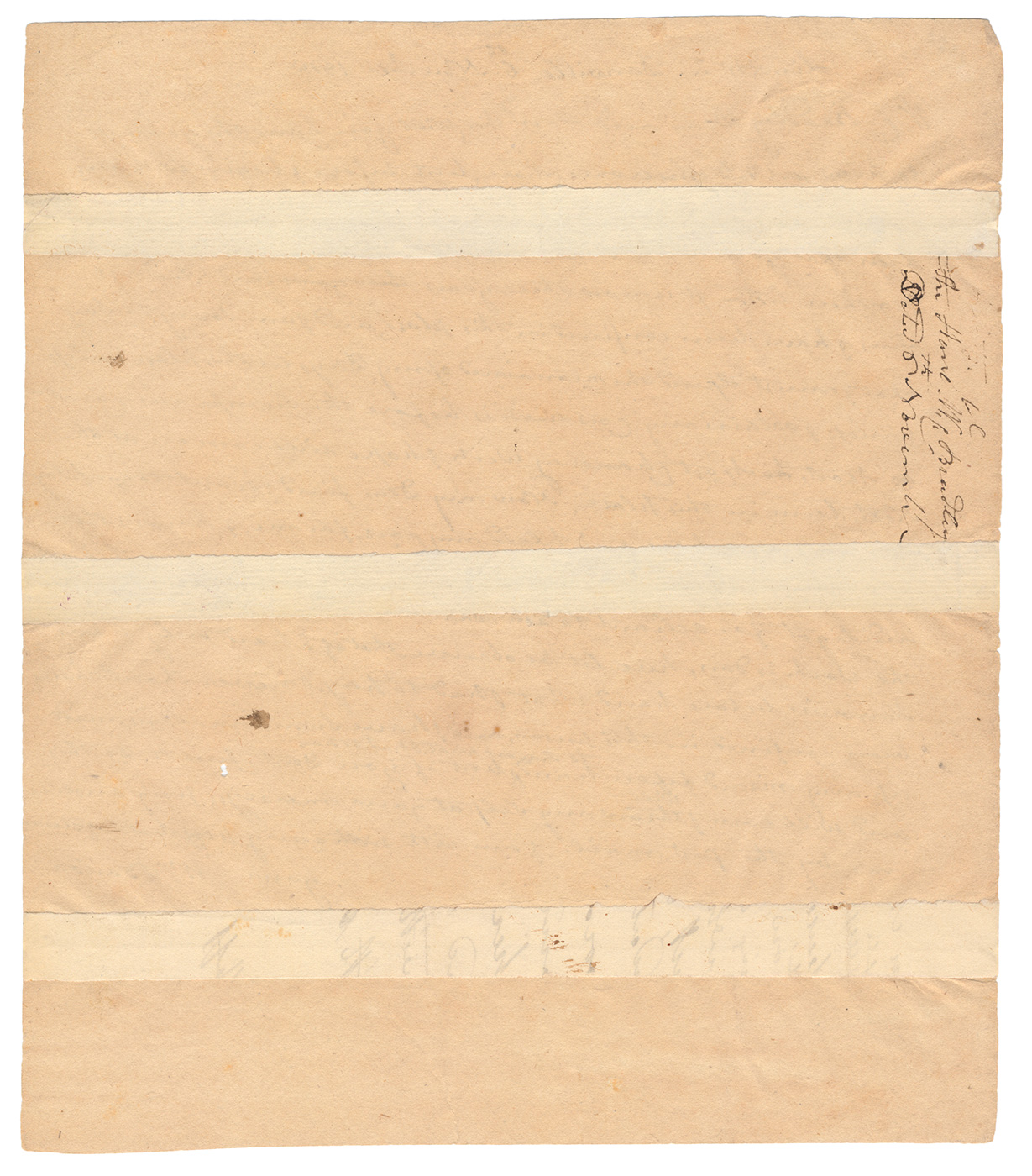
Revolutionary War hero William Barton writes from debtor's prison, 1815 (verso)
“Will you have the goodness to heare [sic] and [sic] old officer once more, but before I begin with my storey[sic]. I was & am Will return you my warmest thanks for the att[ent]i[o]n you have paid to me in having me placed on the Pension list.— It is now three years three years and 45 Days Sins [sic] I have been confined in this plase [sic], and I am Sorrey [sic] to Say that I must Spend the remainder of my Days in this plase unless I obtain my case W[h]ich is before the Supream [sic] Court … A Co[u]rt of Chancery W[h]ich I hope Will com[e] on at the Next term in this plase. Now my Dear friend I want to Employ you too come here and bleed[?] my case, for one, I Know that there are Sum [sic] gentlemen of the Law, that say that it is Inte[?] indiligent [sic] for a client to ask what what they have to pay till the Wash[?]is don[e], here let me observe that if I had only have Known before hand what I had to pay, I never should have been confined in this prison, and I have Sometime Sins made up my mind so far. hard to Know What I had to pay but if you Dont chus [sic] to Do this and Will com[e] I Will throw my Self at your mersey [sic], pray answer me by the first mail.”

Very minor paper loss at bottom right, slight edge wear, archival repairs to verso along usual folds, else very good.

(EXA 5235) SOLD

The last surviving veteran of the Battle of Lexington, Jonathan Harrington, John Parker’s fifer, signs at age 89

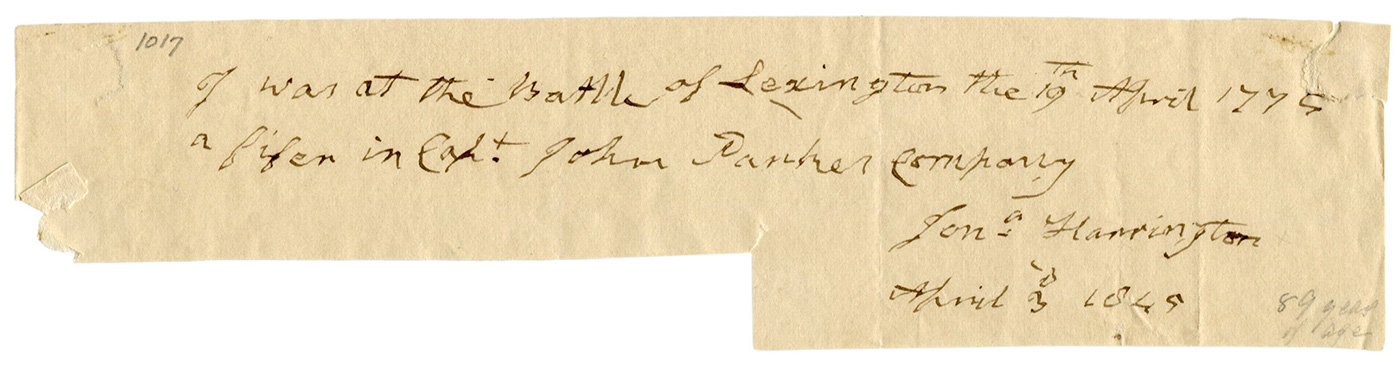
John Harrington signature fifer Battle of Lexington
Jonathan HARRINGTON (1758-1854) The last surviving member of John Parker’s company at the Battle of Lexington on 19 April 1775, serving as the fifer beside drummer William Diamond.

Fine content Autograph Note Signed, “Jon Harrington”, 1p.  48 x 196 mm. (1 7/8 x 7 3/4 in.),  on an irregularly cut slip of paper, [Lexington], 30 April 1845, writing in full: “I was at the Battle of Lexington the 19th April 1775 a fife in Capt. John Parker’s Company”.

When Benson Lossing interviewed Harrington in 1848, the old soldier humbly explained that he only became one of the company’s musicians because he was the only person in Lexington who knew how to play a fife. Harrington recalled, “My mother… called out to me at three o’clock in the morning, ‘Jonathan, Jonathan! The reg’lars are coming and something must be done.’ I dressed quickly, slung my light gun over my shoulder, took my fife from a chair, and hurried to the parade near the meeting house, where about fifty men had gathered and others were arriving every minute. By four o’clock a hundred men were there. We did not wait long, wondering whether reg’lars were really coming, for a man darted up to Captain Parker and told him that they were close by. The captain immediately ordered … Joe[sic William] to beat the drum and I fifed with all my might. Alarm-guns were instantly fired to call distant minute-men to duty. Lights were now seen moving in all the houses. Daylight came at half-past four o’clock. Just then the reg’lars who had heard the drum beat, rushed toward us, and their leader shouted, ‘Disperse, you rebels!’ We stood still. He repeated the order with an oath, fired his pistol, and ordered his men to shoot. Only a few obeyed. Nobody was hurt, and we supposed their guns were loaded only with powder. We had been ordered not to fire first, and so we stood still. The angry leader of the reg’lars then gave another order for them to fire, when a volley killed or wounded several of our company. Seeing the reg’lars trying to surround us, Captain Parker ordered us to retreat. As we fled some shots were sent back. [William] and I climbed a fence near Parson Clarke’s house and took to the wood near by. Climbing over, [William] fell upon a heap of stones and crushed his drum-head. His hand was bleeding badly, and he found that a bullet had carried off a part of his little finger. Eight of our men had lost their lives.”1

Groomed for college, Harrington’s aspirations were dashed when the retreating regulars ransacked his home, taking the Latin books he needed to prepare, and burned them in the street.  Harrington spent the remainder of his life as a farmer in Lexington. In his advanced age, Harrington’s association with the opening battle of the Revolutionary War gave him celebrity as veterans of the war died off.  The curious, traveling from near and and far, made pilgrimages to his East Lexington home to hear his stories. 2 When he died in 1854, nearly 10,000 attended his funeral including the governor, both houses of the legislature and 1,000 soldiers.3

Tape repair to upper right corner slightly affecting the “5” in “1775”, light edge wear, overall very good condition.

(EXA 5222) SOLD.

_____________

1 Benson J. Lossing, Hours with the Living Men and Women of the Revolution, A Pilgrimage (1889), 2-8.

2 Mary B. Fuhrer, Research for the Re-Interpretation of the Buckman Tavern, Lexingon Massachusetts: Conceptions of Liberty (Unpublished report, 2012), 68.

3 “Funeral of Jonathan Harrington” Salem Register, (Mass.), 3 Apr. 1854, 2.

Schuyler Colfax offers to campaign for Republicans in Minnesota, 1857

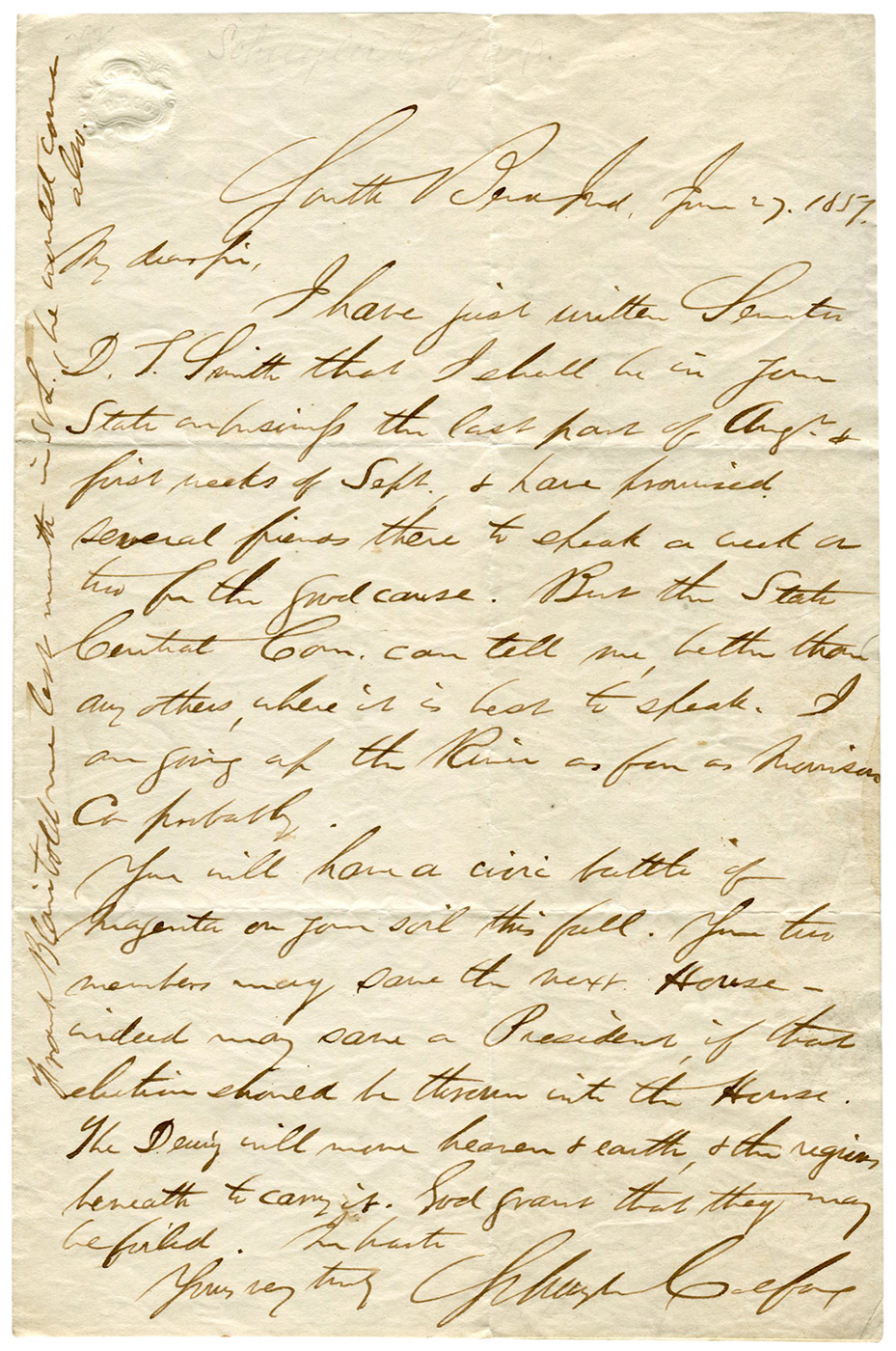
chuyler Colfax ALS
“You will have a civic battle of Magenta on your soil this fall. Your two members may save the next House— indeed may save a President if that election should be thrown into the House. The Dem’y will move heaven & earth, & the regions beneath to carry it. God grant that they may be foiled.”

Autograph Letter Signed “Schuyler Colfax”, 1 page, 197 x 129 mm. (7 3/4 x 5 in.), South Bend, Ind., 27 June 1857. A good political-content letter written in the early years of the Republican Party concerning his intention to travel to Minnesota that autumn to stump for the Republican state ticket there.

“I have just written Senator D[elano] T. Smith* that I shall be in your State on business the last part of Aug. & first weeks of Sept. & have promised several friends there to speak a week or two for the good cause. But the State Central Com. can tell me, better than any others, where it is best to speak. I am going up the River as far as Morrison Co[.] probably. You will have a civic battle of Magenta on your soil this fall. Your two members may save the next House— indeed may save a President if that election should be thrown into the House. The Dem’y will move heaven & earth, & the regions beneath to carry it. God grant that they may be foiled.”, with a post script in the left margin: “Frank Blair told me last month in S.L. he would come also.” Other prominent Republicans canvassed Minnesota on behalf of the fledgling party that fall including Carl Schurz. A good political content letter documenting the early years of the Republican Party.

Schuyler COLFAX (1823-1885) was the 17th Vice President of the United States under President Ulysses S. Grant from 1869 to 1873, a United States Congressman from Indiana from 1855 to 1869, during which time he also served as the 29th Speaker of the U.S. House of Representatives, from 1863 to 1869. He has the distinction of being one of only two Americans (the other being John Nance Garner) to serve as both Speaker of the House and Vice President.

Slight creasing, light edge wear, usual folds, else very good.

(EXA 5219) $375

________
* Smith was a member of the Minnesota State Senate from Hennepin County from 1857 to 1858. (Political Graveyard)
“Political Campaign in Minnesota”, Cleveland Leader, 1 October 1859, 2: “Distinguished speakers from abroad are canvassing the State on both sides. Messrs. Hale, Grow, Colfax, Bingham and Schurz on the Republican, and Willard, Larabee, Rothe and others on the Democratic… The indications are that the Republican State Ticket will be elected by a majority of from three to five thousand, that the Legislature will be Republican, and that there will be a Republican U.S. Senator form Minnesota in Washington next winter.”

Political content letter on the Election of 1824 and the chances of Jackson, Crawford and Adams

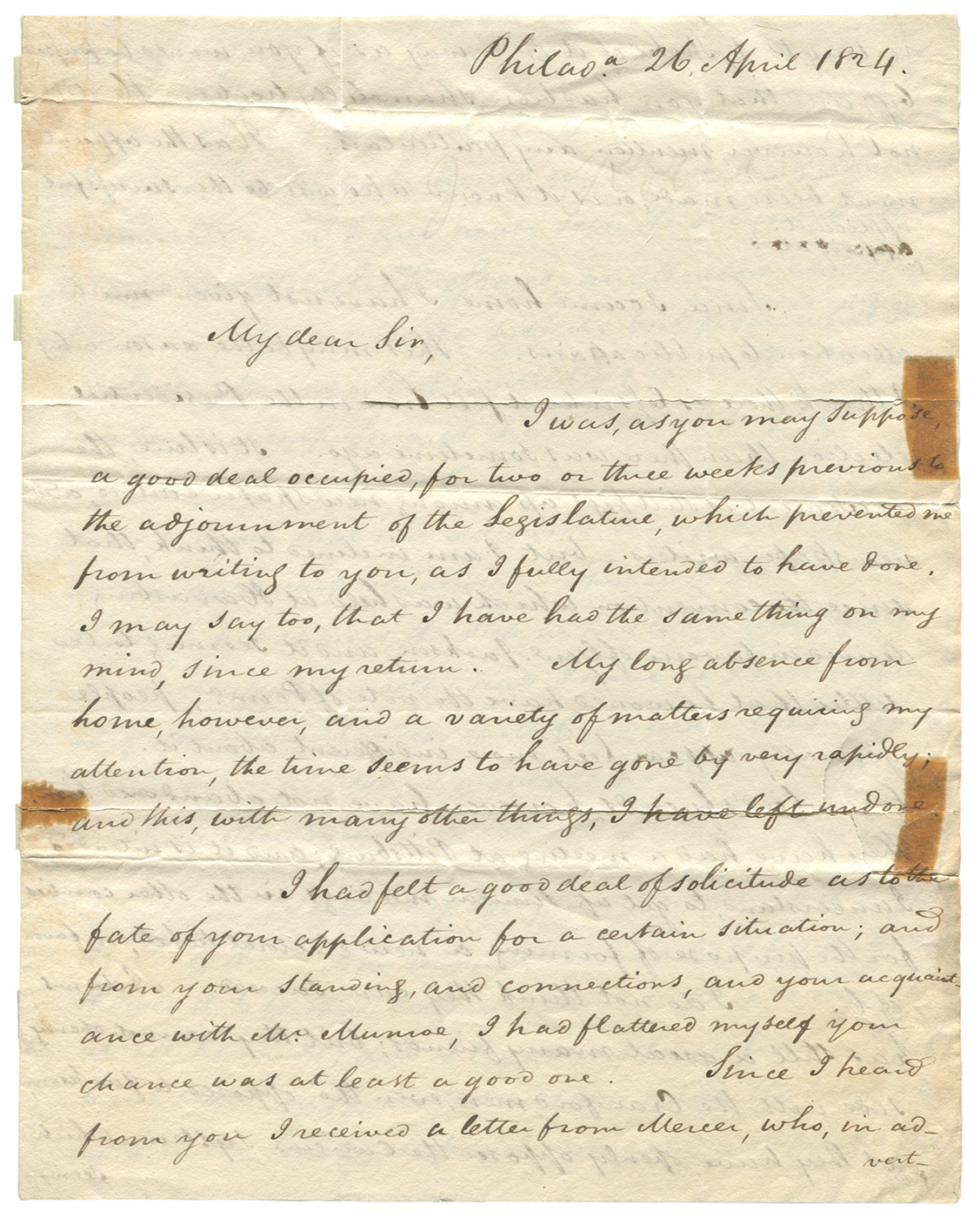
exa4914_01
(Election of 1824) James ROBERTSON (c. 1780-1854) Federalist member of the Pennsylvania State Senate, representing the 1st District of Philadelphia from 1822 until his retirement in 1825. He was an officer for the Bank of the United States from the late 1820s until the bank’s dissolution in 1841.

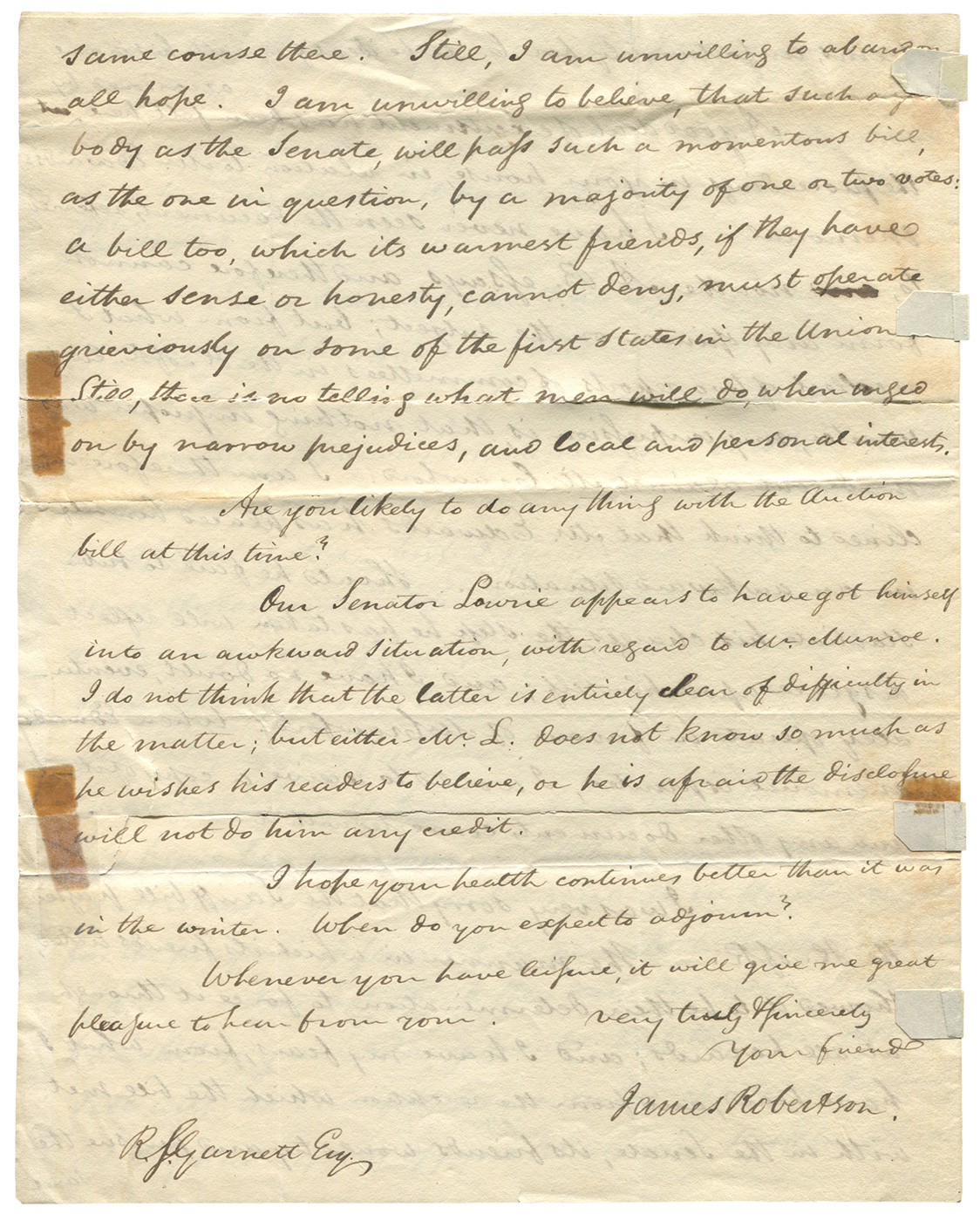
Fine content Autograph Letter Signed “James Robertson” as a representative of the Pennsylvania State Senate, 4pp., 251 x 198 mm. (9 7/8 x 7 6/8 in.), Philadelphia, 26 April 1824, to Robert S. Garnett (1789 – 1840) of Essex County, Va. A chatty political letter to a member of the Congressional faction of the Democratic-Republicans backing Treasury Secretary William H. Crawford of Georgia for President commenting, among other things, on the growing factions growing around of Jackson, Adams and Crawford that would result in the only election ever thrown into the House of Representatives since the passage of the Twelfth Amendment. Robertson admits that since his arrival home from Harrisburg, “I have not given much attention to public affairs. This may be the reason why I think there is less interest felt here in the Presidential election, than there was some time ago. It is true, the excitement is still kept up among newspaper editions, and newspaper writers— but I am inclined to think that since the Convention which was held at Harrisburg, decided in favour of Genl. Jackson, and it seeming to be settled, that he would have the vote of Penna., people general appear feel more indifferent about it. Crawford’s friends, however, have not abandoned him. They have had a meeting at Pittsburg; and it is intended, I understand, to get up similar meetings in the other counties for the purpose of forming a new electoral ticket, in favour of C[rawford]. I do not think they can succeed. Adams has still a great many friends; but they cannot openly side with the Crawford men, even tho’ opposed to Jackson, as they have openly opposed the caucus system, which seem unfortunately for C[rawford] to be identified with his name…” Crawford’s supporters in Congress made a fatal blunder for his candidacy when they staged a Congressional caucus to nominate him for President. Out of 216 Democratic-Republican members of Congress, only sixty-six attended, giving the meeting the appearance of factional meeting without the official sanction of the party, hobbling Crawford’s nomination for President (together with his old friend Albert Gallatin for Vice President).

James Robertson ALS Election of 1824 (2)
The rump Congressional caucus also roused the passions of all of Crawford’s political rivals who promptly went on the offensive. Roberston comments upon the excitement generated by Ninian Edwards’ accusation that Crawford had mismanaged funds in his capacity as Secretary of the Treasury: “A good deal of excitement has been felt here occasioned by the proceedings in your house, in relation to Mr. Edwards’s memorial. I have never seen the document referred to, nor the A.B. essays, and therefore cannot form any opinion on the subject; but from what I recollect of two reports of committees in the H. of R. last winter, my impression is, that nothing improper was made out against Mr. Crawford. I am therefore inclined to think that Mr. Edwards has placed himself in an awkward situation. Should he fail to substantiate his charges, the step he has taken will reflect disgrace upon himself; and I have no doubt, eventually operate in favour of Mr. Crawford. When Edward’s memorial is printed, I would to receive a copy of it and any other documents connected with it.” Crawford had much greater problems. In 1823 he suffered a paralytic stroke. Although Crawford finished third in the Electoral College, which under the Twelfth Amendment, placed him in the running when the race landed in the House of Representatives. His bad health rendered him a non-factor in Congress as all eyes focused on the contenders Andrew Jackson and John Quincy Adams.

Robertson also take some time to criticize the new tariff bill: “…I was very sorry that the Tariff bill passed the H. of R. The manner in which its friends acted, showed it to be their determination to force it through at all hazards; and I have my fears, from what I have heard, and from the reception which the bill met with in the Senate, its friends would try and pursue the same course there. Still, I am unwilling to abandon all hope. I am unwilling to believe that such a [paper loss] body as the Senate, will pass such a momentous bill, as the one in question, by a majority of one or two votes: a bill too, which its warmest friends, if they have either sense or honesty, cannot deny, must operate grievously on some of the first states in the Union. Still, there is no telling what men will do, when urged on by narrow prejudices, and local and person interests…”

Toned spots from tape repairs to separated folds, light toning, else very good.

(EXA 4914) $1,200.00

Bleeding Kansas: a Manuscript Document Signed by two important pro-slavery Kansas politicans, one being the namesake of Lecompton, Kansas

exa5017_01
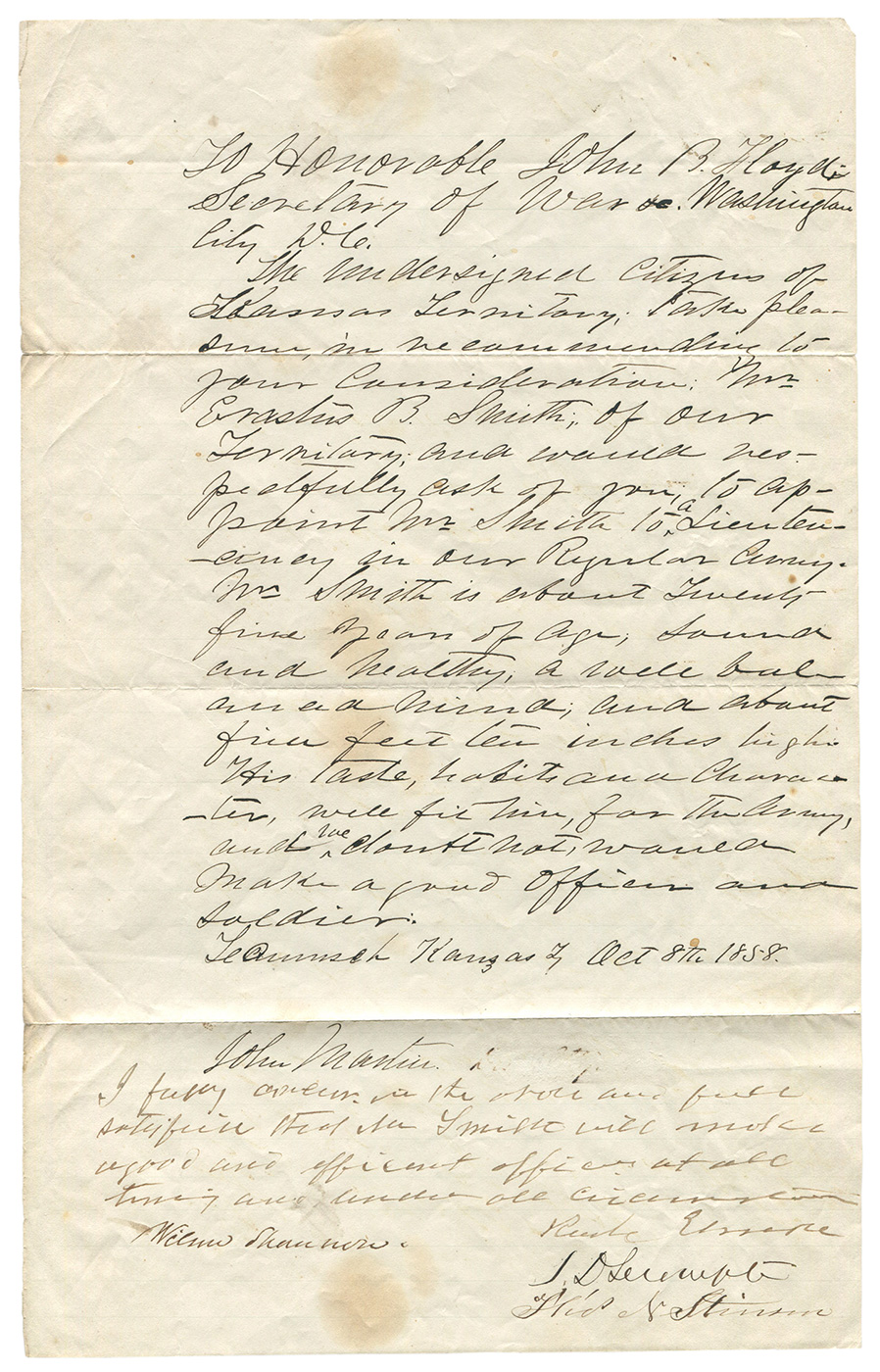
(Bleeding Kansas) Manuscript Document Signed “John Martin”, 1p. 310 x 195 mm. (12 1/4 x 7 5/8 in.), Tecumseh, Kansas Territory, 8 Oct. 1858 a Petition to Secretary of War John B. Floyd by citizens of Tecumseh, Kansas Territory to appoint Erastus B. Smith as a 1st Lieutenant in the regular army. The petition was presented in the midst of the crisis known as “Bleeding Kansas” the struggle between pro-slavery and anti-slavery forces, both trying to sway popular support when the Kansas-Nebraska Act. This divide left the question of slavery in the territory to the popular vote.

The document also bears an Autograph Endorsement Signed at the bottom by Federal Circuit Judge Rush ELLMORE (1819-1864) endorsing Smith’s candidacy. First appointed by Franklin Pierce and later James Buchanan as an Associate Justice on the Kansas Supreme Court, Ellmore was firmly in favor of the Lecompton Constitution and was a delegate to the convention that drafted the document. At the outbreak of the Civil War, he supported the Union. The document is also endorsed by Samuel Dexter LECOMPTE (1814-1888). Lecompte moved to Kansas from Maryland in 1854 and was appointed Chief Justice of the Kansas Territory by Franklin Pierce—and served in that capacity until 1859. He was also the president of the Lecompton Town Company and promoted the city to become the state capital. Although a staunch Democrat, he switched his allegiance to the Republicans in 1865.

We have been unable to discover any record of a regular army commission for Erastus Smith. We are fairly certain Erastus Smith later served D Company, 7th Kansas Cavalry through September 1861 through September 1865. The addressee, John Floyd, was James Buchanan’s Secretary of War who was later accused of personal misuse of funds earmarked for the Indians. Floyd chose to support secession at the outbreak of the Civil War and served as a general in the Confederate Army.

Folds and light creases, minor marginal wear as shown, minor soiling, else very good condition. Note: piece has been stored folded and will be shipped in the same manner.

(EXA 5017) $650

Archive of Pennsylvania Surveyor James Hendricks, 1767-1772

James & Tobias Hendricks Archive

(Pennsylvania) James HENDRICKS (1722-1795) Captain who served in Pontiac’s War, one of several Deputy Surveyors General for Pennsylvania. Tobias HENDRICKS, Jr. (1714-1779) Innkeeper of the landmark “Toby’s Place” located on the Cumberland Trail. A well frequented meeting house for Indian traders and politicians, and a prime hub of Colonial strategic gatherings during the Revolutionary War.

A collection of nine (9) pieces including one Autograph Letter Signed “Tobias Hendricks,” addressed to ”John Lukens,” 23 June 1767, 1p., 183×150 mm., and six Autograph Letters Signed “James Hendricks,” also addressed to John Lukens (Surveyor General of Pennsylvania from 1761-1789), ranging in date from 1770-1772, size range 225×180 – 170×160 mm. Also included is a partial Autograph Letter Signed “James Hendrix” undated, and in three pieces and also together with a manuscript map, 1p. 325×205 mm. [n.p., n.d], of lands granted to officers in the French and Indian War.

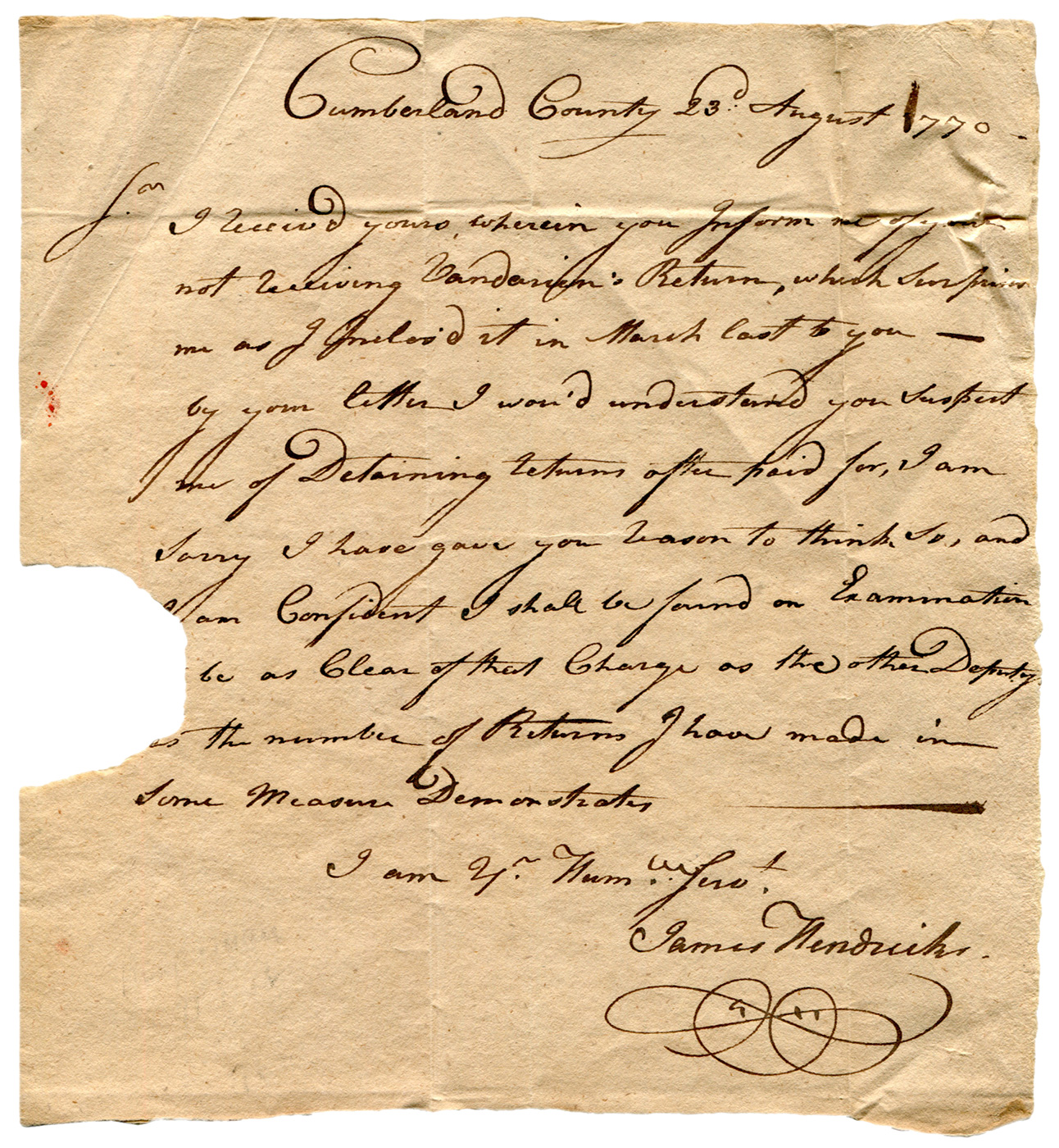
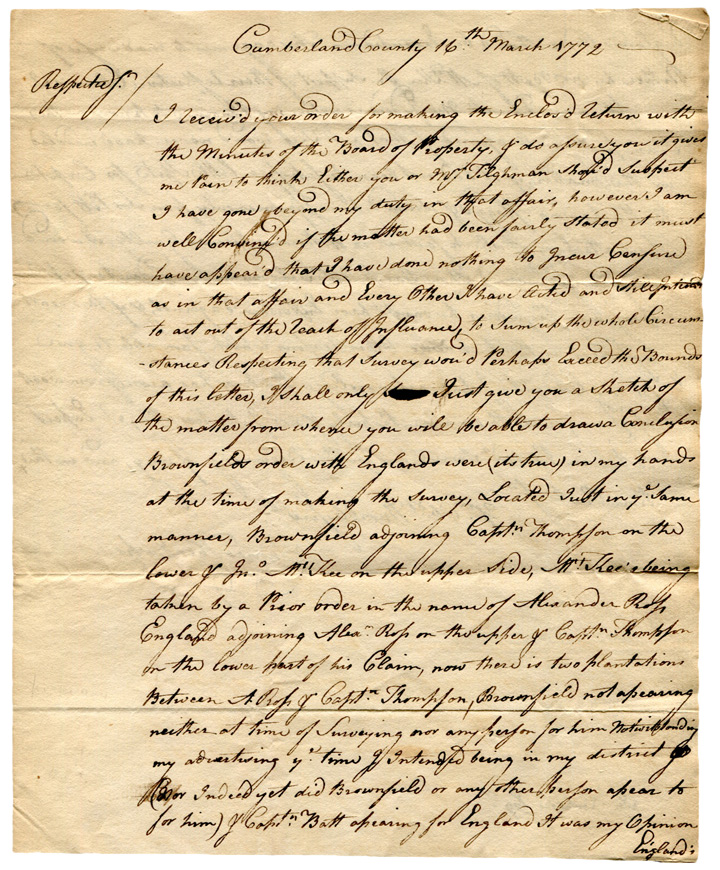
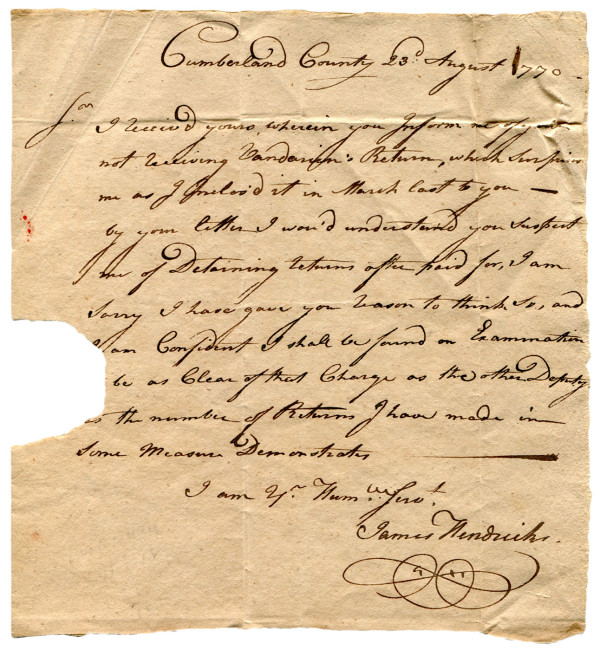
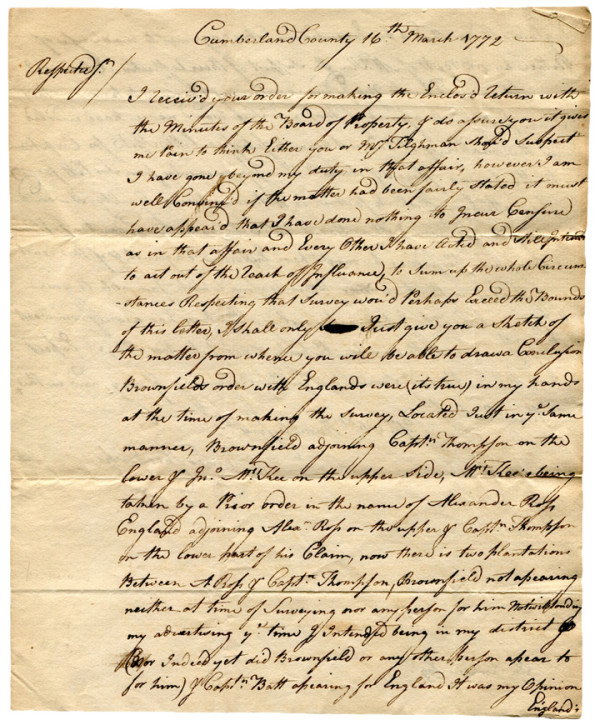
Tobias Hendricks’ letter to “Mr. Lukens” reads in part: “I have sent your Coat and gloves with the Sensang J. Shakeroot, in the pokets [sic] by the Bearer James Hunter, which I think he will deliver safe…” The letters from James Hendricks offer his response to accusations of impropriety by his boss, John Lukens, , and later Secretary of the Proprietary Land Office, John Tilghman. Hendrick’s urgency is heightened with Hendricks archive lettereach letter as the investigation into his dealings intensified. Cumberland County, 23 August 1770, in full: “Sir, I received yours, wherein you Inform me of your not receiving Vandarin’s Return, which Surprises me as I Enclos’d it in March last to you – by your letter I would understand you Suspect me of Detaining returns after paid for, I am Sorry I have Gave you Reason to think So, and I am Confident I shall be fun on Examination to be as clear of that Charge as the other Deputy as the number of Returns I have made in some Measure Demonstrates. I am Yr. Hum. Servt., James Hendricks.” Cumberland County, 4 October 1770, in full: “Sir, I Inclos’d [sic] two returns to you a few days ago by One Paul Peirce but he being in the land Jobbing way I am Suspicious he will not deliver them he has Several more in my hands but as he has not Comply’d with the Custom of Paying for the Surveys I have detain’d, which has so exasperated him that he has threatened to lodge a Complaint with you against me, but as I can easily Clear up any thin he Can say I have only Just hinted to you, for fear the fellow might have forged some Idle Story to my Prejudice I am now setting off for my District. I am yr. most Obligd Humble Servt., James Hendricks.” Cumberland County, 30th January 1771, in full: “Sir, Having this opportunity, I thought proper to request you wou’d let me know if it wou’d be attended with any bad Consequences my not making the few Returns are in my hands untill [sic] the first of March next as I am oblig’d to be in Philada. at the time, and if Possible I wou’d make one Journey Answer both purposes, Indeed the fare things bear in our back Country, I am Suspicious the People will not be Anxious in Patenting their lands, if their is a Necessity of Returning I will Come down before that time which you’ll be kind enough to let me know. I am yr. Oblig’d Humble Servt., James Hendricks.” Cumberland County, 16 March 1772, in full: “Respected Sir, I received your order for making the Enclos’d Return with the Minutes of the Board of Property, & do assure you it gives me Pain to think Either you or Mr. Tilghman should Suspect I have gone beyond my duty, in that affair, however I am well Convinc’d if the matter had been fairly stated it must have appear’d that I have done nothing to Incur Censure as in that affair and Every Other I have Acted and still Intend to act out of the Reach of Influence, to Sum up the whole Circumstances Respecting that Survey wou’d Perhaps Exceed the Bounds of this letter, I shall only Just give you a Sketch of the matter from whence you will be able to draw a Conclusion. Brownfields order with Englands were (its true) in my hands at the time of the making the Survey, Located Just in ye same manner, Brownfield adjoining Camptn. Thompson on the lower & Jno. McKee on the upper side, McKee’s being taken by a Prior order in the name of Alexandar Ross England adjoining Alexn. Ross on the upper & Captn. Thompson, Brownfield not appearing neither at time of Surveying nor any person for him notwithstanding my advertising ye time & Intended being in my district (nor Indeed yet did Brownfield or any other person appear to for him) & Captn. Batt apearing [sic] for England It was my Opinion England’s Order shou’d be Executed – The arguments made use of Either by Mr. Batt or McKee In support of their respective Claim I am not acquainted with nor Indeed is not in my Province to know – this I am pretty well assured of, that McKee wou’d never have meddled in the matter if it had not been to satisfy a little spite for Captn. Batt’s having flogg’d and drum’d him Ignomenouly [sic] from Fort Pitt for Horse Stealing of which fact it is Notorious he was Guilty, I wou’d be glad you wou’d show this to Mr. Tilghman in order to wipe away any Prejudices he might have Entertain’d against, & if this is not Sufficient with such Other reasons which I am able to give for my Conduct, I shall acknowledge the Error has arose from ant of not seeing into the matter Properly & not Intentionally, I Expect to Be in Philada. some time in the Beginning of Mat, an in the mean time Rests. Sr., Yr. Obdt, humble Servt., James Hendricks.” No place, no date, in part: “Respected Sir, I receiv’d yours of 29 [missing content] later than I ought Occasion’d by the Post being detain’d by the Ice on our River) wherein you desire me to furnish you with those Papers Relative to my office as Deputy Surveyor & your intention of Calling on my Bail for that purpose shou’d I not do it soon – as I have ever gave as little as possible to my friends I shou’d now be wanting in my duty shou’d I now do it – I shou’d have been glad you had been more particular in mentioning what is necessary to be done on this Occasion and what Papers I am to Send shall be much oblig’d to you to write me by Post what I am to do, and in the meantime I intend sending by the first Safe Opportunity, all orders unexecuted and a list of those executed & return’d shou’d these not be sufficient I’ll beg you’ll impute it not to want of respect, Neglect or any other Cause than that of not knowing what is Necessary to furnish you with, what more may be Necessary for me to do I shall be ready to Comply with Imediately [sic] on my getting an answer to this which I request you will send, I live in this Town where there is a Post Office kept so that I shall be in no danger of not getting it. If you remember on my last seeing you I told you I did not intend on Visiting my district again untill [sic] things there were put on Better footing when I have been insulted on many occasions and indeed some times in real danger – if my leaving the prvince without giving up my District has [missing content] intentionally as I had Conceiv’d [missing content] of Consequence Cou’d be done in it [missing content] him, and any thing that might Come in the way of expence [sic] M. Alexander McClean wou’d have Call’d at your office for as a person who was near the district and one that I might Confide in which was likewise my reason for not Calling on you on my being in Philadelphia – if no Opportunity offers before next month I then have a Safe one to send you my Papers so that I Conceive there will be no Damage to the Propriatary affairs arise before then & I hope no Necessity of Calling on my Bail – as I said before I shall expect an Answer to this from the many instances of friendship that you have favour’d me with I flatter myself I shant be disappointed – I conclude with my Compts. to your sons Jesse & Jno. & my best wishes for your welfare, Yr. Oblig’d Hble Srvt., James Hendricks. Be Please likewise to let me know if It will not still be in my power to make such Returns that is executed & and not paid for. J.H.
The undated letter is separated at a vertical crease with partial separation to the other and marginal losses (as shown) affecting content. All other letters are intact, with  expected toning to paper, usual seams, some with slight separation at seams, most contain remnants of original red wax seal, overall very good condition. Together, nine pieces. 

(EXA 3422) $350
The First Chaplain of the House of Representatives writes to Jedediah Morse on Indian affairs

exa4051_01
William LINN (1752 – 1808) Presbyterian clergyman; first Chaplain of the United States House of Representatives; second President of Queen’s College (Rutgers) from 1791 to 1795.

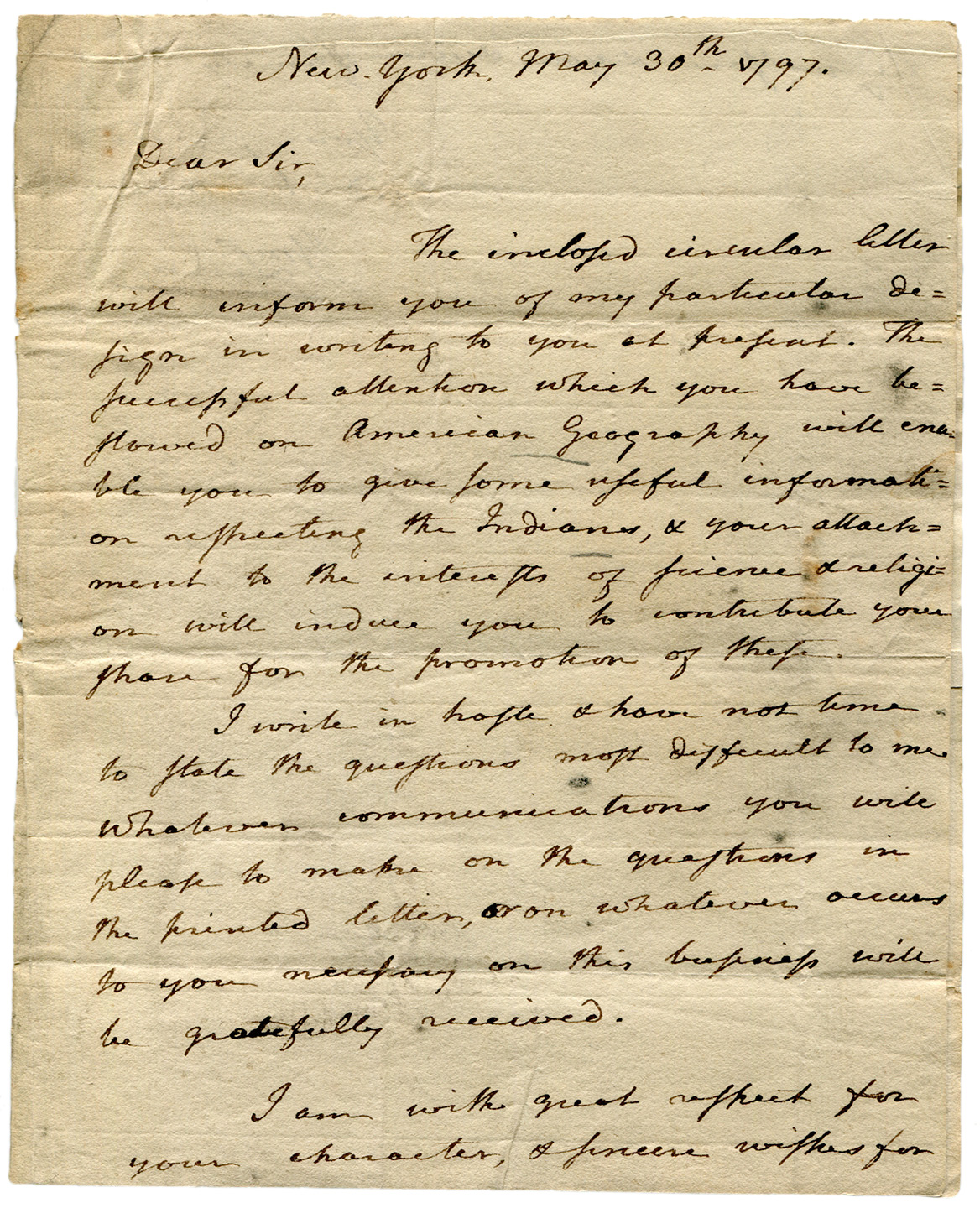
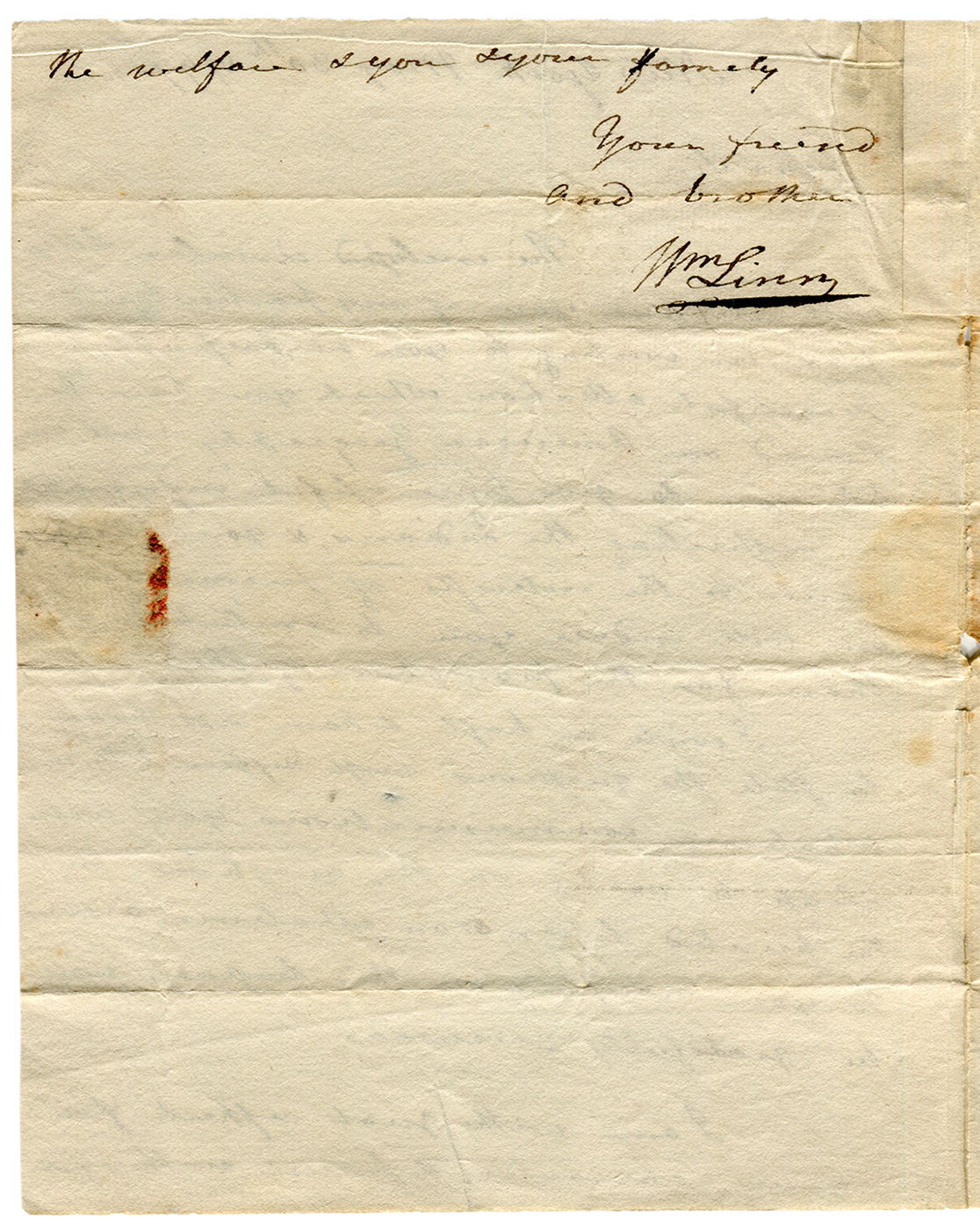
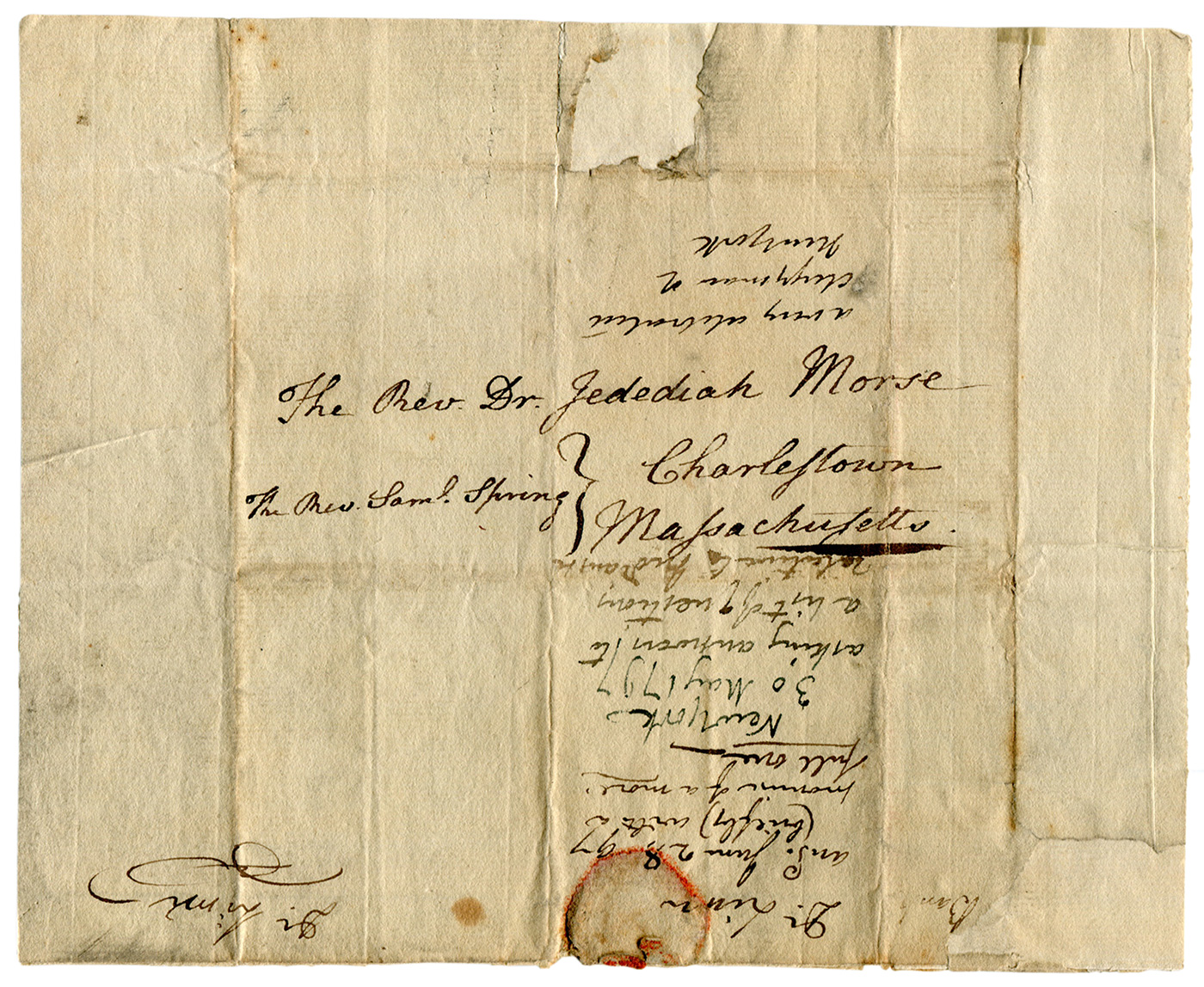
Autograph Letter Signed, “Wm Linn“, 2pp., 8 x 6 1/4 in. (200 x 160 mm.), New York, 30 May 1797, with integral transmittal leaf addressed in his hand to “The Rev. Dr. Jedediah [sic] Morse Charleston Massachusetts” (and carried by “The Rev Saml. Spring“). Docketed by Jedediah MORSE (1761-1826) below: “Dr Linn and. June 28 97 (briefly) with a promise of a more full one … asking answers to a list of questions relative to Indians &c” and identifying his correspondent above the address as “a very celebrated clergyman of New York“.

exa4051_02
Linn opened introducing an enclosure of a questionnaire concerning American Indians,”The successful attention which you have Bestowed on American Geography will enable you to gain some useful information respecting the Indians, & Your attachment to the interests of science & religion will induce you to contribute your Share for the promotion of these. I write in haste and have not the time to state the questions most difficult to me. Whatever communications you will please to make on the questions in the printed letter, or on whatever occurs to you necessary on this business will be greatly received…

Jedediah Morse was a noted American minister, accomplished geographer, and father of Samuel F. B. Morse, the telegraphy pioneer. The author of numerous textbooks beginning in 1784, Morse enjoyed national recognition as the “father of American geography.” Morse was very interested in American Indian affairs, and in 1820 the Secretary of War commissioned him to study tribes on the frontier and to recommend a means of “improving” their condition.

Samuel Spring (1746-1819), the bearer of the letter, was a conservative Massachusetts Congregationalist minister and chaplain during the Revolutionary War who served during the Siege of Boston and accompanied Arnold to Quebec.


exa4051_03
Marginal losses at seal tear and corner of address leaf filled in, minor tears at margins, one of which is reinforced with glassine, usual folds, partly split at spine, else very good.

exa4051_04
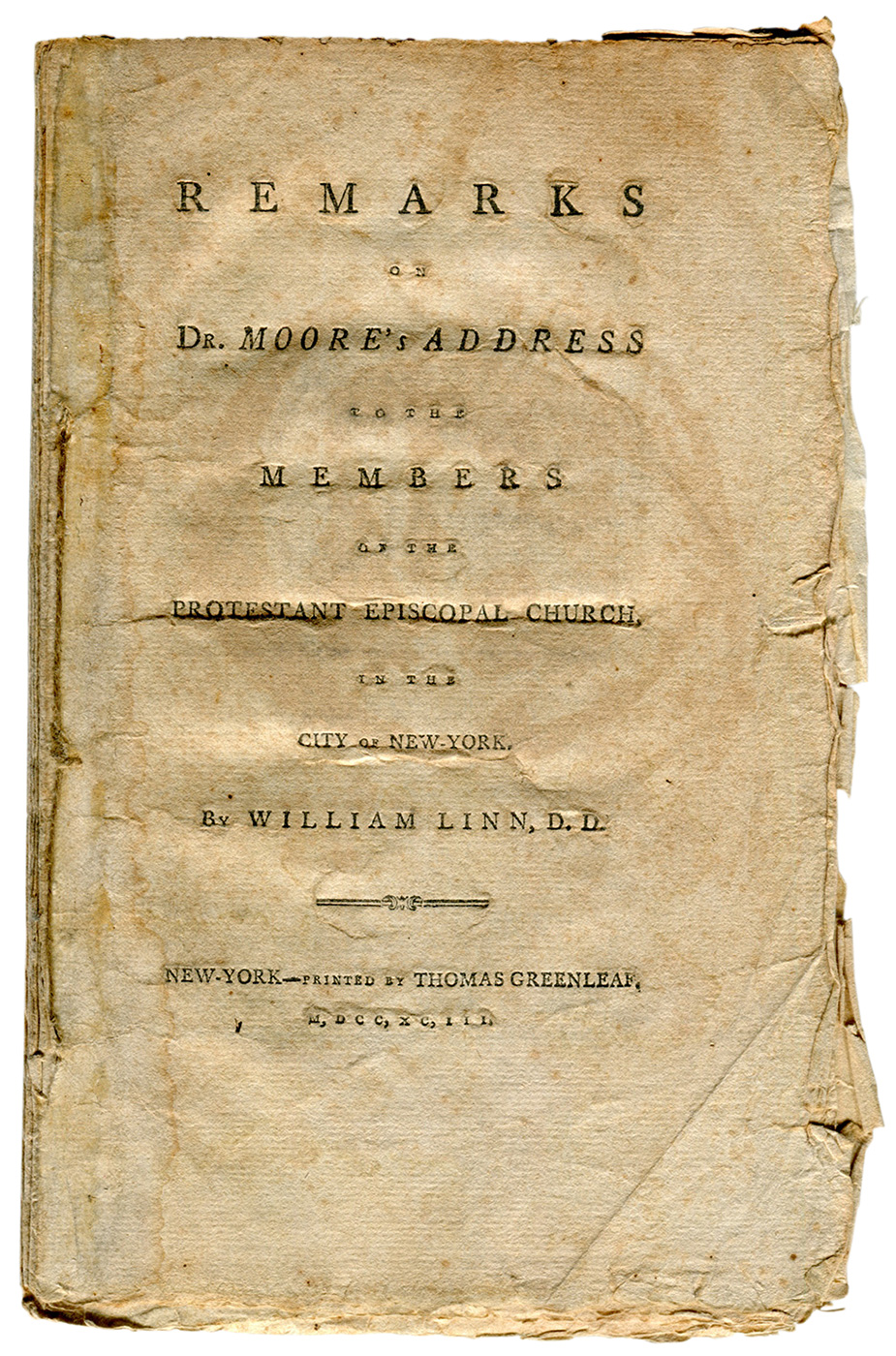
Together with William LINN, REMARKS on Dr. MOORE’s ADDRESS to the MEMBERS of the PROTESTANT EPISCOPAL CHURCH, in the CITY of New-York. (New York: Printed by Thomas Greenleaf, 1793) 46 pp. 8vo., string bound. Evans 25722.

Marginal tears, light dampstains, else very good.

(EXA 4051) $750

Federalist Samuel West Jr. writes letter complaining of electoral shenanigans by 
Democratic-Republicans in Columbia, CT

Electorial Shenanigans Letter
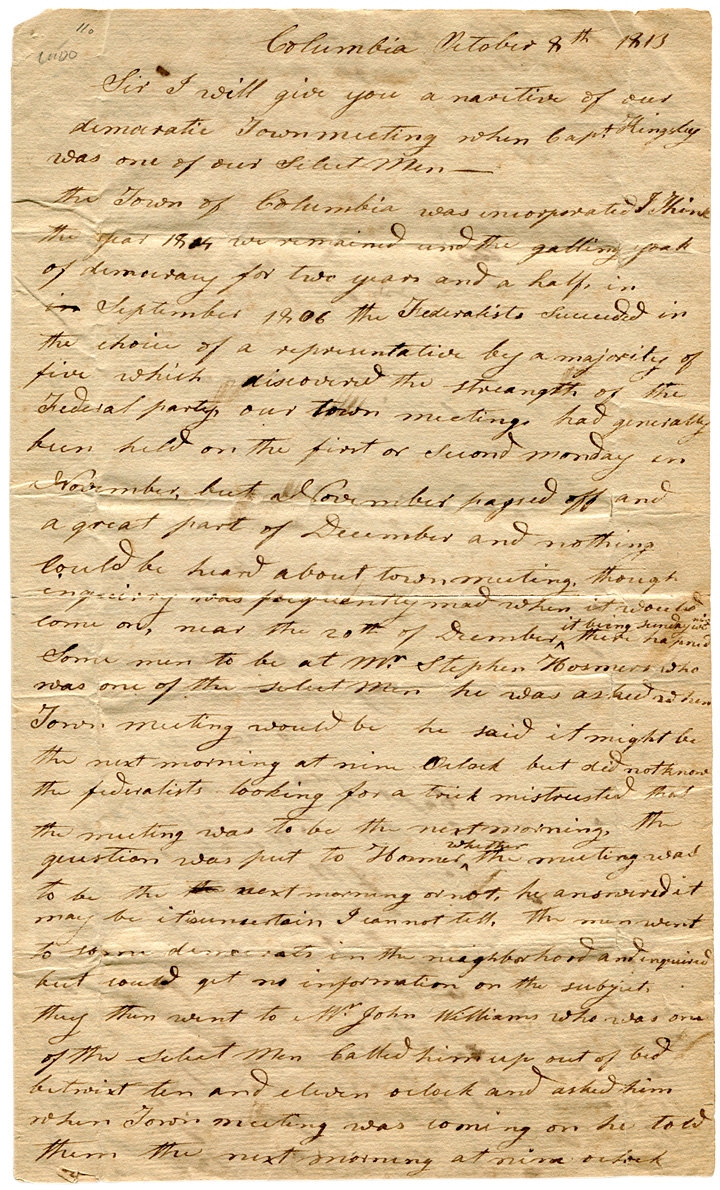
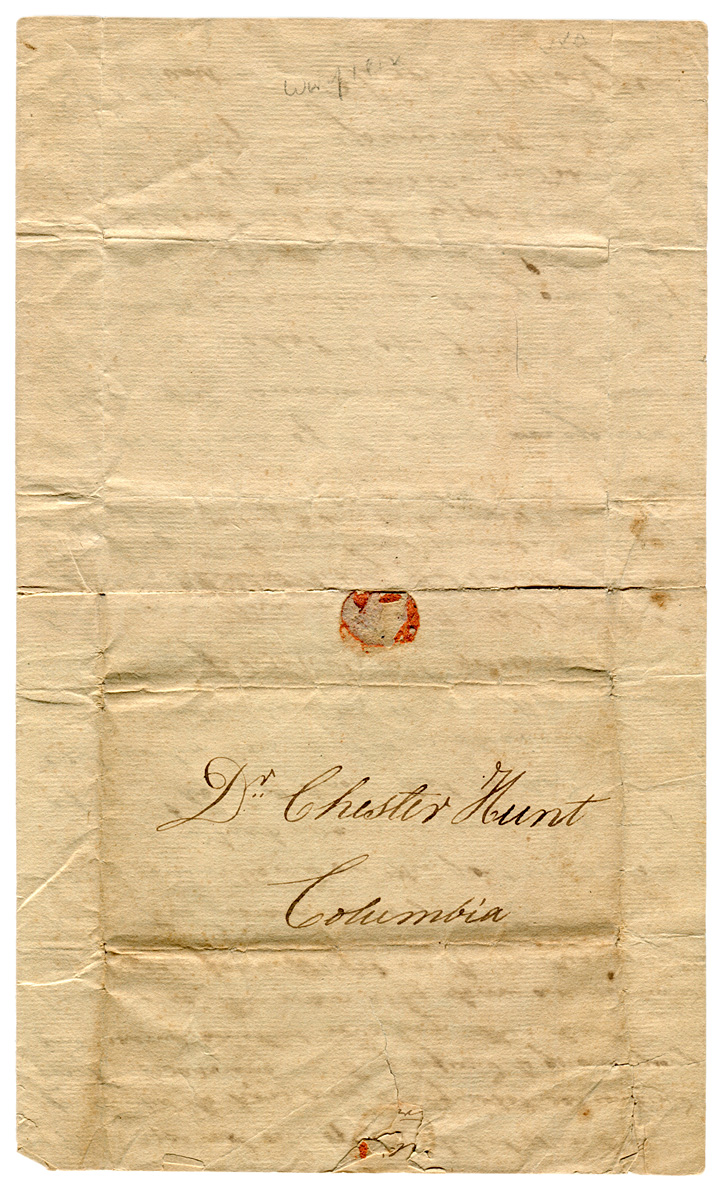
(First Party System & The War of 1812) Extremely fine content A.L.S. “Samuel West Jr.”, 3pp. + integral address leaf, 319 x 190 mm., Columbia, [Conn.] 8 Oct. 1813 to Dr. Chester Hunt complaining of one Captain Kingsley, a Democrat, who the author believed had tricked the Federalist residents of the town into missing a town meeting. A terrific story, worthy of quoting nearly in its entirety: “… Sir I will give you a nar[r]itive of our democratic Town meeting when Capt. Kingsly was one of our Select Men—. The Town of Columbia was incorporated I think the year 1804 we remained and the galling yoak of democracy for two years and a half, in September 1806 the Federalists Succeeded in the choice of a representative by a majority of five which discovered the streangth [sic] of the Federal party[.] our town meeting had generally been held on the first or second Monday in November, but November passed off and a great part of December and nothing could be heard about town meeting, though inquiry was frequently made when it would come on, near the 20th of December it being Sunday morning [?] there hap[p]ened Some men to be at Mr. Stephen Hosmers who was one of the select Men he was asked when Town meeting would be he said it might be the next morning at nine Oclock the federalist railed. men were sent in every direction through the Town to notify the federalists they were all notified before day it was expected the Select Men after finding that the federalists had got knowledge of the meeting and was ready and willing to vote them out of office that they would pleas’d that their warning had blown off from the post and they had got no Copy and would not do any business, to prevent that a man went to Cap… Kinglsey (who was one of the select men) early in the morning to find Electorial Shenanigans letter (2) whether they had got a copy or not. he says to Capt. Kingsley I want a little brandy to carry to Norwich with me to day I am going the road Capt Kingsley not knowing what had taken place during the night say you will not go to Norwich to day it is Town meeting to day, Town meeting to day says the man I was at meeting yesterday. I saw no warning on the post, Capt. Kinglsy says likely has likely blown off but that will make no difference we have got a Copy of the warning. the man went home and attended meeting the Select Men finding the federalists all on the ground and able to vote them down came forward and said that they would do no business. the warning was lost and they had got no copy, the man who had seen Capt. Kingsly came forward and said that Capt. Kinglsey had told him that morning that they had got a copy, Capt Kinglsy replied he did suppose that they had a copy amongst them but it proved they had on them was not one of [the?] Select Men th[a]t pretended to know any thing what was contained in the warning. They refused to go on business and warned another meeting. this Capt. Kingsly is the man who some are recommending highly for a Major in the 12 Regiment he is the man who just put the warning above mentioned on the post in a stormy evening which was never seen nor heard of after[.] I do not know that he had any evil intention but it is strong that the democrats should all have the information and the federalist all ignorant of it until late in the night the last preceding the meeting, I think it likely that had not the federalists got information of the meeting the democrats would have met and would have had a copy of the warning to done[?] the business of the meeting. If ou should feal [sic] willing to copy the substance of the above in our own Stik [?] and communicate it to Phinahas Talbot Esqr for him to communicate to his excellency the Governor if he should think proper I should be glad, I should like to have the upper house know something of the transaction without doing it my self – yours with esteem Samuel West, Jr…”

A wonderful description of the bitter conflict between the declining Federalist party and the Democratic-Republicans in New England during the War of 1812.

Dr. Hunt, mentioned in this letter, had recently built a house (1800) in neighboring Windham and the building is still in a state of preservation and on the National Register since 1970.

Clean fold separations to front leaf, partial on verso, minor marginal chips and tears affecting several words of text, usual folds, small loss from seal tear, else very good condition overall.

(EXA 2438) $450