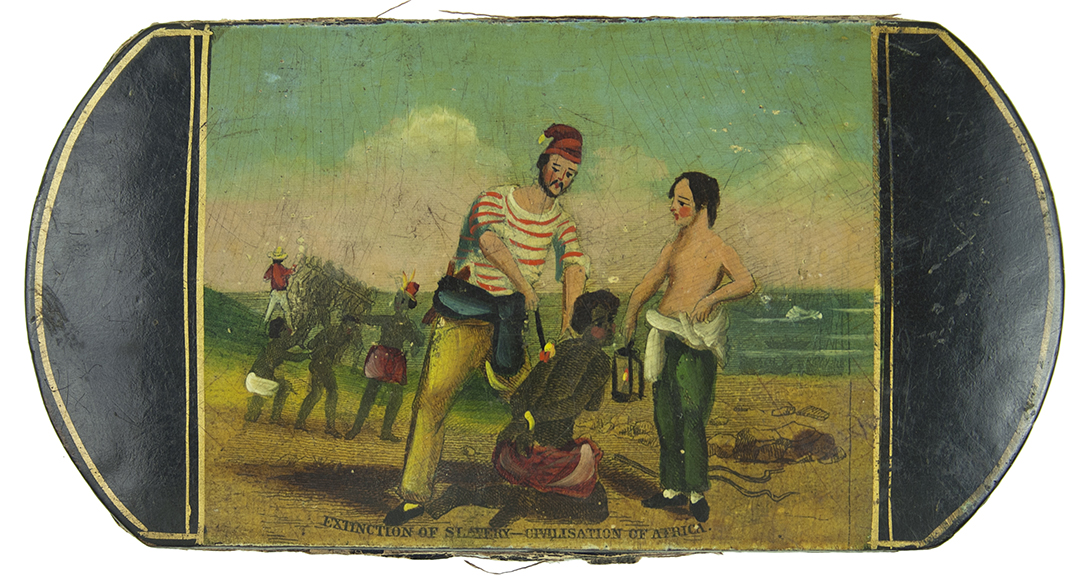
 (Abolition) Important and extremely rare papier-mâché cigar case, 70 x 135 mm. (2 3/4 x 5 3/8 in.), c. 1840-1850 with gilt-painted borders. One side features an overpainted engraving depicting a sailor branding a female slave on her back with the slogan beneath: “EXTINCTION OF SLAVERY—CIVILISATION OF AFRICA.” The image is loosely adapted from François-Auguste Biard’s c. 1840 painting, Scenes on the Coast of Africa. Biard (1799-1882), a French artist, was a staunch abolitionist and outspoken opponent of the slave trade. When the painting was exhibited at the Royal Academy in London, author William Makepeace Thackeray declared it: “the best, most striking, most pathetic lecture against the trade that ever was delivered.” He also called upon “the friends of the negro forthwith buy this canvass, and cause a plate to be taken from it. The picture is as fine as Hogarth.”*
The opposite side of the case (which would have been considered the front) bears a three-quarter length portrait of a woman, dressed in extremely fine regalia—most likely a portrait of a young Queen Victoria. Her consort, Albert, served as president of the Society for the Extinction of the Slave Trade, and for the Civilization of Africa which was established in June 1839, soon before Biard’s painting was exhibited at the Royal Academy.
Papier-mâché cigar cases were manufactured primarily in Europe from the 1820s to the 1850s. Constructed of two lacquered papier-mâché panels connected with an accordion-like leather lining, they were lightweight, but still strong enough to protect a small cache of cigars. These cases were often decorated with portraits of important personages or with historic or allegorical scenes.
Extremely rare. This is the only example of a cigar case decorated with this motif we have ever encountered. We have seen only one other example of the engraving: an unpainted example adorning a mid-nineteenth century papier-mâché snuff box.
Some crazing and scratching to surfaces, side bearing Victoria’s portrait cracked with minor loss as shown. Panels nearly separated from and original connecting leather is lost. Despite the wear, the artwork remains extremely bright and vivid.
(EXA 5092) SOLD.
__________
* Fraser’s Magazine (1840), Vol. 21, 731-2. Thackeray also implored Thomas Babington Macualy to purchase the work: “Macualy, who has a family interest in the matter, and does not know how to spend all the money he brought home from India; let the right honorable gentleman look to it. Down with your dust, right honourable sir; give Monsieur Biard a couple of thousand for his picture of the negroes, and it will be the best black act you ever did in your life; and don’t go for to be angry at the suggestion…” The painting was given to Sir Thomas Fowell Buxton, a noted abolitionist and now resides at Wilberforce House in Hull.