New Selections

The United States Navy begins preparations for the Second Barbary War by authorizing the French born block maker, John Rose, to oversee the construction of a new block mill to replace the one destroyed by the British burned Washington the previous summer.
Sec of Navy BW Crowninshield ALS 1815(Second Barbary War) Benjamin Williams CROWNINSHIELD (1772-1851) Hailing from the Boston Brahmin Crowninshield family of shipping merchants, Crowninshield served as United States Secretary of the Navy from 1815 to 1818, spanning the administrations of Presidents James Madison and James Monroe. He oversaw naval strategy during the Second Barbary War of 1815, and otherwise transitioned the Navy to a peace time force following the War of 1812. He was elected to Congress in 1823, serving four consecutive terms as a U.S. Representative from Massachusetts, concluding in 1831.

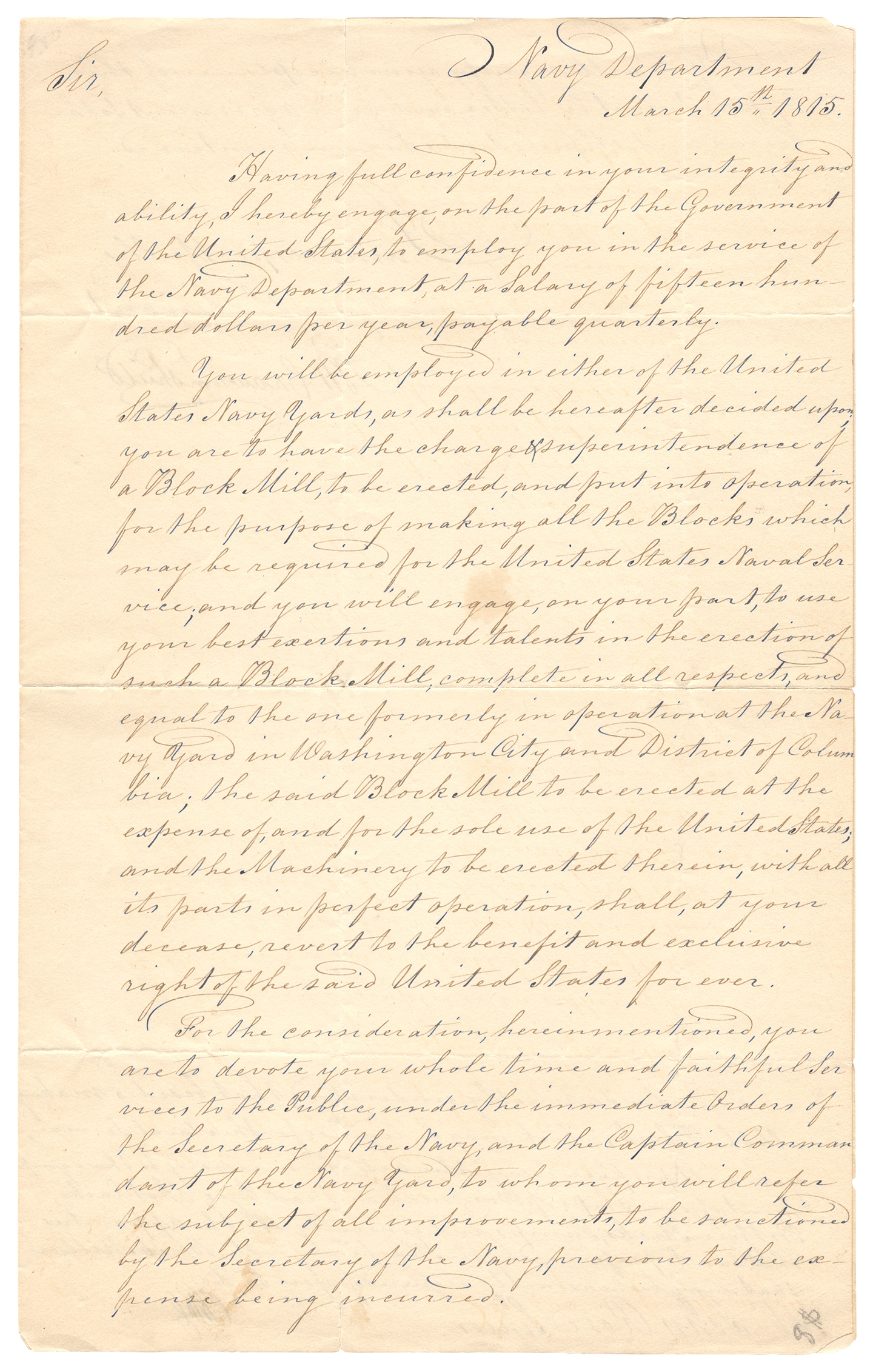
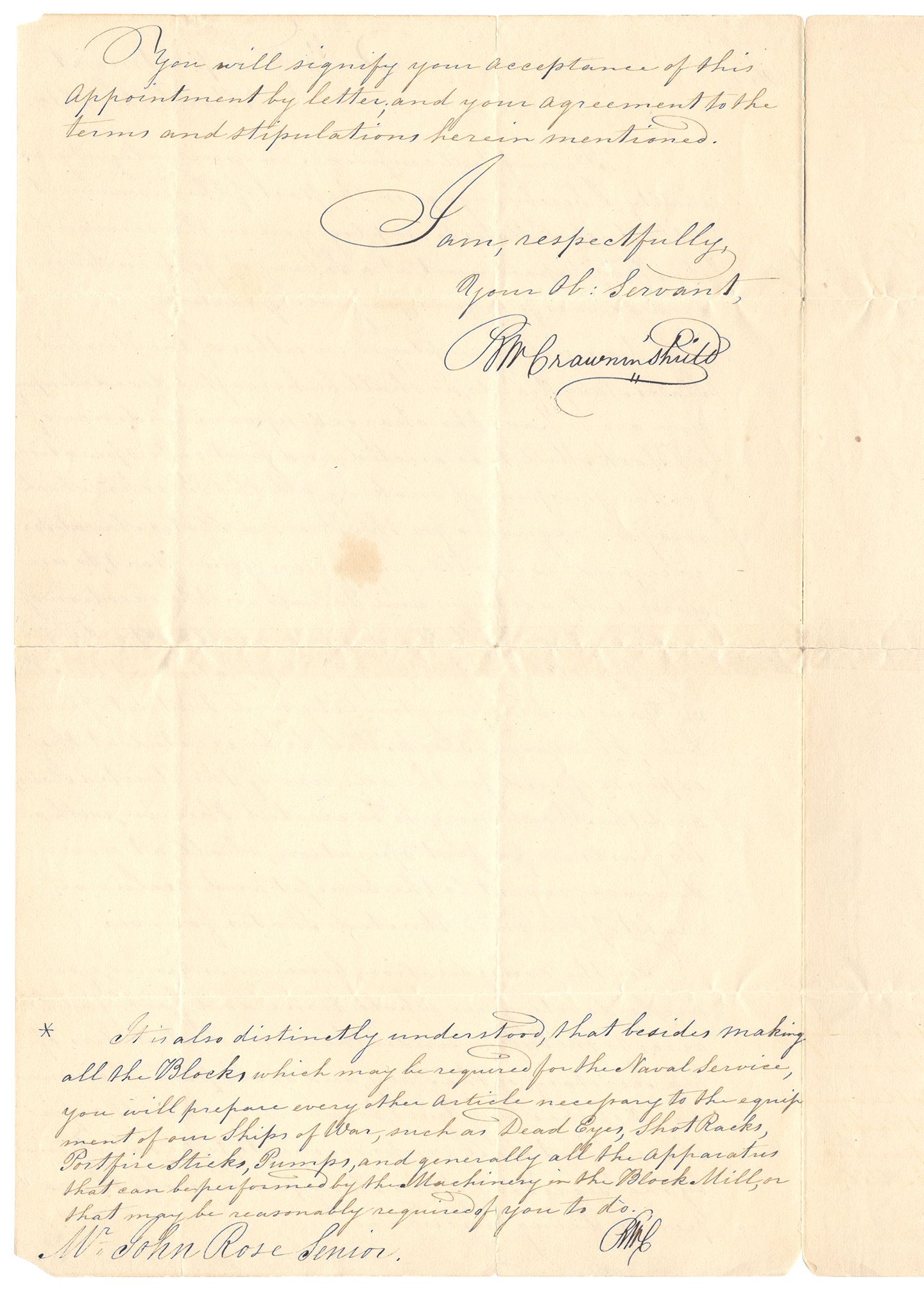
Autograph Letter Signed “BW Crowninshield” as Secretary of the Navy and initialed “BWC” under postscript, 2pp., 317 x 203 mm. (12 1/2 x 8 in.), 15 March 1815, Navy Department [Washington], to Mr. John Rose, Sr., employing him as a superintendent of a Block Mill for the United States Navy.

Crowninshield writes, in large part: “Having full confidence in your integrity and ability, I hereby engage, on the part of the Government of the United States, to employ you in the service of the Navy Department, at a Salary of fifteen hundred dollars per year, payable quarterly. You will be employed in either of the United States Navy Yards, as shall be hereafter decided upon you are to have the charge of superintendence of a Block Mill, to be erected, and put into operation, for the purpose of making all the Blocks which may be required for the United States Naval Service; and you will engage, on your part, to use your best exertions and talents in the erection of such a Block Mill, complete in all respects, and equal to the one formerly in operation at the Navy Yard at Washington City and District of Columbia; the said Block Mill to be erected at the expense of, and for the sole use of the United States; and the Machinery to be erected therein, with all its parts in perfect operation, shall, at your decease, revert to the benefit and exclusive right of the said United States for ever. For the consideration, hereinmentioned, you are to devote your whole time and faithful Services to the Public, under the immediate Orders of the Secretary of the Navy Yard, to whom you will refer the subject of all improvements, to be sanctioned by the Secretary of the Navy, previous to the expense being incurred…” Added in a postscript: “It is also distinctly understood, that besides making all the Blocks which may be required for the Naval Service, you will prepare every other Article necessary to the equipment of our Ships of War, such as Dead Eyes, Shot Racks, Portfire Sticks, Pumps, and generally all the Apparatus that can be performed by the Machinery in the Block Mill, or that may be reasonably required of you to do.

In 1812, Hajji Ali, the Dey of Algiers declared the annual tribute offered by the United States under the terms of a 1795 treaty as insufficient and declared war. The United States, in the midst of war with Great Britain, was unable to respond. The singing of the Treaty of Ghent at the close of 1814 however allowed the country to focus its attention on North Africa. On March 3, 1815, Congress authorized the use of force against Algiers, and the Navy sent a full squadron under the command of Stephen Decatur to the Mediterranean.
Sec of Navy BW Crowninshield ALS 1815Needless to say, John Rose (1749 – 1828) had his work cut out for him, as the Navy was still rebuilding after a costly but successful sea war against the Royal Navy. Born in France as Louis Rose in L’Orient, he was a seasoned block maker for Louis XVI’s navy at Brest and Le Harvre by the time he arrived in the United States in 1805—leaving his native country due to his dislike of Napoleon Bonaparte. Constructing a block mill in Philadelphia, he came to the attention of Benjamin Henry Latrobe who secured Rose services to run a block mill at the Washington Navy Yard. The industrious block maker secured several patents for improvements in block making, and in conjunction with Latrobe, erected a a powered block mill, which was destroyed by the Navy Yard officials before the British overran and burned Washington in August 1814. Although the Navy wanted to construct a new block mill, and in the present document, retained Rose’s services in supervising its erection, Congress was unable to find sufficient funds to undertake it. Still a valuable, skilled craftsman, Rose remained on the government payroll as a senior block maker and machinist. He became a naturalized citizen in 1817—having already anglicizing his first name to John. He remained working for the Navy until his death in January 1828.1

Rose’s letter to to the Board of Naval Commissioners, submitted in response to legislation that all employees of the federal government had to be U.S. Citizens, in which he declares his loyalty to the United States, is worth quoting at length: “… I quitted the French government in 1805 with the intention to Conform to every Law and Regulation that might be required of me, and am Resolved at an Advanced age to devote all my inventions and talents for the Utility of the Country which I have Adopted. Conformable to the Law for the Encouragement of Aliens, in Feb. 1814 I took out a patent for the Block Mill Machines; with the intention of giving the invention, to the sole use of the U.S. Navy. At the same time the greatest part of the Machines were Completed, and in full Activity in the Navy Yard ; My first Agreement I fulfilled with that fidelity and integrity , becoming an honest man which I think you can testify. Since that period, on the 15th of March 1815 I made a fresh agreement with the Hon Secretary of the Navy to be retained in the Service, and to build another Block Mill, and likewise for that purpose to hold myself in readiness to proceed to such Navy Yard…”
Sec of Navy BW Crowninshield ALS 1815A fine piece of Navy history documenting the numerous ties between France and the United States, despite frayed relations over the previous two decades.

Usual folds with some separation at folds and seam, tape repair to horizontal center seam, edge wear, light soiling and toning, overall very good to fine condition.

(EXA 6021) $1,200
_________
1 John G. Sharp, “John Rose, Letter April 22, 1817” Washington D.C. Genealogy Trails (http://genealogytrails.com/washdc/WNY/wnyroseletter1817.html).
2  John Rose to Thomas Tingey, 22 April, 1817, NARA, as quoted in Sharp.
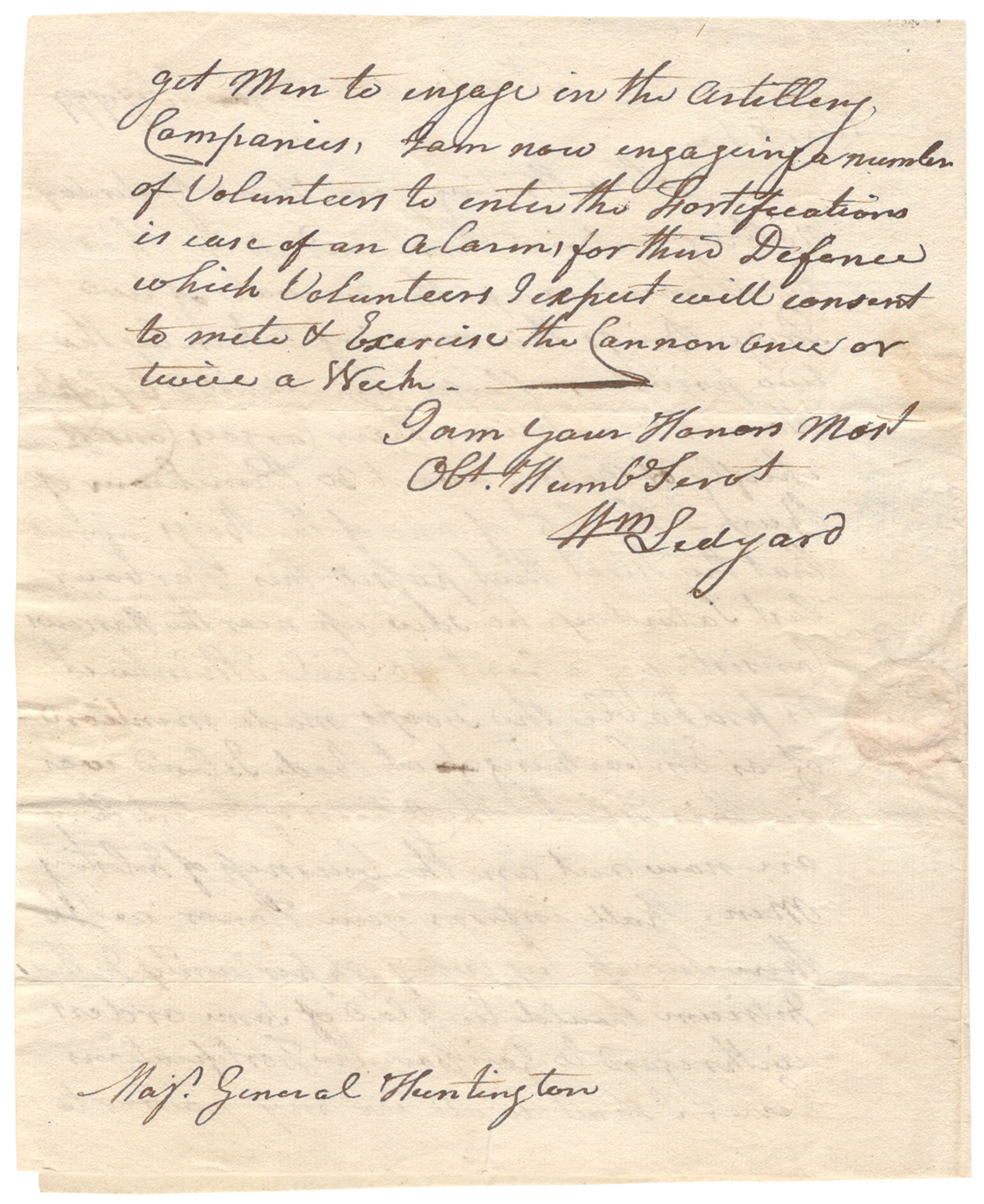
A fine military-content letter by the Hero of Fort Griswold, William Ledyard, reporting on the exploits of privateers, the gradual British withdrawal from Newport, and most importantly, recruiting artillerymen to staff the fort he would die defending from the traitor Benedict Arnold

William Ledyard ALS 1779 Fort Griswold William Ledyard ALS 1779 Fort Griswold

William LEDYARD (1738-1781) Connecticut militia officer who commanded Fort Griswold guarding New London, Connecticut. He was tragically killed on 6 September 1781 during Benedict Arnold’s Raid on New London. Although Ledyard ordered his men to lay down their arms when the enemy captured Fort Griswold, the British officer in command killed him with the sword he had offered in surrender—precipitating a massacre of the fort’s eighty defenders.

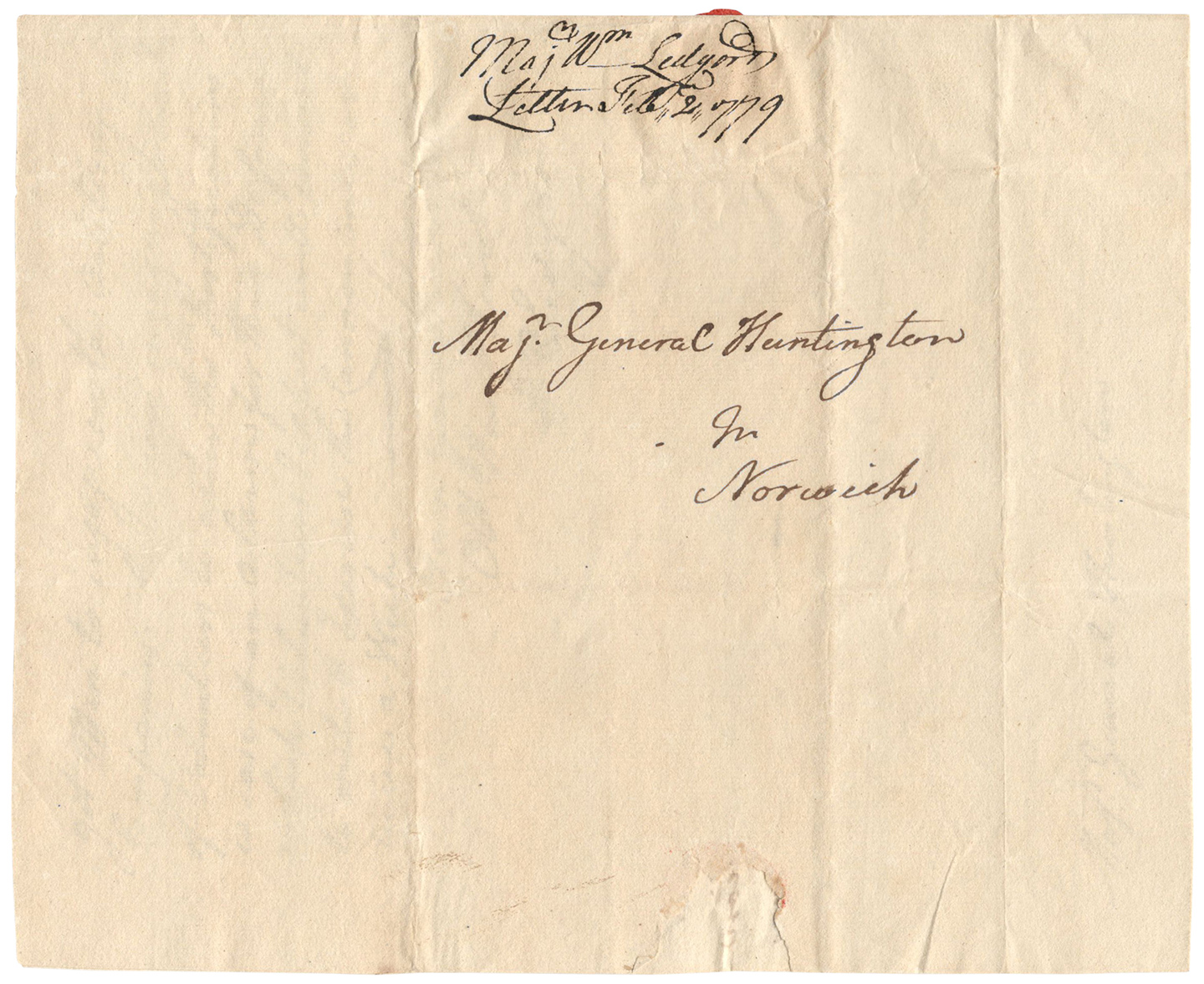
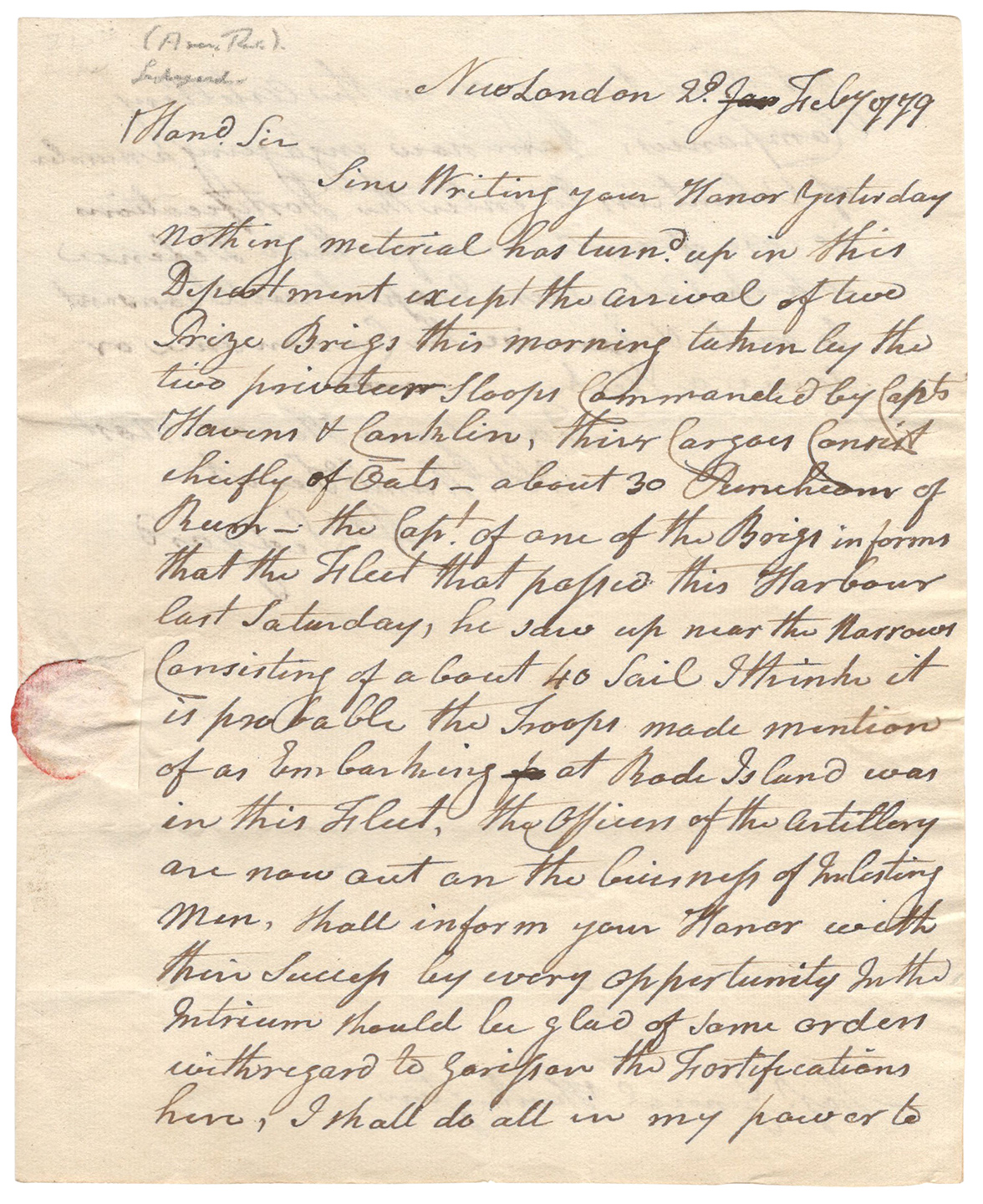
Fine content War date Autograph Letter Signed, “Wm. Led yard” as Lieutenant Colonel, 2pp., 195 x 155 mm. (7 5/8 x 6 1/4 in.), New London [Connecticut], 2 February 1779, addressed in his hand on the integral transmittal leaf to “Maj General [Jabez] Huntingdon In Norwich“. Docketed on verso by Jabez HUNTINGTON (1719-1786). An informative letter, updating his commander on naval affairs, and British moves around Newport, as well as the critical need to recruit artillerymen to reinforce Fort Griswold.

Ledyard opens his letter reporting on the continued success of American privateers operating against British shipping on Long Island Sound: “Since Writing your Honor yesterday nothing material has turn[e]d up in this Department except the arrival of two Prize Brigs this morning taken by the two privateers Sloops Commanded by Capts Havens & Conklin[g], their Cargoes Consist chiefly of Oats — about 30 Puncheons of Rum –” Nearly 3000 imperial gallons of rum and 12,000 bushels of oats bound for British troops stationed in eastern Long Island was the day’s haul for Connecticut privateer sloops Beaver, commanded by Captain Havens and the sloop Eagle, a six gun vessel, led by Captain E. Conkling. The ships they had seized were part of a much larger relief fleet that had arrived in New York from Cork several weeks before, providing much-need supplies to their headquarters in New York and garrisons in Newport and other outposts. The seizure proved to be the end of a productive week for the two Connecticut privateers who had the previous week had taken the Ranger a 12-gun British privateer that had been terrorizing the Long Island Sound for some time. The Connecticut captains had surprised the Ranger at Sag Harbor, and after delivering the brig to New London, again took to the sound where they were forced to take shelter behind Gardiner’s Island after they spotted a large fleet of 20 sail under escort, entering the Sound bound for New York. The next morning they arrived again at Sag Harbor where they found seven of the ships they saw the previous day anchored at Sag Harbor. The However the Connecticut brig, Middletown, which had accompanied the Beaver and Eagle, became stuck on a shoal and became an easy target for the British armed brig protecting the other vessels. After about 4 or 5 hours, the crew of the Middletown was forced to abandon ship. The other two Connecticut vessels took on them on and left the area only to happen upon the two aforementioned British brigs hauling oats and rum—a worthy consolation prize.1

Ledyard also chronicles the beginning of the end of the British occupation of Newport—a post that had been under severe stress for want of supplies following the American attempt wrest control of the town the previous year at the Battle of Rhode Island. He reports the observation of “… the Capt. of one of the Brigs in forms that the Fleet that passed this Harbour last Saturday, he saw up near the Narrows Consisting of about 40 Sail I think it probable the Troops made mention of as Embarking at R[h]ode Island was in this Fleet…” A contemporary newspaper account corroborates Ledyard’s suspicions: a man who crossed the British lines from New York around 2 February reported that an entire brigade had arrived in the city from Newport—which would correspond to timing of Ledyard’s report2. Only a month before, a British expeditionary force of 3,500, drawn from Sir Henry Clinton’s main army in New York, had taken Savannah, Georgia. Now, seeking to take Charleston, South Carolina as well, he required reinforcements—enough so to make the continued occupation of Newport impracticable. By October 1779, they had abandoned the Rhode Island town for good. Ledyard’s report of the troop embarkation from Newport appears to be the beginning of Clinton’s drawing-down process.

While Ledyard surely welcomed prospect of the end of British control of Newport, that alone would not end British threats to the Connecticut coast. He moves on to the subject of reinforcing Fort Griswold, a critical defense for the town of New London, and the place he would meet his fate in 1781: “… the Officers of the Artillery are now out on the business of Inlisting Men, shall inform your Honor with their Success by every opportunity In the Interum should bee glad of some orders with regard to Garrison the Fortifications here, I shall do all in my power to get Men to engage in the Artillery Companies, I am now engaging a number of Volunteers to enter the Fortifications is case of an alarm, for their Defence which Volunteers I expect will consent to mete & Exercise the Cannon once or twice a week.—

Although Fort Griswold, situated on the eastern bank of the Thames River opposite New London, commanded a strong position, it’s secrets were betrayed by Benedict Arnold, who, in September 1781, led a raid on New London, burning much of the strategically-important Connecticut seaport. Arnold, having an intimate knowledge of the Fort’s layout and firing angles, managed steer the British fleet clear of its guns. A detachment of 600 redcoats, led by Lieutenant Colonel Eyre, landed on the eastern bank of the Thames and surrounded Fort Griswold, demanding its surrender. Ledyard refused, and the British attacked the Fort, defended by less than 160 poorly-trained militiamen. Despite the odds, Ledyard’s men defended it for at least an hour, mortally wounding Colonel Eyre during the action. Command devolved to Major Montgomery, who was, in turn, killed while mounting the parapet.

Next in command was Major Bromfield, a Loyalist, who managed to breach the entrance and led the troops into the fort’s interior. When he entered the fort, he demanded to know who had been in charge. Ledyard reportedly responded, “I did sir, but you do now,” and offered his sword in surrender. Bromfield took the sword and stabbed Ledyard to death with it, which set off a massacre of about 80 of the fort’s now defenseless defenders.

William Ledyard ALS 1779 Fort GriswoldBenedict Arnold, who was busy setting fire to New London across the river, was not present at the Fort Griswold massacre. That did not prevent him from attempting to cover up the crime in his report to Sir Henry Clinton in New York the following morning: “I have inclosed a return of the killed and wounded, by which your excellency will observe that our loss, though very considerable, is short of the enemy’s, who lost most of their officers, among whom was their commander, Col. Ledyard. Eighty-five men were found dead in Fort Griswold, and sixty wounded, most of them mortally. Their loss on the opposite side (New London) must have been considerable, but cannot be ascertained.”3

A superb military-content letter, by an important officer, tragically killed in action.

Expected mailing folds, minor loss to integral transmittal leaf from seal tear well clear of any text, else quite clean and bright and in very fine condition.

(EXA 6000) SOLD.
_________
1 Connecticut Journal, New Haven, 10 Feb. 1779, 3.
2 Exeter Journal (N.H.), 23 Feb. 1779, 3.
3 “Ledyard, William, “Appleton’s Cyclopædeia of American Biography, 1892 ed.

Important letter by abolitionist Gilbert Farquhar Mathieson on the possibility of emancipation in Jamaica and other British possessions in the Carribiean

… unless we resign the islands to the Negroes entirely, it is impossible to give them their liberty at any definite period, consistently with the safety of the whites, and the happiness of the whole Community…

Gilbert Farqhuar Mathieson ALS 1824 Jamaican slavery question(Abolition and Slavery) Gilbert Farquhar MATHISON (MATHIESON, c. 1803 – 1854) British author, traveler, abolitionist, served as private secretary to the Chancellor of the Exchequer, and as Secretary to the Mint beginning in 1828. Mathison is also the author of Narrative of a Visit to Brazil, Chile, Peru and the Sandwich Islands, during the years 1821 and 1822 (1825) describing his journey to Macao, China, where he worked for his cousin Walter Stevenson Davidson in the opium trade.

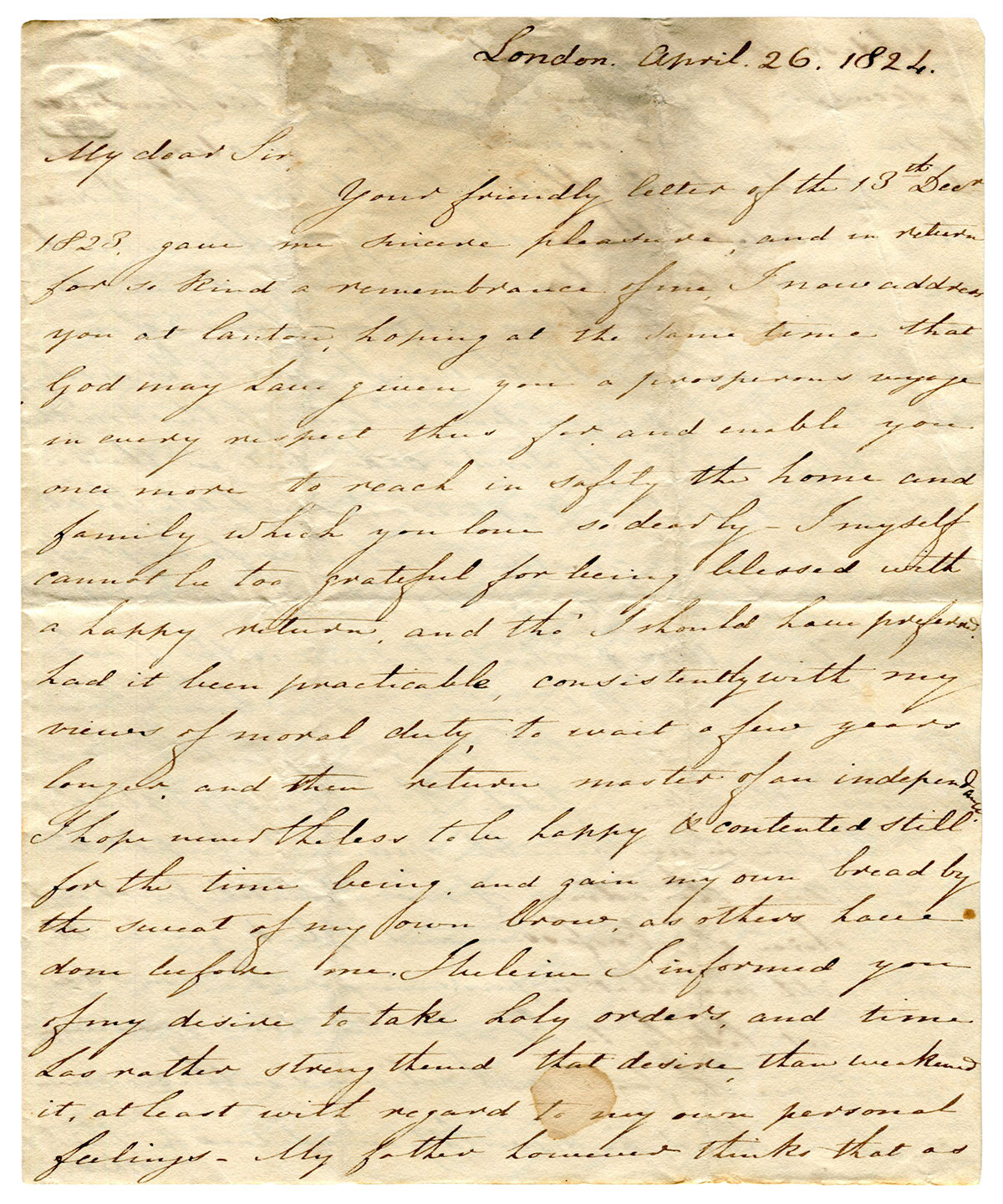
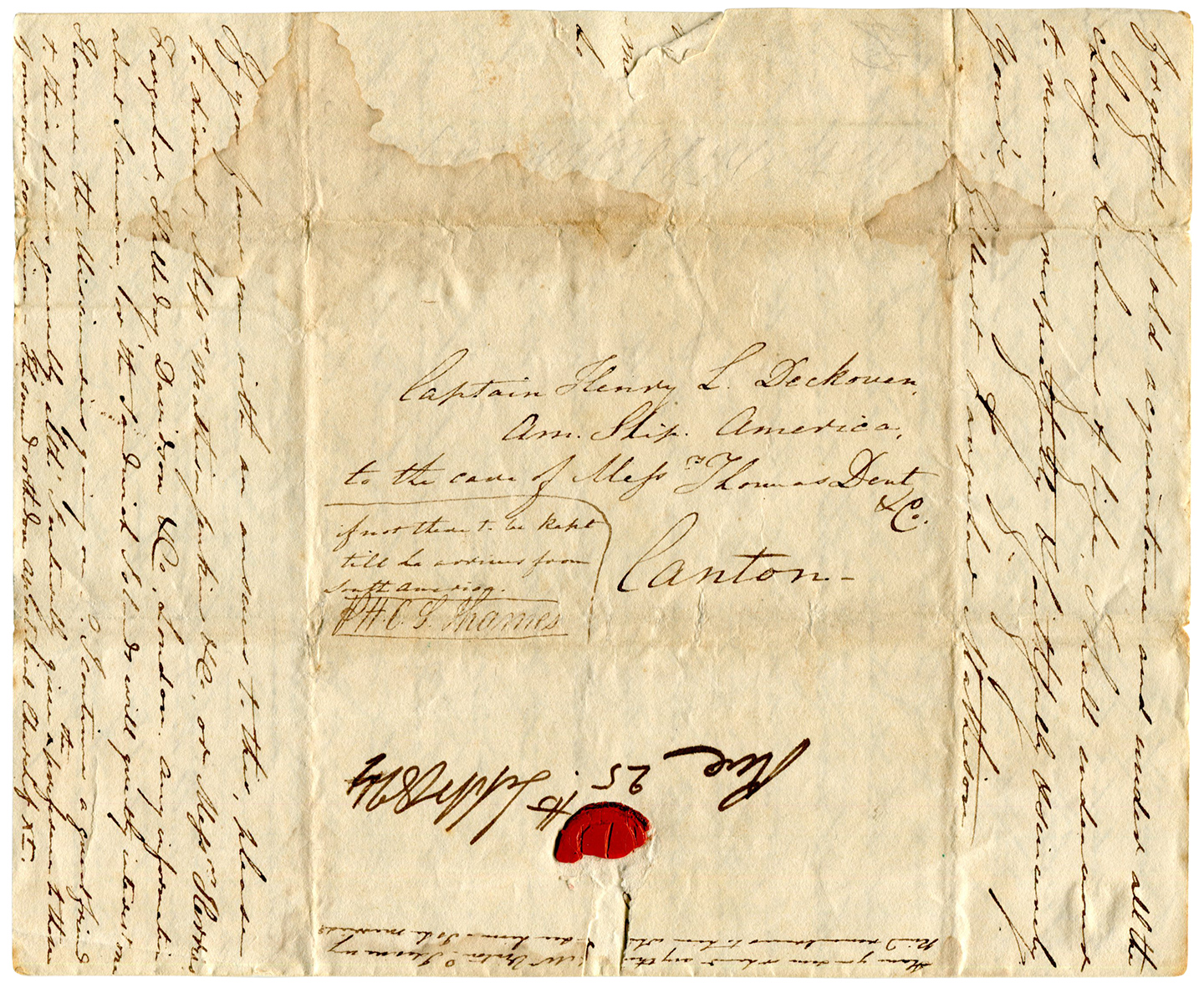
Fine content Autograph Letter Signed “Gilbert Farquhar Mathieson“, 11pp., London, 26 April 1824, a lengthy communication to Captain Henry L. DeKoven* aboard the Ship America docked in Canton, China, regarding his intentions to join the clergy, his current course of legal studies, and the necessity of emancipating the slaves in the British colonies in the West Indies.

A young Mathison, recently returned from a world tour that brought him to South America, Hawaii and China, writes on his prospects and expectations for his life, and ponders becoming a clergyman. He muses: “… I may or may not make a trip to Jamaica some day, according to circumstances, and if so shall hardly fail to take America en route…” A mutual associate, Mathison notes, “is now there in Kingston in my father’s employ,” but thinks that a position might open up for himself as his father’s current man was in “very low spirits and appears terribly apprehensive about catching the fever…”

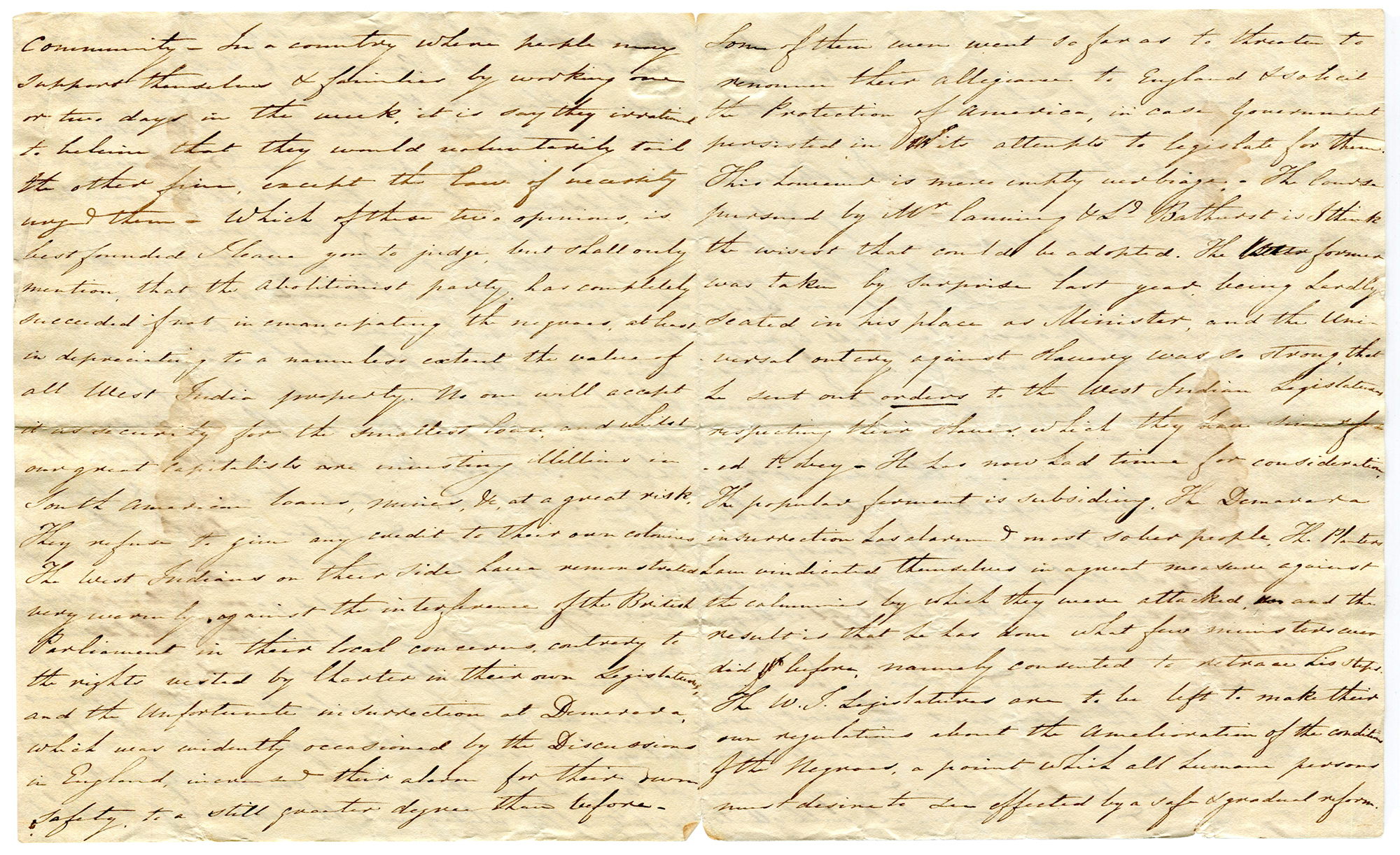
Gilbert Farqhuar Mathieson ALS 1824 Jamaican slavery questionMathison then discusses the prospects for ending slavery in the British colonies at some length: “You are not likely to have heard much in South America, about the question of emancipating the Slaves in the West Indies that has been agitated by Mr. Wilberforce & his friends in Parliament of late— It has given rise to much paper warfare, and in the general dearth of all Political events of importance abroad or at home, the controversy between the West Indian Planters & abolitionists has excited general attention— The object of the latter is to leave a definite period named after which all the Children who are born shall be considered free & independent of their former masters. It is asserted that they will then work in the same way that our peasants do for wages, & become not only more happy but more industrious & virtuous than they now are so as to render the plan of abolition mutually beneficial to all parties.— The Planters on the contrary attest, that to suppose 800,000 negroes, would in a free state, be content of serve & obey a few score thousand whites is little short of downright folly— That to imagine that the present generation would go on toiling as before and remain slaves, whilst their children were all free, is equally absurd, and in short, that unless we resign the islands to the Negroes entirely, it is impossible to give them their liberty at any definite period, consistently with the safety of the whites, and the happiness of the whole Community— In a country where people may support themselves & families by working one or two days in the week, it is say they irrational to believe that they would voluntarily toil the other five, except the hour of necessity waged them— Which of these two opinions is best founded I have you to judge, but shall only mention, that the Abolitionist party has completely succeeded if not in emancipating the negroes, at least in depreciating to a nameless[?] extent the value of all West India property. No one will accept it as security for the smallest loan, and whilst our great capitalists are investing Millions in South American loans, mines &c., at a great risk, they neglect to give any credit to their own colonies. The West Indians on their side remonstrated very waringly against the interference of the British Parliament in their local concerns… Some of their men went so far as to threaten to renounce their allegiance to England & so to at the Protection of America, in case Government persisted in its attempts to legislate for them… The course pursued by Mr. Canning & Ld. Bathurst is I think the wisest that could be adopted… [Lord Bathurst] in his place as Minister… the universal outcry against slavery was so strong, that he sent out orders to the West Indian Legislatures respecting their slaves which they have since refused to obey… The small island of Trinidad is about to be selected as the Theatre of such experiments as Government may deem expedient for the advancement of the Negroes to a state of Civilisation & freedom… the administration of James Monroe in America is not more satisfactory to his constituents than that of George Canning, at the present moment to the Citizens of Great Britian. He has upon several occasions taken the opportunity of declaring his respect & good will towards your Government & country. I sincerely trust that good will may long continue to subsist between our two Governments, and that whenever war is again necessary, we may cooperate as allies & brothers, rather than as enemies—…

Gilbert Farqhuar Mathieson ALS 1824 Jamaican slavery question

His father, Gilbert Mathison, died in 1828, and his inheritance included a number of slaves. When Great Britain ordered the emancipation of colonial slaves in the 1830s, Mathison was assessed with ownership of twenty-five individuals.

Light creases and expected mailing folds, light toning and soiling, else very good.

(EXA 5935) SOLD
________
* Henry Louis DeKoven (1784-1804) Middletown, Connecticut shipping magnate active in the China trade during the early 19th century, a merchant and banker, and an early land holder in what would later become Chicago.

A month after he provided critical help at the Battle of Monmouth, Philemon Dickinson contends with petty local politics

Philemon Dickinson ALS 1778Philemon DICKINSON (1739-1809) American attorney and politician, served as U.S. Senator from New Jersey from 1790 to 1793, and was a major general in command of the New Jersey Militia during the American Revolutionary War. Born in Maryland and raised in Delaware, he represented Delaware at the Continental Congress in 1782 and 1783. In 1784, he served on the commission that selected Washington D.C. as the site of the nation’s capital. He was the younger brother of John Dickinson (1732-1808), a founding father heavily involved in the drafting of the Constitution.

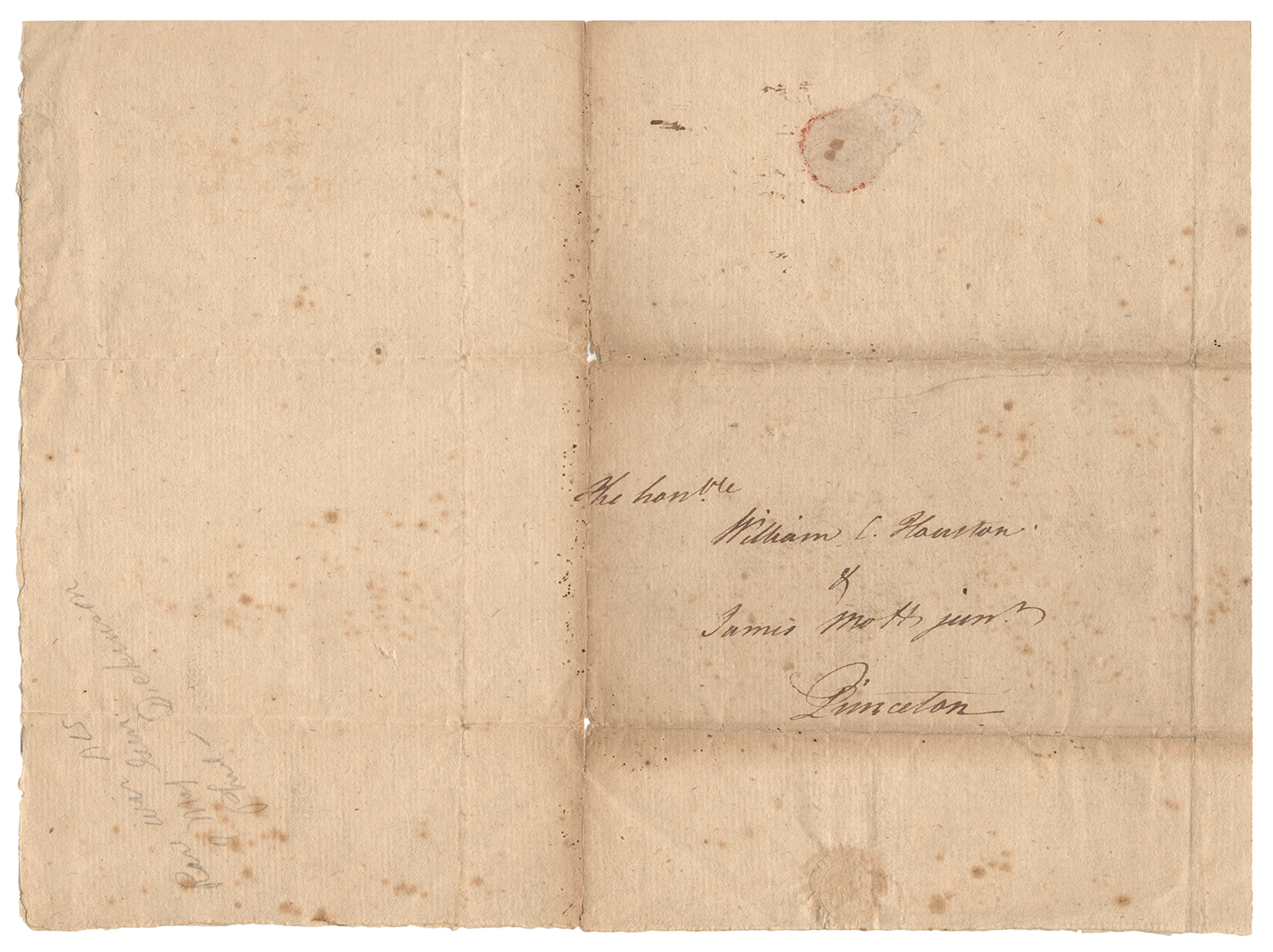
A good content, war-date Autograph Letter Signed “Philemon Dickinson“, 1 page, 285 x 215 mm. (11 1/4 x 8 1/2 in.), Trenton [New Jersey], 29 July 1778, to William C. Houston & James Mott, Jr. of Princeton concerning his supposed handling of public monies, in full: ““I this moment received your favor of the 25th instant. I perfectly remember, the Ordinance of the Convention which you mention, but I absolutely refused having the money paid into my hands, as I never had any Public accounts in my life. I cannot possibly recollect, to which amounts I gave Orders, but those Orders, which lay before you Gentlemen, specify the Sums, & for what purpose— I never recd. a single Shilling of this money, & left the accounts solely to the Treasurer to settle, which must appear by their Books & Vouchers. I have no Public account, of any kind to settle, having intentionally avoided it. My information that is in my Power to give you, respecting the Application to the monies you mention, shall be given with the greatest Pleasures…” He adds in a postscript: “I shall remain here 4, or 5 days longer.

Philemon Dickinson ALS 1778
Less than a month before, George Washington had offered his congratulations to Dickinson for his critical in obtaining a strategic victory at the Battle of Monmouth, observing, “General Dickinson, and the Militia of this State, are also thanked for their nobleness in opposing the enemy in their march from Philadelphia, nd for the aid which they have given in harassing and impeding their motions, so as to allow the conditional troops to come up with them.”*

Usual folds with separation at horizontal centerfold repaired with tape, light toning and foxing, soiling, overall fine very good to fine condition.

(EXA 6037) $1,200

______________
* George Washington, General Orders, June 29, 1778, Fitzpatrick, ed, The Writings of George Washington from the Original Manuscript Sources, 1745-1799

William Jennings Bryan presents a tolken of his peacemaking ideals to a newspaper editor who crusaded the chain gang system in Georgia.

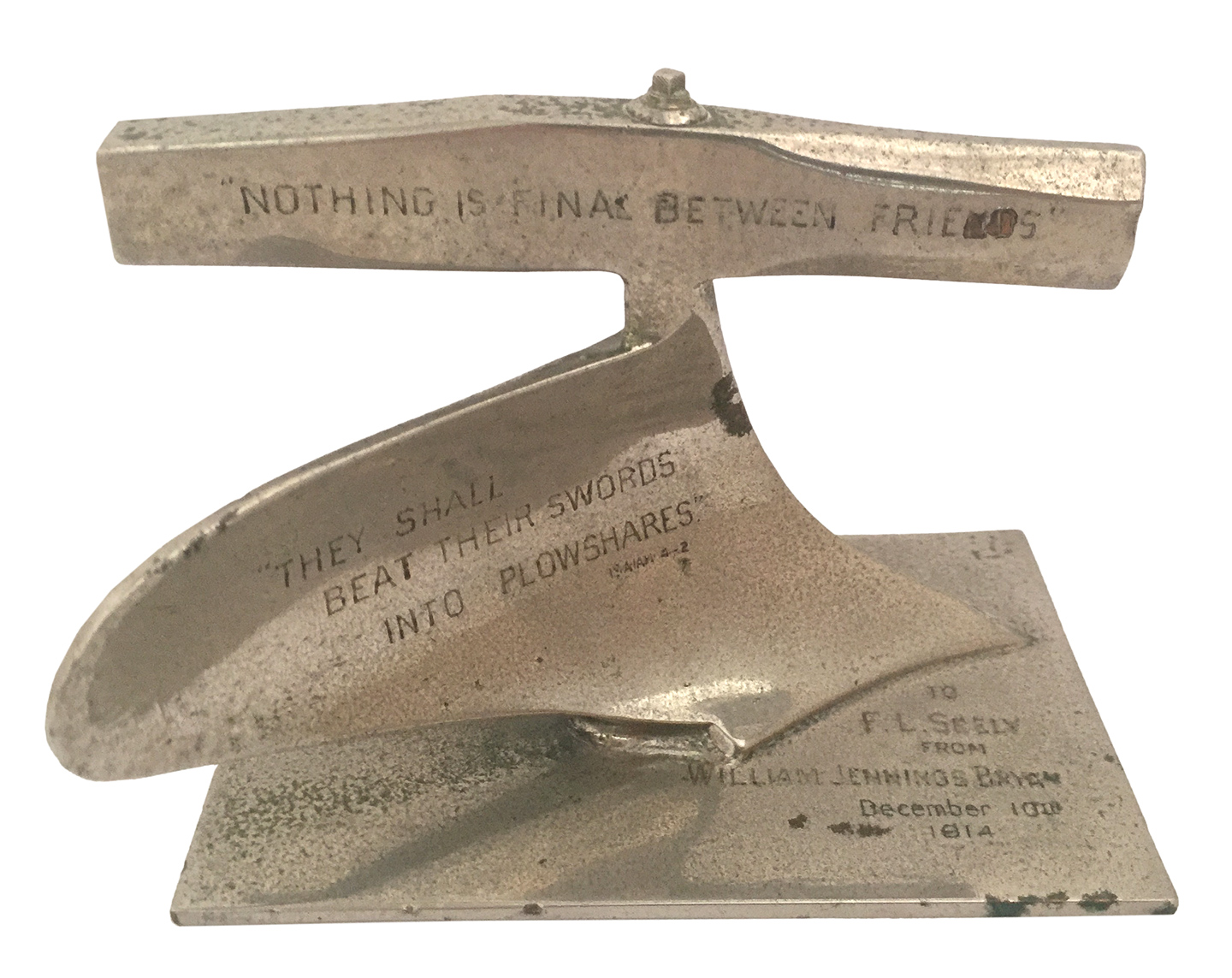
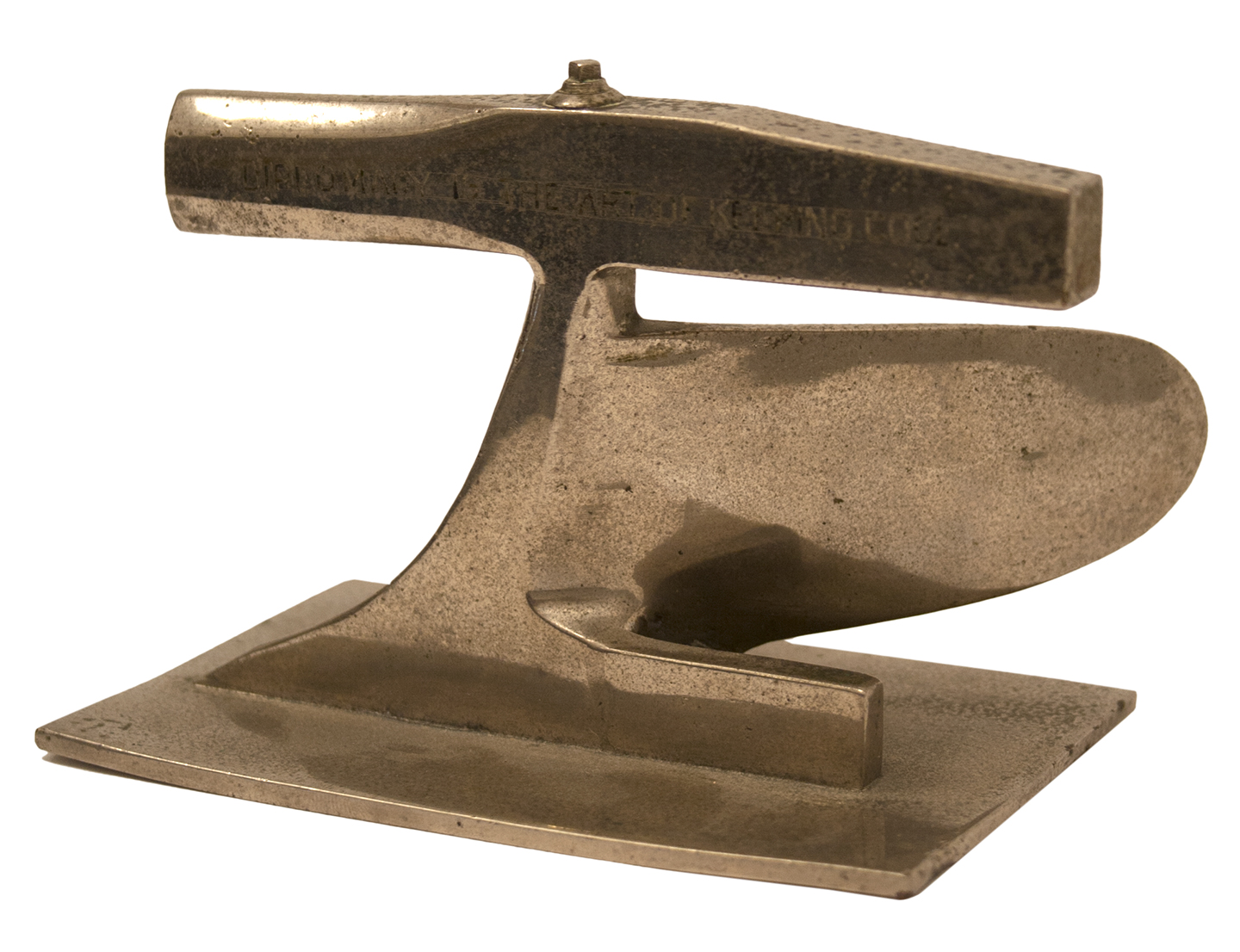
William Jennings Bryan inscribed paperweight(William Jennings Bryan) A nickel-plate steel paperweight cast in the form of a plow, with engraved biblical quotation, “‘THEY SHALL BEAT THEIR SWORDS INTO PLOWSHARES’ ISAIAH 2-4 [sic]” and across the “DIPLOMACY IS THE ART OF KEEPING COOL.“. On the reverse, “NOTHING IS FINAL BETWEEN FRIENDS.” The base bears a an inscription: “To F[red]. L[oring]. Seely from William Jennings Bryan December 10th 1914.

William Jennings Bryan pacifism dominated his tenure as Secretary of State, negotiating numerous treaties with other nations that provided for procedures for conciliation when war threatened to erupt. When war came to Europe in August 1914, Bryan urged Wilson, citing the United States’ position as the most powerful neutral, to mediate the conflict. Wilson, who gave Bryan his post for political considerations and not his acumen for international affairs, consulted him only occasionally, preferring to formulate important foreign policy decisions from the White House. Tensions grew between the two. Bryan advocated strict neutrality, and was troubled by Wilson’s demands for German accountability following the sinking of the Lusitania. Bryan resigned his post in June 1915, a month following the ship’s sinking that killed 128 U.S. citizens among the nearly 1,200 who lost their lives. When the United States entered the First World War, Bryan offered Wilson his services in any capacity, but the President never offered him a post.

William Jennings Bryan inscribed paperweightBryan’s reason for having these paperweights produced is unknown. It does not appear to mark any special occasion. We are aware of at least one other example, presented to Attorney General McReynolds in August 1914 (the present example is dated December 10). Bryan presented this paperweight to Fred Loring Seely (1871-1942), a wealthy chemist, inventor, newspaperman and a close friend of Bryan. Both were strong temperance advocates and Loring’s paper, the Atlanta Georgian, staunchly supported Bryan’s 1908 bid for the Presidency.1

The New Jersey-born Seely established the Atlanta Georgian in 1906, and beyond stumping for Bryan, the daily took on major social issues. The most promoting of which were exposes on the chain gang system in Georgia in which prisoners were rented out to local famers and businesses who often mistreated them. Seely’s personal advocacy was instrumental in ending the practice in Georgia. But his advertisers, many of whom profited from the chain-gang system, pulled out from advertising in the paper. In 1912, Seely was forced to sell his paper to William Randolph Hearst.

Some pitting and minor losses to plating with expected oxidation.

(EXA 6005) $1,450
__________
* “Saloon must Go, Declares Bryan to the Famers,” The Atlanta Georgian, 9 May 1910, 1; “William J. Bryan speaks of himself as Candidate of the Democratic Party,” Ibid, 21 Sept. 1906, 1.